We use cookies to enhance your browsing experience and analyse our traffic. By clicking “Accept All”, you consent to our use of cookies according to our Cookie Policy. You can change your mind any time by visiting out cookie policy.
We analyzed 59,000+ daily records from 256 sauna users to quantify what saunas actually do to your body. Using paired t-tests on same-day wearable data, we found a clear recovery signal that lowers nighttime heart rate, higher activity, and distinct effects across males and females and menstrual cycle phases.
Sauna recovery signals are real — we compared sauna and non-sauna days across 256 wearable users. Resting heart rate drops, activity is higher, and the effects hold even after controlling for exercise. The data backs what sauna believers have been saying for years.
Nighttime heart rate drops ~3bpm on sauna days — even after controlling for higher activity levels, minimum heart rate falls on sauna days. That's a physiological recovery signal, not just a side effect of the workout that came before it.
The effect is different for women — menstrual cycle phase matters. The heart rate drop only really kicks in during the luteal phase. During the follicular phase, it's there but small. Timing might matter more than we thought.
Saunas have been around since the primitive years in ancient Finland, and have always been considered to have a therapeutic effect[1]. Saunas are a hot, dry environment used to stimulate our cardiovascular system. During extreme heat exposure, our heart rate rises and our vessels dilate to increase the delivery of blood volume in order to protect the body[2].
This extra pressure on the heart is known to have long-term health benefits[3]. The heat exposure also promotes sweating and therefore the elimination of toxins, including those generated in the process of repairing small muscle tears after exercise[4]. It is for this reason that saunas are also considered great for recovery. All of this is no news, at the end of the day isn’t that what roman baths were built for? For recovery after battle[5]!
However, most studies have looked at the benefits of frequent sauna bathing and the impacts on long-term health. Motivated to understand the immediate physiological response to saunas, we looked at the same-day effects across ~59,000 daily records from 256 users.
Same-day Effects of Saunas
We used simple paired t-test evaluations to assess the immediate same-day effects of saunas.
Sauna days were associated with:
Higher activity (longer activity time and greater distance)
Higher maximum and average heart rate
That fits our intuition: many people sauna after a workout.
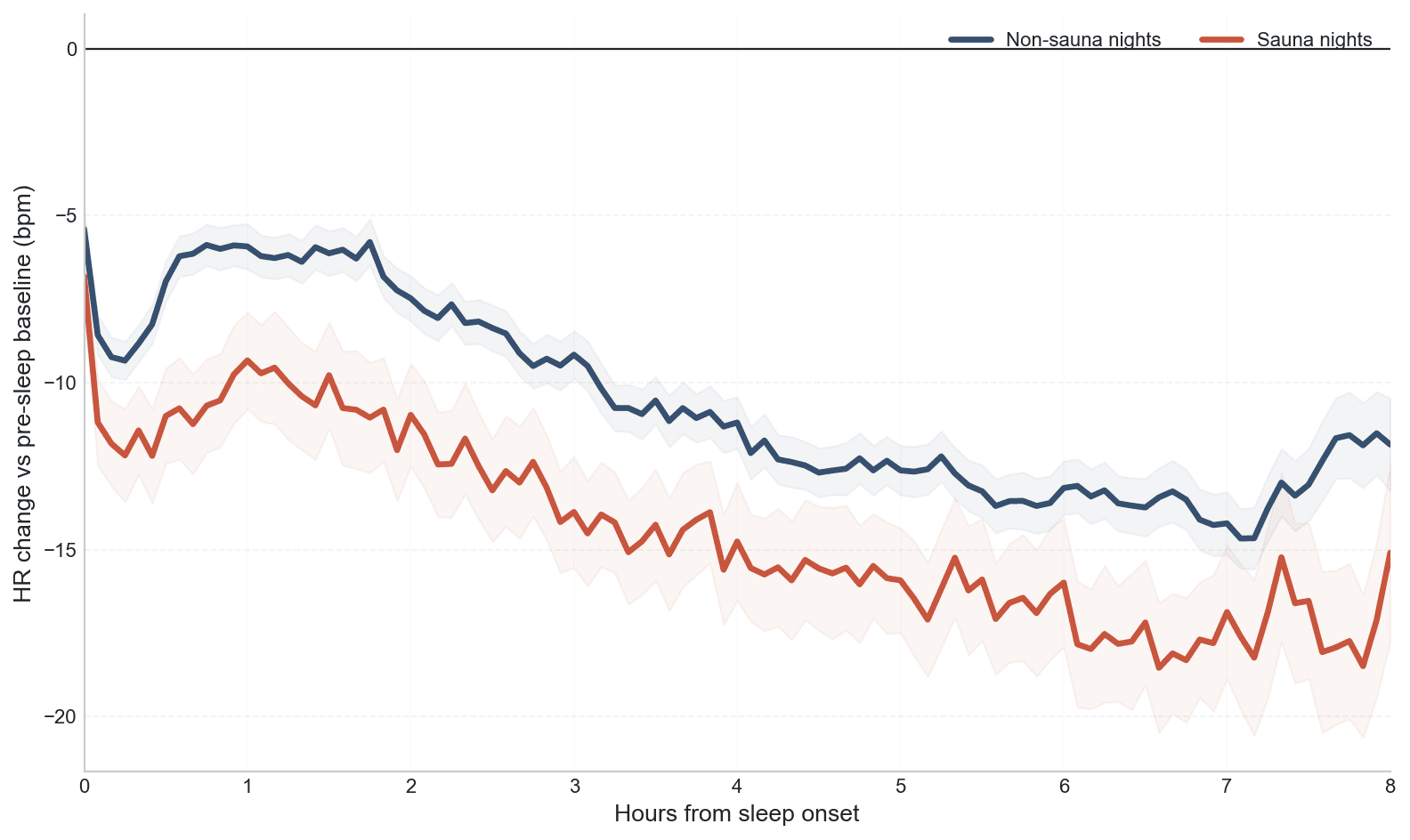
Sauna days also showed lower minimum heart rate compared to non‑sauna days. Importantly, this effect remains even after controlling for activity, which suggests the lower nighttime heart rate isn’t simply due to exercise. The difference between sauna and non-sauna days is on average 5% (3bpm) which is a noticeable physiological change.
Figure 1: Heart rate drop from pre-sleep baseline, showed throughout sleep duration. Sauna days, in red, have lower heart rates compared to non sauna days in blue.
These results were statistically robust (FDR‑corrected p < 0.05 and Cohen’s d > 0.2), supporting the idea that sauna use may be linked to better same‑day recovery.
Get the latest Terra Research reports and insights every week as soon as they're published.
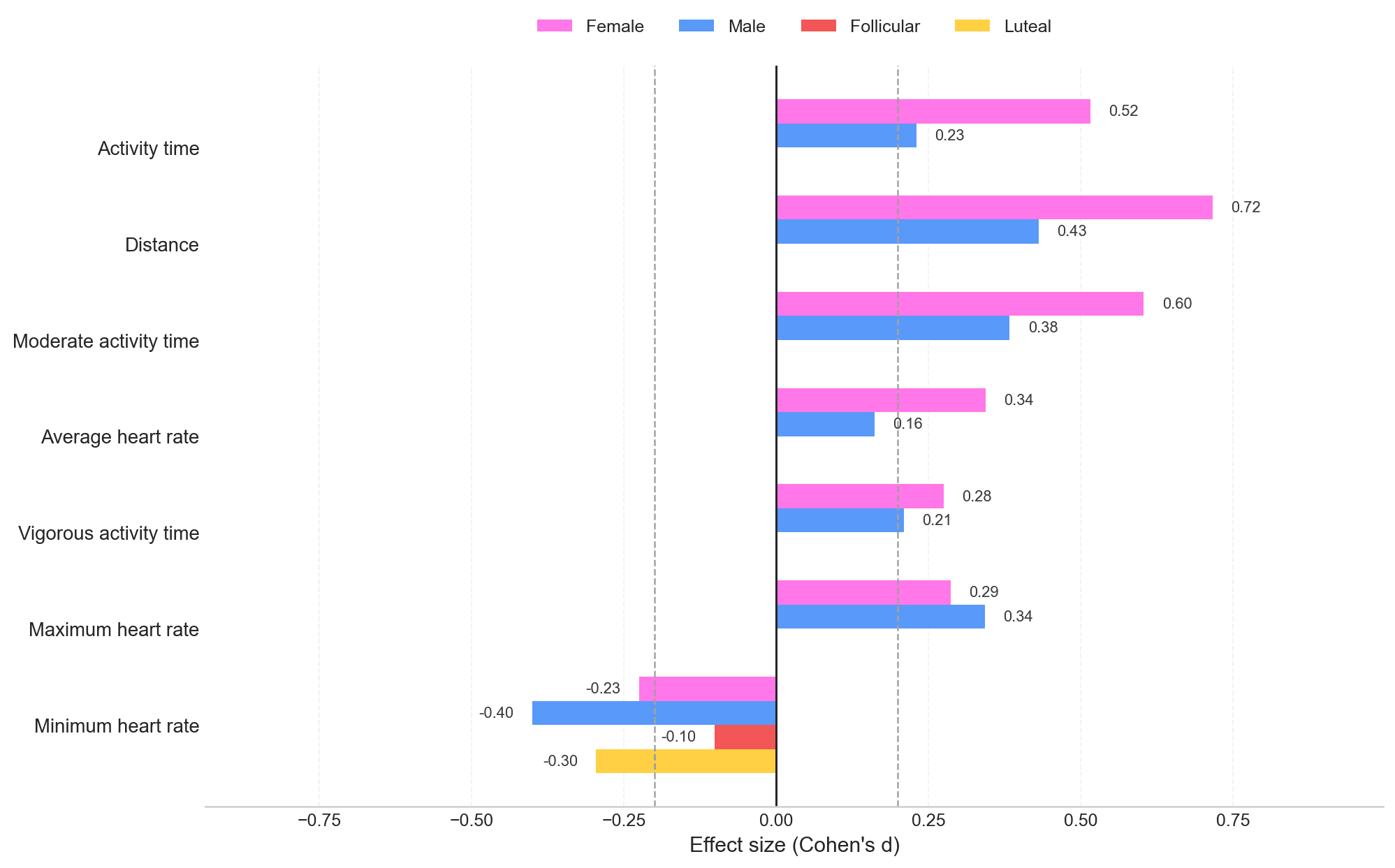
Females showed larger activity increases on sauna days, which may reflect more consistent sauna use on workout days. However, females showed a smaller drop in minimum heart rate than males on sauna days.
Figure 2: Bar chart of the effect sizes (cohen d values) of the changes in physiology and activity on sauna days compared to non sauna days. Females (in pink) have greater increase in activity time compared to males (in blue), but lower drop in heart rate at night.
As we looked at in previous blogs, the menstrual cycle can influence recovery and nighttime heart rate. For this reason, we evaluated sauna effects across the follicular and luteal phases and observed statistically higher activity and lower heart rate when women use the sauna on their luteal phase. In fact, heart rate at night was only meaningfully lower (Cohen d > 0.2) compared to non sauna days during the luteal phase. Or in other words, the benefits of saunas seem to appear only during the luteal phase…
What Does This All Mean?
Sauna use is part of a recovery‑oriented day. Sauna days are more active, which fits how people actually use saunas, often as a post‑workout routine. Yet even after accounting for activity, nighttime minimum heart rate is lower on sauna days, suggesting a physiological recovery signal beyond exercise alone.
Mechanistically, this pattern is consistent with known heat‑stress physiology: heart rate increases during sauna exposure, followed by recovery dynamics that can reflect increased parasympathetic influence during cooling [6][7] Within women, the strongest recovery signal in our dataset appears in the luteal phase, where the effect size crosses a meaningful threshold.
Ketelhut, S., & Ketelhut, R. G. (2019). The blood pressure and heart rate during sauna bath correspond to cardiac responses during submaximal dynamic exercise. Complementary therapies in medicine, 44, 218–222. https://doi.org/10.1016/j.ctim.2019.05.002
Laukkanen T, Kunutsor SK, Khan H, et al. Sauna bathing is associated with reduced cardiovascular mortality and improves risk prediction in men and women: a prospective cohort study.BMC Medicine. 2018;16:219. (PMC: PMC6262976)
Kuan, W. H., Chen, Y. L., & Liu, C. L. (2022). Excretion of Ni, Pb, Cu, As, and Hg in Sweat under Two Sweating Conditions. International journal of environmental research and public health, 19(7), 4323. https://doi.org/10.3390/ijerph19074323
Laukkanen JA, Laukkanen T, Kunutsor SK. Cardiovascular and Other Health Benefits of Sauna Bathing: A Review of the Evidence.Mayo Clinic Proceedings. 2018;93(8):1111–1121. (PubMed: 30077204)
Yes. Across ~59,000 daily records from 256 users, sauna days showed a roughly 5% (about 3 bpm) lower minimum nighttime heart rate compared to non-sauna days. The effect was statistically robust (FDR-corrected p < 0.05, Cohen's d > 0.2), pointing to a real same-day recovery signal rather than noise.
Is the lower heart rate just because I worked out before the sauna?
No. Sauna days were more active — with longer activity time, greater distance, and higher max and average heart rate — but the drop in nighttime minimum heart rate persisted even after controlling for activity. That suggests the sauna itself contributes a recovery effect beyond the workout that often precedes it.
How much does my heart rate actually drop on a sauna day?
On average, minimum nighttime heart rate was about 3 bpm lower on sauna days versus non-sauna days — roughly a 5% reduction. That's a noticeable physiological shift, and it shows up consistently throughout sleep when comparing pre-sleep baselines.
Do saunas affect women and men differently?
Yes. Women showed larger increases in activity on sauna days, likely because they tend to sauna on workout days, but their drop in nighttime minimum heart rate was smaller than men's. The recovery-related heart rate signal was more pronounced in males in this dataset.
Does the menstrual cycle change how saunas affect recovery?
Strongly. When the data was split by cycle phase, the lower nighttime heart rate effect only crossed the meaningful threshold (Cohen's d > 0.2) during the luteal phase. In the follicular phase, sauna use didn't produce a comparable recovery signal — suggesting timing matters for women looking to maximize sauna benefits.
During heat exposure, heart rate rises and vessels dilate to move blood volume and protect the body — similar to submaximal exercise. The cooling phase afterward is associated with increased parasympathetic activity, which is consistent with the lower nighttime heart rates observed in the data and aligns with prior research on heat-stress physiology.
Can wearable data detect sauna recovery effects?
Yes. Using ~59,000 daily records from 256 users and simple paired t-tests, wearable-derived metrics like minimum nighttime heart rate, activity time, and distance were sensitive enough to pick up sauna-specific effects with statistical robustness. You don't need lab measurements to see that sauna days look physiologically different from non-sauna days.
Should I sauna after my workout to get the most benefit?
That's how most users in the dataset already behave — sauna days were more active, suggesting post-workout use is the norm. The combined signal of higher daytime activity plus lower nighttime minimum heart rate supports treating the sauna as part of a recovery-oriented day rather than a standalone intervention.