We use cookies to enhance your browsing experience and analyse our traffic. By clicking “Accept All”, you consent to our use of cookies according to our Cookie Policy. You can change your mind any time by visiting out cookie policy.
We analyzed ~3 million nights of wearable sleep data to see whether the menstrual cycle leaves a measurable signature in night physiology — and how that affects training and recovery signals. Using temperature autocorrelation, we found a dominant ~30-day rhythm in women that is largely absent in men, allowing us to align metrics by cycle phase. When we compare follicular vs luteal, the pattern is consistent: the luteal phase shows higher internal load (elevated night heart and breathing rates), lower HRV, and lighter, more fragmented sleep. In a smaller linked exercise sample, heart rate at a fixed workload didn’t clearly change — suggesting capacity is stable while recovery costs more.
We tested whether the menstrual cycle leaves a detectable signal in wearable sleep data — analyzing ~3 million nights of sleep, using autocorrelation to separate biological rhythms across genders.
Luteal phase recovery metrics look worse, but the body isn't broken — women show higher heart rate (+0.2 std), lower HRV, and more fragmented sleep, driven by progesterone's shift in autonomic balance.
Key takeaway — your body can still perform the same in both the luteal and follicular phases, but lower biomarkers in the luteal phase just means your recovery is more costly.
What Does Night Temperature Tell Us?
Every night, our bodies quietly tell a story. As we sleep, core temperature lowers, heart rate slows, breathing steadies, and the nervous system resets [1].
These patterns follow rhythms - daily, weekly, seasonal - and are shaped by our routines, environment and biology. Today, we uncover a hidden rhythm: the menstrual cycle.The autocorrelation of our temperature signal tells us how well it aligns with itself when shifted in time, meaning we can expect peaks at all of the different rhythm time-scales.
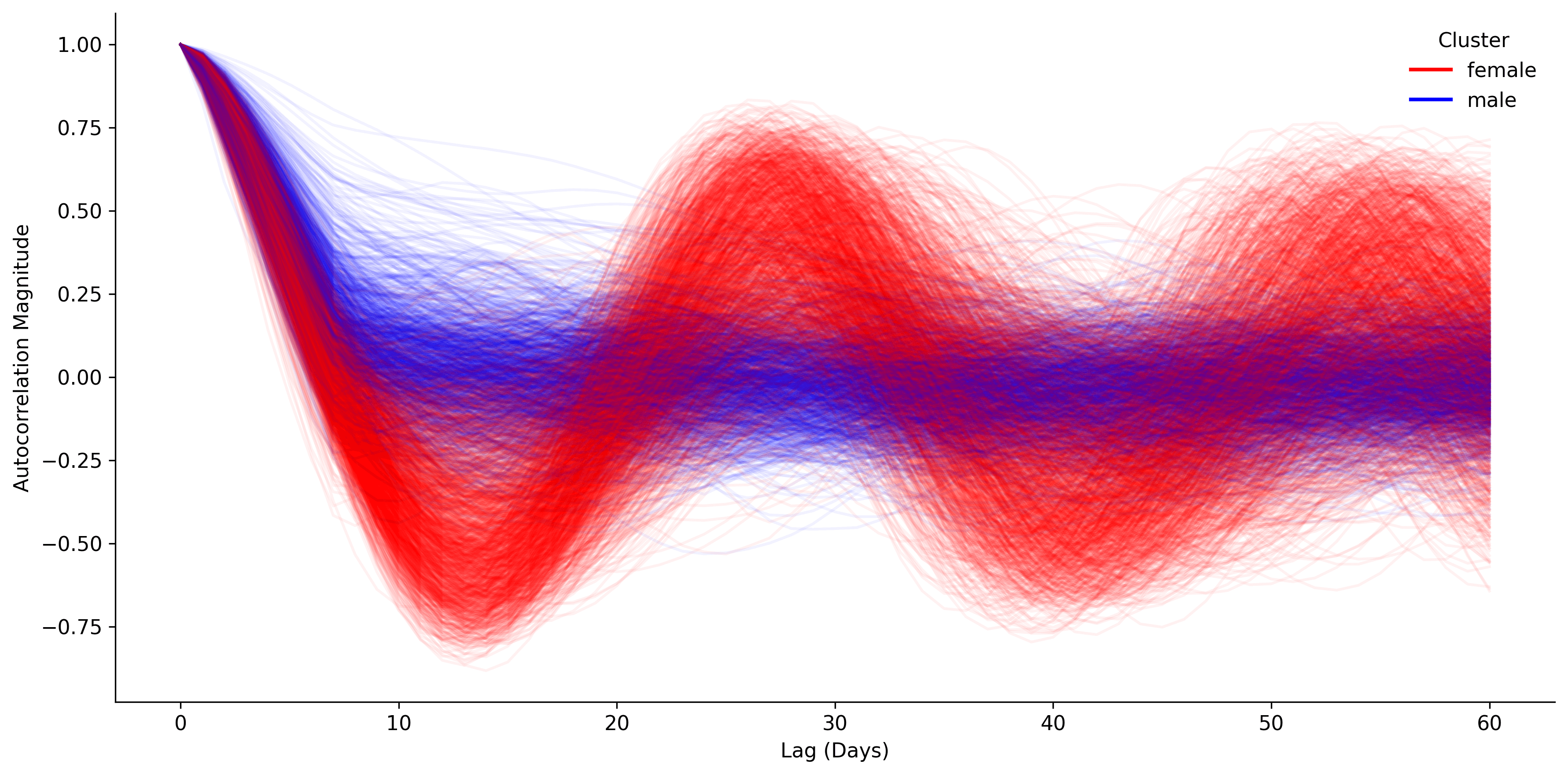
The menstrual cycle is strongly tied with body temperature, and has a very distinct monthly pattern appearing in this autocorrelation profile as peaks roughly every 30 days. Using this, we can distinguish biological sex in our data and understand the effects of the menstrual cycle on sleep, physiology and behavior.
Get the latest Terra Research reports and insights every week as soon as they're published.
We looked at a cohort of 3,972 wearable data users with a total of 2,964,571 nightly sleep records. To ensure stability in analyzing long-term patterns, only sleep records from users with over 6 months of data and 80% data coverage were included.
Only the longest sleep records per night were retained to exclude naps and implausible recordings. The remaining cohort consisted of 906,572 records from 2954 users.Females in the cohort were identified as those with a more prominent autocorrelation magnitude within the 25 to 35 day window compared to the autocorrelation around 7 days.
This clustering assumes the dominating rhythm in females is monthly whereas in males its weekly. The resulting split was 1072 males to 1882 females.
Figure 1. Autocorrelation profiles of night temperature recordings clustered by gender. In red, females have a cyclical autocorrelation aligning with the menstrual cycle while men have a static autocorrelation profile.
The Luteal and Follicular Phases
The menstrual cycle is composed of four distinct phases: menstrual, follicular, ovulation and luteal. The menstrual phase exists within the start of the follicular phase and the ovulation can be defined as the transition from the follicular to the luteal phase. Therefore for simplicity, we assessed the differences between the two largest phases: luteal and follicular.
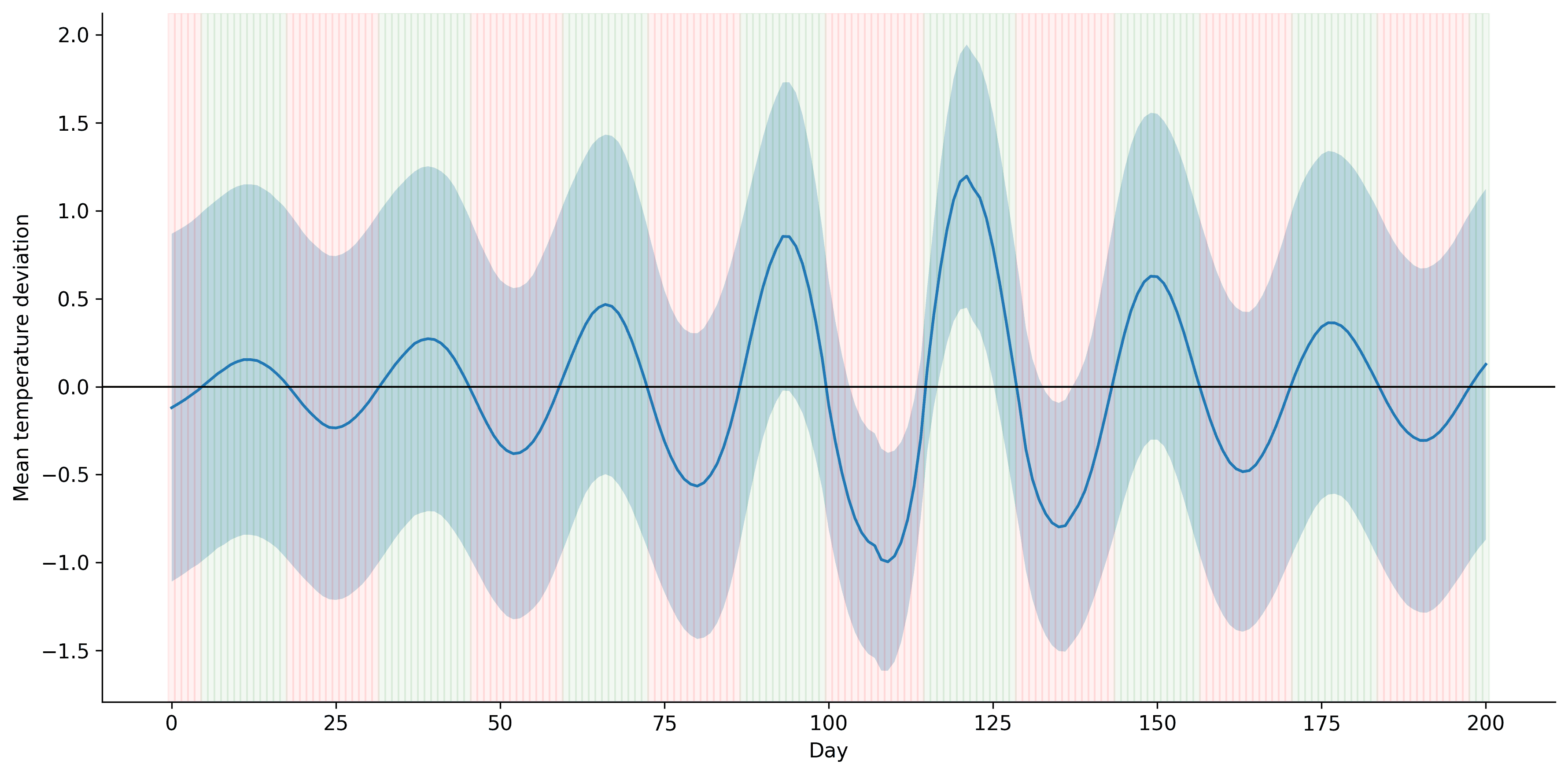
Our core temperature at night rises above our baseline temperature during the luteal phase and drops during the follicular phase[2].
Figure 2: Mean female temperature profile over 200 days, phase-aligned for visualization. Luteal is shaded green and follicular pink. The larger central peak reflects the alignment (Heaviside step), not a true increase in temperature amplitude.
Sleep and Physiological Differences in Women
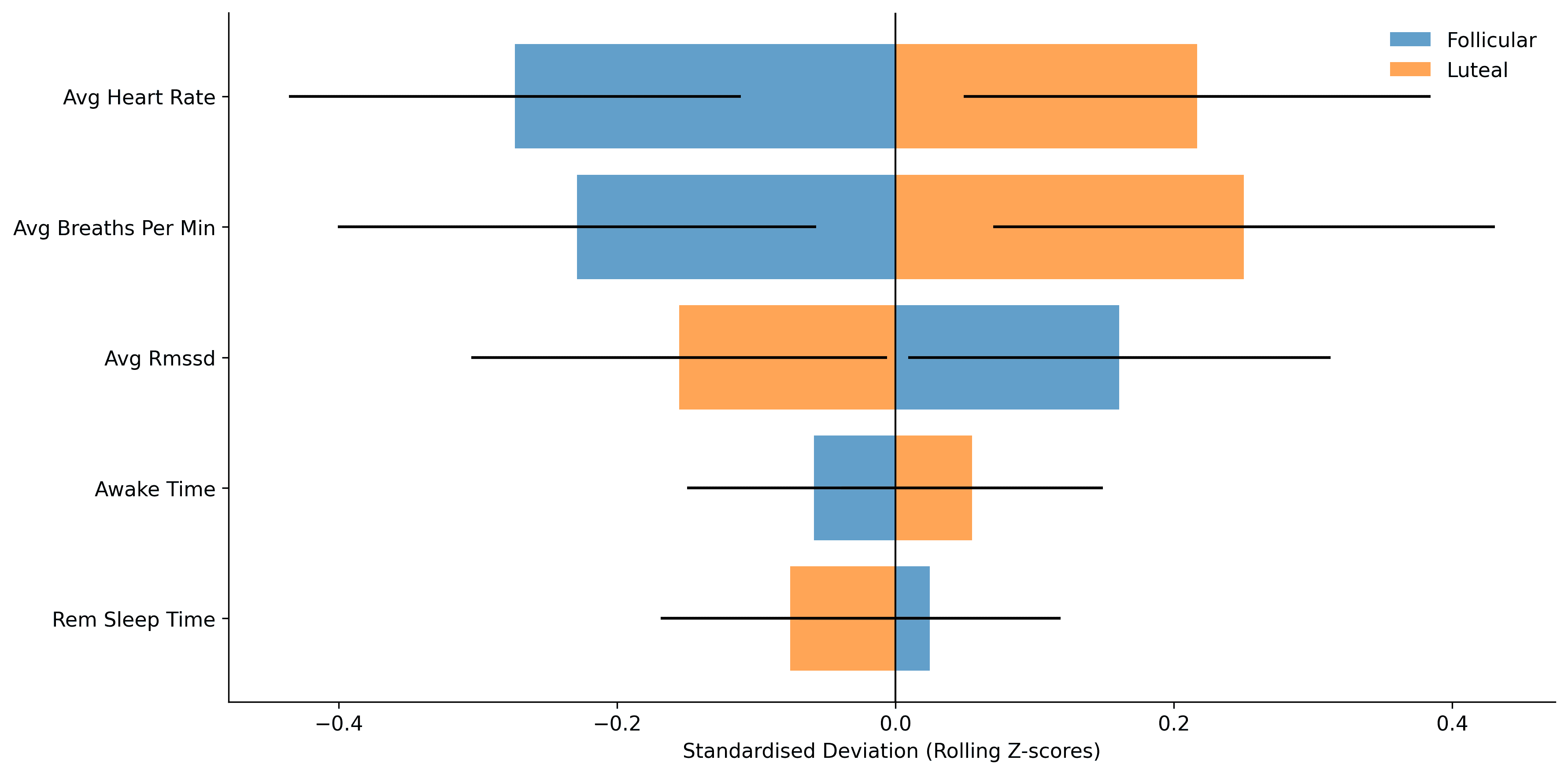
Feeling more tired and less recovered during certain weeks of the month is not just perception, it is measurable physiology. We compared rolling z-scores of sleeping metrics across the two phases to factor in inter-subject variability and moving trends over time.
Across the female population, the luteal phase is associated with:
Higher nighttime heart and breathing rates
Lower heart rate variability (HRV)
Lighter, more fragmented sleep
These changes reflect the shift in autonomic balance across the menstrual cycle, where higher progesterone levels in the luteal phase are associated with increased resting metabolic rate, reduced vagal (parasympathetic) activity, and a state of greater strain and lower recovery potential. [3]
Figure 3. Mean deviations from individual baseline (rolling z-scores) across cycle phases. The luteal phase shows higher night heart and breathing rates, lower HRV (RMSSD), and lighter, more fragmented sleep.
Performance: Recovery or Metabolism?
Motivated to understand how the physiological differences impact activity, we analyzed data from 50 users who had wearables connected. Among 20 runners with sessions recorded in both menstrual phases, energy expenditure, total calories burned, and activity duration were all higher in the follicular phase.
Calorie and energy consumption metrics provided by the devices are primarily derived from distance and duration, and only moderately influenced by heart rate, making them an inaccurate gauge of metabolism. Mixed-effects modeling revealed that distance is a strong positive predictor of heart rate, as expected. Once workload was accounted for, there was no clear evidence that heart rate differs between the different phases, indicating comparable metabolic performance.
However, the fragmented sleep and lower HRV suggest that reduced activity in the luteal phase is more likely constrained by recovery capacity than by metabolic performance.
Why Does This Matter?
The menstrual cycle leaves a clear and measurable signal in night physiology. Far from being background noise, this monthly rhythm shapes sleep quality, autonomic balance, and how the body tolerates stress and training.
The luteal phase is a period of higher internal load: elevated heart and breathing rates, reduced HRV, and a more fragmented sleep all point toward a lower recovery capacity. This challenges our interpretation of recovery, performance, and sleep metrics. A given lower HRV value or restless night does not carry the same meaning every week of the month.
Accounting for menstrual phase adds context, helping distinguish between meaningful strain and normal cyclical variation, and aligns expectations for training and recovery.
References
[1] Alzueta, Elisabet, and Fiona C. Baker. “The Menstrual Cycle and Sleep.” Sleep Medicine Clinics, vol. 18, no. 4, 2023, pp. 399–413, https://pubmed.ncbi.nlm.nih.gov/38501513/.
[2] Zhang, Simeng, et al. “Changes in Sleeping Energy Metabolism and Thermoregulation During Menstrual Cycle.” Physiological Reports, vol. 8, no. 2, 2020, article e14353, https://pubmed.ncbi.nlm.nih.gov/31981319/.
[3] Schmalenberger, Katja M., et al. “Menstrual Cycle Changes in Vagally-Mediated Heart Rate Variability are Associated with Progesterone: Evidence from Two Within-Person Studies.” Journal of Clinical Medicine, vol. 9, no. 3, 2020, article 617, https://pubmed.ncbi.nlm.nih.gov/32106458/.
Summary questions
Can wearable data actually detect the menstrual cycle?
Yes, and clearly. In a cohort of 2,954 users with 906,572 nightly sleep records, the autocorrelation of night temperature showed distinct peaks roughly every 30 days in females, versus a flat profile in males. This signal was strong enough to cluster the cohort into 1,882 females and 1,072 males based purely on temperature rhythm — no self-report needed.
Why do I feel more tired and run-down the week before my period?
Because your physiology genuinely shifts. Across the female cohort, the luteal phase showed higher nighttime heart and breathing rates, lower HRV (RMSSD), and lighter, more fragmented sleep compared to the follicular phase. That fatigue isn't perception — it's a measurable change in autonomic balance driven by elevated progesterone.
Does my metabolic performance actually drop during the luteal phase?
No — the data suggests metabolic capacity is comparable across phases. Among 20 runners with sessions in both phases, mixed-effects modeling showed that once distance and workload were accounted for, heart rate did not differ meaningfully between luteal and follicular phases. The lower activity observed in the luteal phase is more likely a recovery constraint than a metabolic one.
Why does my HRV look worse some weeks even when nothing has changed?
Menstrual phase is a major hidden driver. The luteal phase is associated with reduced vagal activity and lower HRV across the population, meaning the same HRV value carries different meaning depending on where you are in your cycle. A dip during the luteal phase is often normal cyclical variation, not accumulated strain.
How does night temperature change across the cycle?
Core temperature at night rises above baseline during the luteal phase and drops during the follicular phase. This thermal shift is consistent enough across users that it produces a clean ~30-day periodic signal in autocorrelation profiles, which is exactly what allowed the cohort to be sex-clustered from temperature alone.
Should I train differently in the luteal vs. follicular phase?
The data supports adjusting recovery expectations rather than capability. Energy expenditure, total calories, and activity duration were all higher in the follicular phase among the 20 tracked runners, but heart rate at matched workload didn't differ — meaning you can perform, but recovery capacity is lower in the luteal phase. Plan harder sessions when recovery markers support them, not by the calendar alone.
How was biological sex identified without self-report in this study?
Through temperature autocorrelation. Users whose night temperature signal had a stronger autocorrelation peak in the 25–35 day window than around 7 days were classified as female, on the assumption that the dominant rhythm is monthly in females and weekly in males. This produced a 1,882 female to 1,072 male split from 2,954 users — a fully data-driven classification.
Why does accounting for menstrual phase matter for interpreting wearable metrics?
Because a single HRV reading or fragmented night doesn't mean the same thing every week. The luteal phase systematically elevates heart and breathing rates, suppresses HRV, and disrupts sleep architecture across the female population. Without phase context, wearables risk flagging normal cyclical physiology as poor recovery or excessive strain.