We use cookies to enhance your browsing experience and analyse our traffic. By clicking “Accept All”, you consent to our use of cookies according to our Cookie Policy. You can change your mind any time by visiting out cookie policy.
We analyzed large-scale wearable data to understand what cold exposure actually does to your body. Sporadic plunges act as a stressor, raising sleeping heart rate. But with consistent use, around 3 sessions every 14 days, the effect flips, improving recovery and sleep scores. We also found that women's responses differ significantly by menstrual cycle phase.
Sporadic cold plunges act as a stressor, not a recovery tool — they raise your sleeping heart rate by ~1 bpm, triggering a sympathetic response as your body reacts to the rapid temperature drop.
The stress-to-adaptation crossover sits at around 3 sessions per 14 days — below that threshold, you're just spiking sympathetic activity. Above it, cold exposure starts to improve recovery scores, sleep scores, and resting heart rate.
Women's adaptive response differs by cycle phase — during the luteal phase, cold exposure raises sleep heart rate even with frequent use, suggesting the hormonal environment blunts the adaptation seen in other contexts.
Plunging into freezing water is becoming more common recently, because its thought to have a positive effect on our recovery, resilience and overall health. Extreme cold conditions are known to impact our physiology and metabolism.
Inuit people can survive temperatures up to -31°C in the Arctic. The reason? That’s a high concentration of brown fat (brown adipose tissue)[1]. Brown fat is largely different from white fat, who’s high concentrations are associated with diabetes and cardiovascular disease.
White fat can turn into brown fat through exposure to cold temperatures; brown fat burns more sugars and calories which increases our metabolism but in turn also increases our calorie demands[2].
There is little agreement across studies on protocols, methods and effects across genders so, motivated to understand the benefits of cold exposure in large scale wearable data, we analyzed over 170,000 nights of data from 577 users.
Benefits (or risks) of Cold Plunging
We analyzed the physiological response to cold plunging using mixed-effects models that accounted for repeated measurements within each user and, in adjusted models, training load.
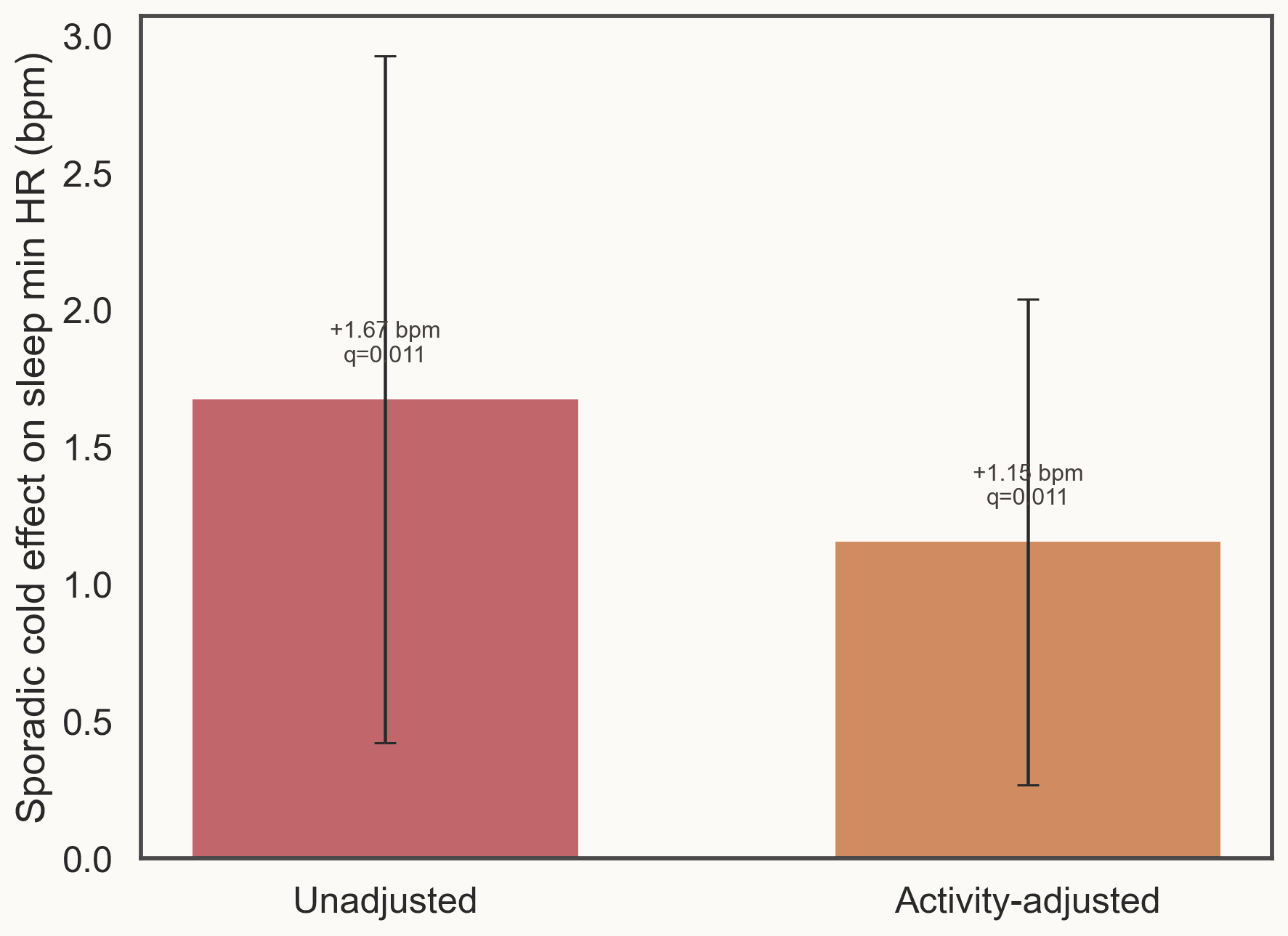
Cold plunges turn out to be a substantial stressor on the body. The rapid drop in temperature likely triggers an adrenergic response as the body shifts into a more sympathetic-dominant state[3]. Sporadic cold exposure sessions raise sleeping heart rate by around 1 bpm (p < 0.05). The wide error bars suggest that the impact is moderated by different user habits, such as the timing, intensity, and duration of the exposure.
A plunge close to bedtime, for example, may have a stronger effect than earlier cold exposure, and some users may also be logging milder exposures such as cold showers.
Figure 1: Sporadic cold exposure is associated with higher sleep minimum heart rate, consistent with an acute stress response.
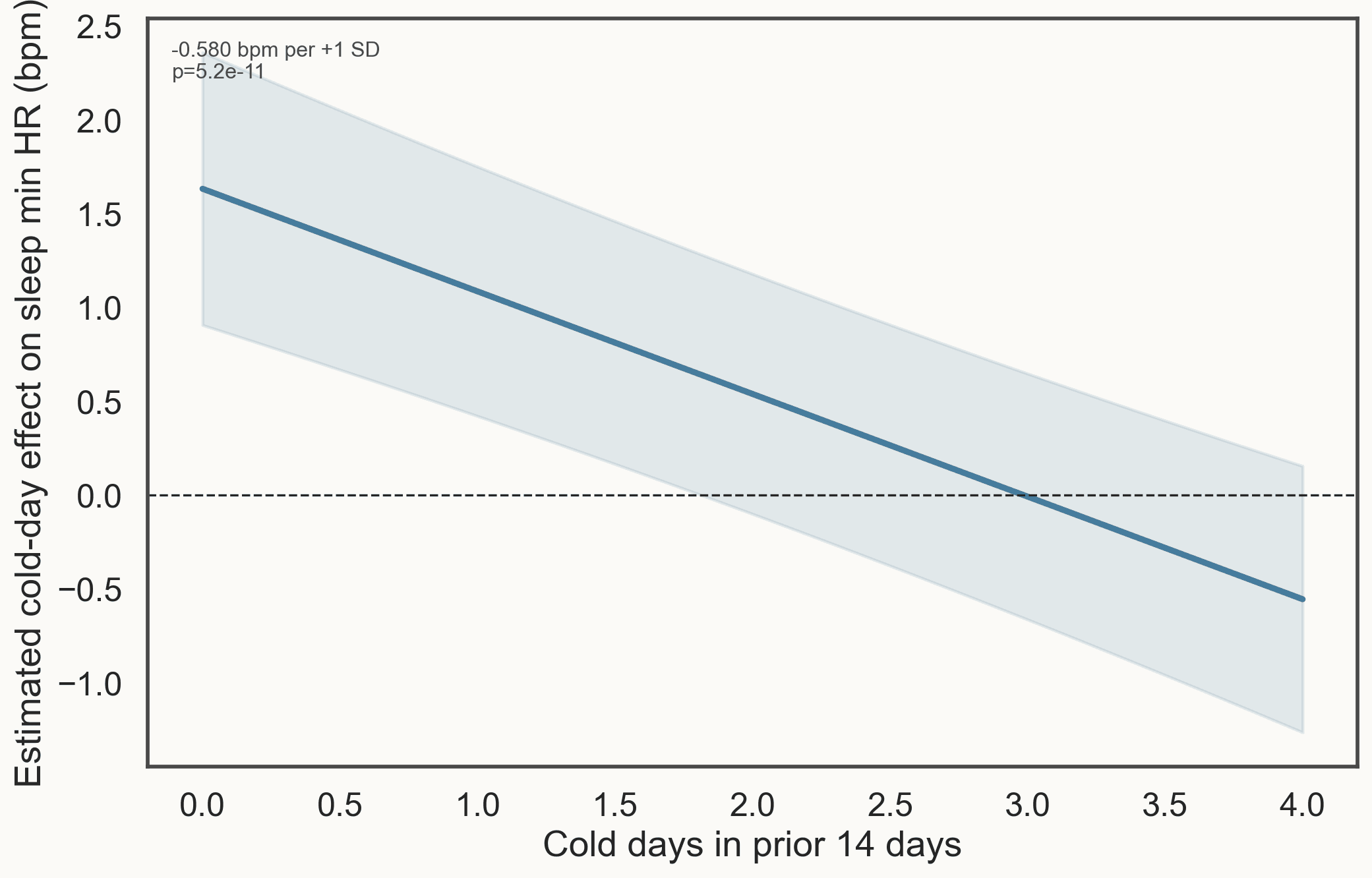
The real benefit seems to come with consistency. Using an interaction model, we found that each +1 SD increase in recent cold-use density was associated with an additional -0.58 bpm shift in sleep minimum heart rate in the activity-adjusted model.
In the unadjusted model, the shift was even larger at -1.05 bpm per +1 SD. The fitted curve crossed the null around 3 sessions in the previous 14 days, suggesting that this is the point where cold exposure stops looking predominantly stressful and starts looking adaptive.
Figure 2: Interaction model showing that more frequent recent cold exposure shifts the effect of cold days toward lower nighttime minimum heart rate.
We used this threshold in further analyses. Once users were in this adapted state, cold exposure days were associated with:
+1.33 higher recovery score (p=0.015)
+1.01 higher sleep score (p=0.057
-0.97 bpm daily heart rate (p=0.066)
Get the latest Terra Research reports and insights every week as soon as they're published.
As we found in the previous blog, sauna use has a clearer same-day cardiovascular effect, especially on daily minimum heart rate. Cold exposure, by contrast, seems to behave more like an intervention that requires adaptation before benefits emerge. In other words, sauna appears to act on a shorter timescale than cold exposure, and the two are not necessarily best captured by exactly the same metrics.
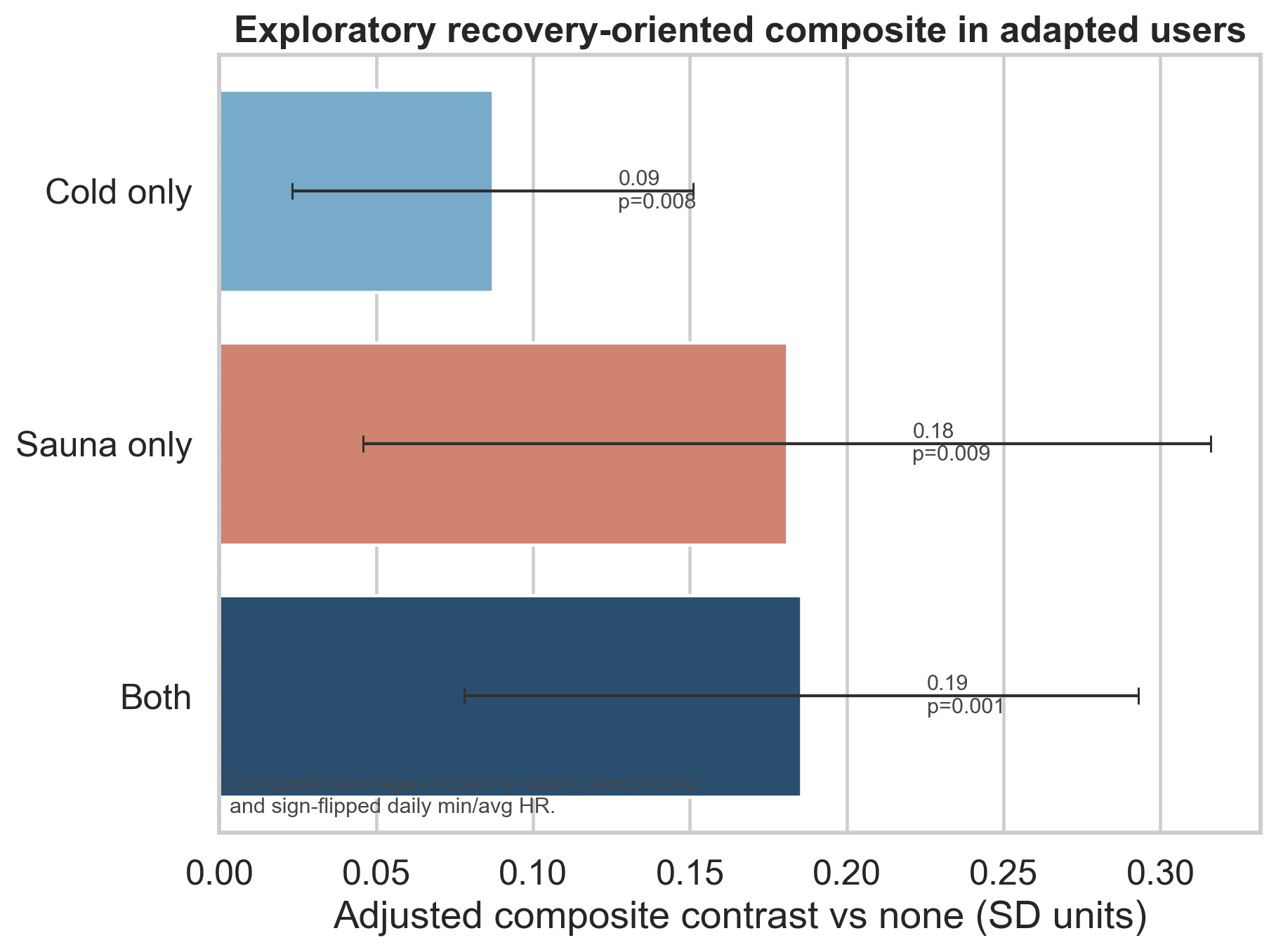
To summarize the broader pattern, we created an exploratory recovery-oriented composite by averaging standardized recovery score, sleep score, and sign-flipped minimum and average heart rate, so that higher values reflected a more recovery-like physiological state overall.
In adapted users, all three conditions looked better than no exposure, but the highest composite value was seen on days with both sauna and cold exposure. Sauna-only was very close, suggesting that sauna may be the main driver of this effect, with cold adding only a small extra contribution.
Figure 3: Exploratory recovery-oriented composite in adapted users. The composite combines recovery score, sleep score, and sign-flipped daily minimum and average heart rate, so higher values indicate a more recovery-like physiological state.
Women’s Effects
Women have a naturally higher percentage of brown fat than male[4], and most studies have been conducted on males. Given the benefit of cold exposure is transforming white fat into brown fat, there surely is a different effect on a population with greater content of brown fat!
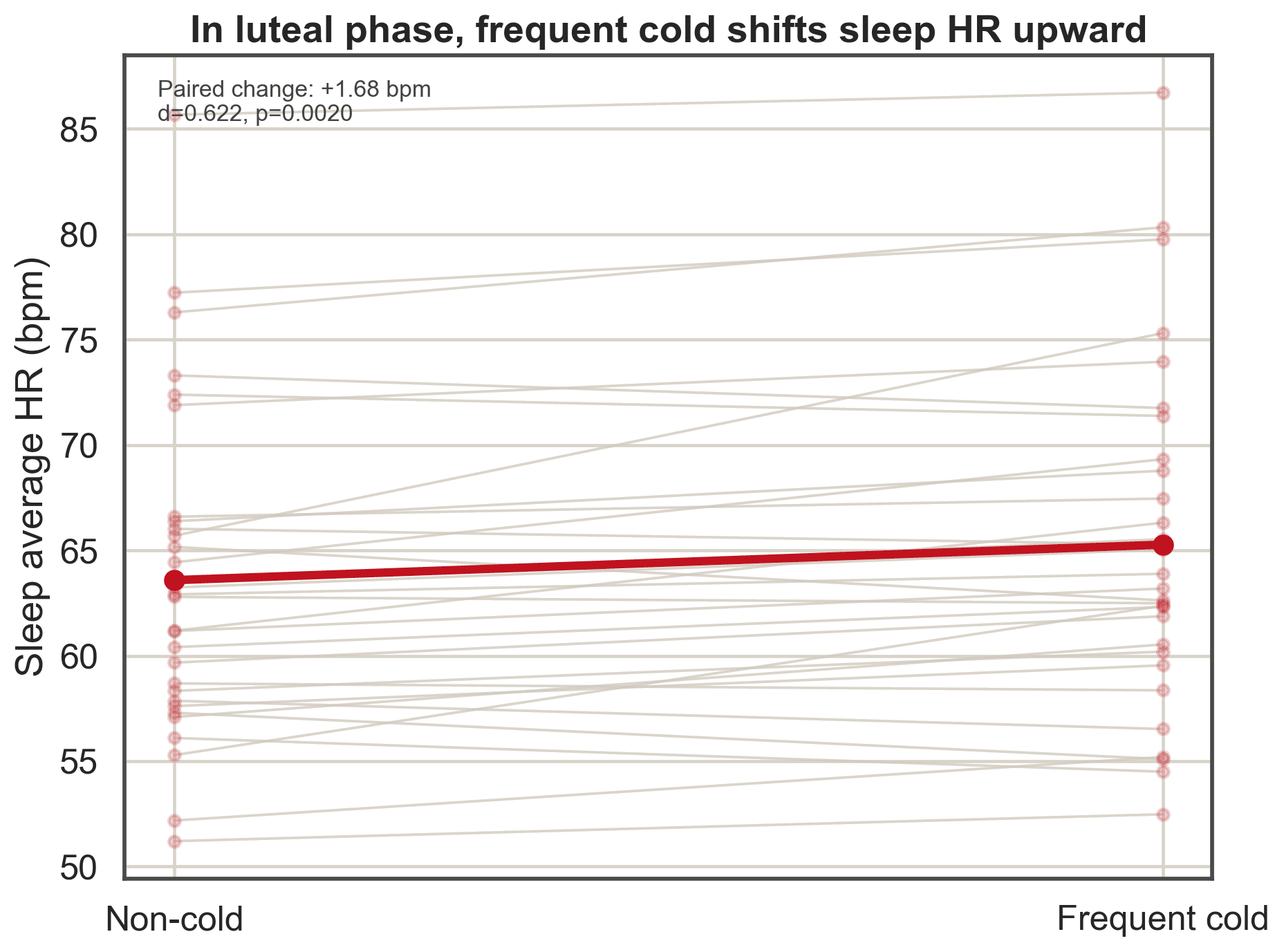
Paired within-user analysis showed that, on average, frequent cold exposure during the luteal phase was associated with an increase in sleep average heart rate of +1.68 bpm (d=0.62, p=0.002) rather than an adapted drop in heart rate. This comparison was made within women who frequently used cold exposure, comparing exposure and non-exposure days specifically during the luteal phase.
By contrast, the follicular phase showed no meaningful difference in sleep average heart rate (-0.06 bpm, p=0.92).
Figure 4: In luteal phase, frequent cold exposure is associated with higher sleep average heart rate versus non-cold days. No equivalent effect was seen in follicular phase.
Conclusion
When cold plunges are used sporadically, they look like a stressor and raise sleep HR. When used repeatedly, they become associated with better recovery, better sleep score, and a progressively more favorable nighttime HR response.
Sauna appears to have the clearest immediate cardiovascular effect, while cold exposure seems to require repeated use before benefits emerge. Adaptation is key: Inuits did not wake up one day and suddenly tolerate the cold.
Huo, C., Song, Z., Yin, J., Zhu, Y., Miao, X., Qian, H., Wang, J., Ye, L., & Zhou, L. (2022). Effect of Acute Cold Exposure on Energy Metabolism and Activity of Brown Adipose Tissue in Humans: A Systematic Review and Meta-Analysis. Frontiers in physiology, 13, 917084. https://doi.org/10.3389/fphys.2022.917084
John-Paul Fuller-Jackson, Aimee L Dordevic, Iain J Clarke, Belinda A Henry, Effect of sex and sex steroids on brown adipose tissue heat production in humans, European Journal of Endocrinology, Volume 183, Issue 3, Sep 2020, Pages 343–355, https://doi.org/10.1530/EJE-20-0184
Summary questions
Does cold plunging actually help my recovery?
Only after you've adapted. In an analysis of over 170,000 nights from 577 users, sporadic cold exposure raised sleeping heart rate by about 1 bpm (p < 0.05), behaving like a stressor. Once users crossed roughly 3 sessions in the previous 14 days, cold days were associated with +1.33 higher recovery score (p=0.015) and a -0.97 bpm drop in daily heart rate (p=0.066).
How many cold plunges per week do I need before I see benefits?
The data points to about 3 sessions in any rolling 14-day window as the tipping point. Below that, the fitted curve shows cold exposure looking predominantly stressful; above it, the response shifts adaptive. Each +1 SD increase in recent cold-use density was linked to an additional -0.58 bpm drop in sleep minimum heart rate in the activity-adjusted model (-1.05 bpm unadjusted).
Why is my heart rate higher the night after a cold plunge?
Because a single cold plunge is a sympathetic stressor. The rapid temperature drop triggers an adrenergic response, and sporadic exposures raised sleep minimum heart rate by ~1 bpm on average. Timing matters too — plunges close to bedtime or longer/colder exposures appear to amplify the effect, which is why error bars in the data are wide.
Is the sauna better than a cold plunge for recovery?
On a same-day basis, yes. Sauna use shows a clearer immediate cardiovascular effect, particularly on daily minimum heart rate, while cold exposure only delivers benefits after repeated use. In the recovery composite, sauna-only days were nearly identical to sauna+cold days, suggesting sauna is the primary driver and cold adds only a small extra contribution.
Should women cold plunge during their luteal phase?
Probably not as aggressively. In a paired within-user analysis of women who frequently used cold exposure, luteal-phase cold days were associated with a +1.68 bpm increase in sleep average heart rate (d=0.62, p=0.002) — the opposite of the adapted drop seen in the broader cohort. The follicular phase showed essentially no difference (-0.06 bpm, p=0.92), so cycle phase appears to meaningfully shift how the body responds.
Can wearable data really detect the effects of cold exposure?
Yes. Mixed-effects models on 170,000+ nights from 577 users picked up both the acute stress signature (+1 bpm sleep minimum HR) and the adaptive shift after repeated exposure (-0.58 to -1.05 bpm per SD of cold-use density). Nighttime heart rate metrics, recovery scores, and sleep scores together capture the full arc from stressor to adaptation without lab testing.
Does combining sauna and cold plunging give the best results?
It produces the highest composite recovery score in adapted users, but only marginally. Days with both sauna and cold exposure topped the recovery-oriented composite, yet sauna-only days were nearly indistinguishable. The practical takeaway: most of the benefit comes from the sauna, and cold adds a small increment on top — not a doubling effect.
Why does cold exposure require adaptation when sauna doesn't?
The two interventions act on different timescales. Sauna's heat exposure produces a clear same-day cardiovascular response, while cold exposure first registers as sympathetic stress and only flips to a recovery signal after roughly 3 sessions in 14 days. As the article frames it: Inuit cold tolerance — and the brown fat that supports it — wasn't built in a day.