We use cookies to enhance your browsing experience and analyse our traffic. By clicking “Accept All”, you consent to our use of cookies according to our Cookie Policy. You can change your mind any time by visiting out cookie policy.
We analyzed 856,000 exercise sessions from Europeans across 20 countries to find out how people really train across the year. The data reveals three distinct exerciser phenotypes — and an entire category of athlete that didn't exist a decade ago, invented by indoor cycling platforms like Zwift.
Running and walking are nearly season-proof — with coefficients of variation of just 13% and 11%, they form the year-round backbone of European exercise, while downhill skiing and open-water swimming are almost entirely confined to specific months.
Indoor cycling replaces only 24% of outdoor hours lost in winter — the substitution pattern looks like a perfect mirror, but the numbers tell a different story: cyclists lose 21.8 hours outdoors and gain just 5.2 indoors.
The committed group's winter floor exceeds the casual group's summer ceiling — consistency isn't seasonal or motivational, it's structural, built over years with routine across longer sessions, more modalities, and flatter seasonal curves.
When I first started training on the quiet country lanes and footpaths of Yorkshire, I always got told the same thing: winter is for easy training. Winter miles make summer smiles. "Long and slow" was the prescription. The endurance sport seasons, triathlon, cycling, and athletics, run from spring to early autumn. Then you rest, recover, and slowly get "back into" training.
A lot has changed since then. Seasons in a sporting sense have become more convoluted as sport has become more international and exists around the world. And indoor cycling training has got a lot more interesting. Some of my worst memories of training are in a garage, staring at a clock, watching the seconds tick down. Time has never gone slower. Now, when I need to, I quite enjoy jumping on the trainer for a quick Zwift race. The concept that hasn't changed is the fundamental belief that the health and performance benefits of training come over months, not weeks. And those consistent months of training tend to come at times of the year when athletes are not preparing for, recovering from, or travelling to the next event.
This dataset of 856,000 activity sessions from 9,437 European users, tracked by wearable devices across 20 countries between 2021 and 2024, gave me the opportunity to work out how Europeans actually exercise. Not the elite athletes, but the broader population: the club runners, the weekend warriors, the indoor cyclists. What does their year look like? And are there distinct types?
The Sporting Year
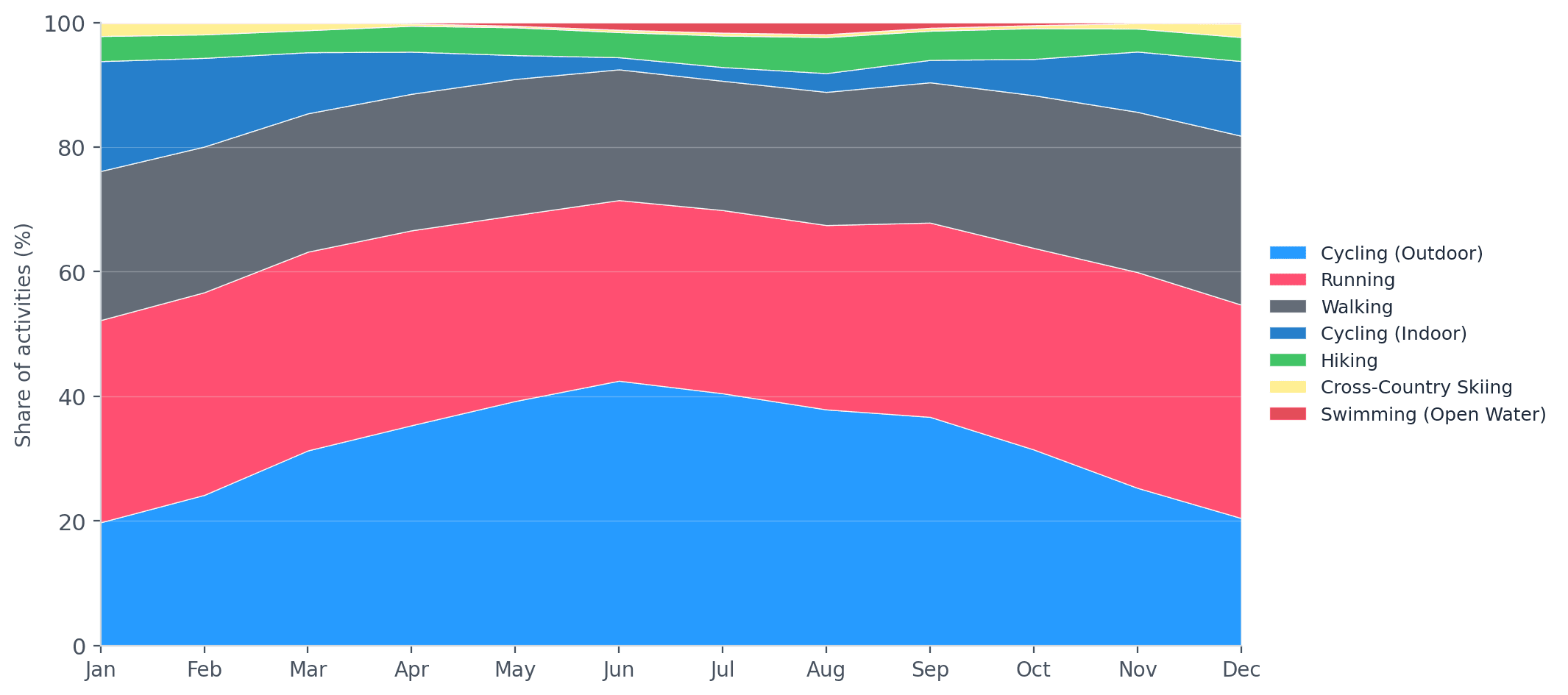
Figure 1: Running and outdoor cycling account for the bulk of Europe's active hours year-round, but their relative share shifts with the seasons. Indoor cycling surges to roughly 15% of all hours in January before almost disappearing by June, while hiking and swimming expand to fill the summer months.
Running and outdoor cycling account for the bulk of Europe's active hours year-round, but their relative share shifts with the seasons. Indoor cycling surges to roughly 15% of all hours in January, then almost disappears by June. Hiking and swimming expand to fill the summer months. Skiing (cross-country, downhill, and touring) appears briefly in winter and vanishes.
The dataset captures nine modalities. Running dominates at roughly 45% of all sessions, followed by walking (~20%) and outdoor cycling (~12%). But this breakdown masks the most interesting patterns: what happens when you look at the differences between sessions and hours, and the enormous variation between individuals.
Get the latest Terra Research reports and insights every week as soon as they're published.
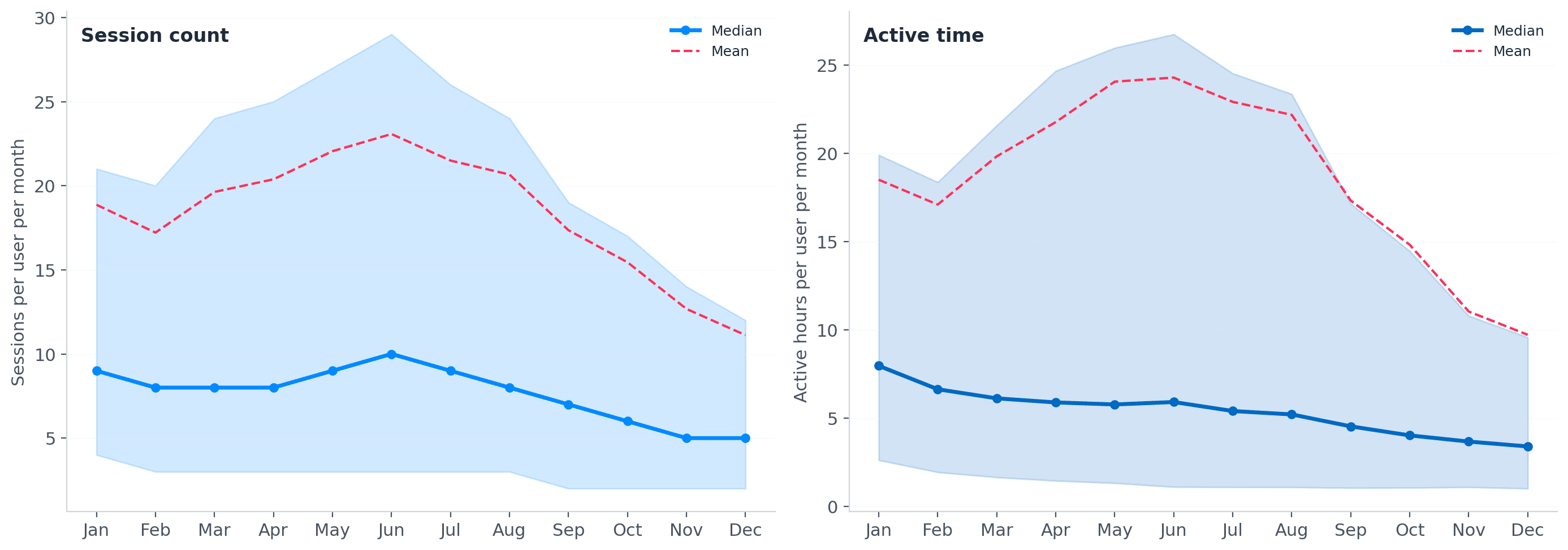
Figure 2: The left panel shows per-user session counts; the right shows active hours. The seasonal swing is more dramatic in hours (35% summer-to-winter drop) than sessions (25%), because summer activities like outdoor cycling are substantially longer per session.
The per-user monthly sessions follow a predictable, gentle pattern: a median of about 10 in June, dipping to 5 in December. But when you switch to hours, the pattern is more extreme; volume (measured in time) drops more between seasons than frequency. Again, this makes sense. I'd imagine more outdoor exercise makes a higher active volume more likely. It certainly does for me, as the temperature warms and the days lengthen, my hours go up too.
Outdoor cycling sessions average 66 minutes. Running averages 46. Walking, 36. A cyclist doing three sessions per week logs nearly as many hours as a runner doing five. Any exercise analysis that counts sessions without weighting for duration will systematically overstate the contribution of runners and understate cyclists.
The Indoor-Outdoor Mirror
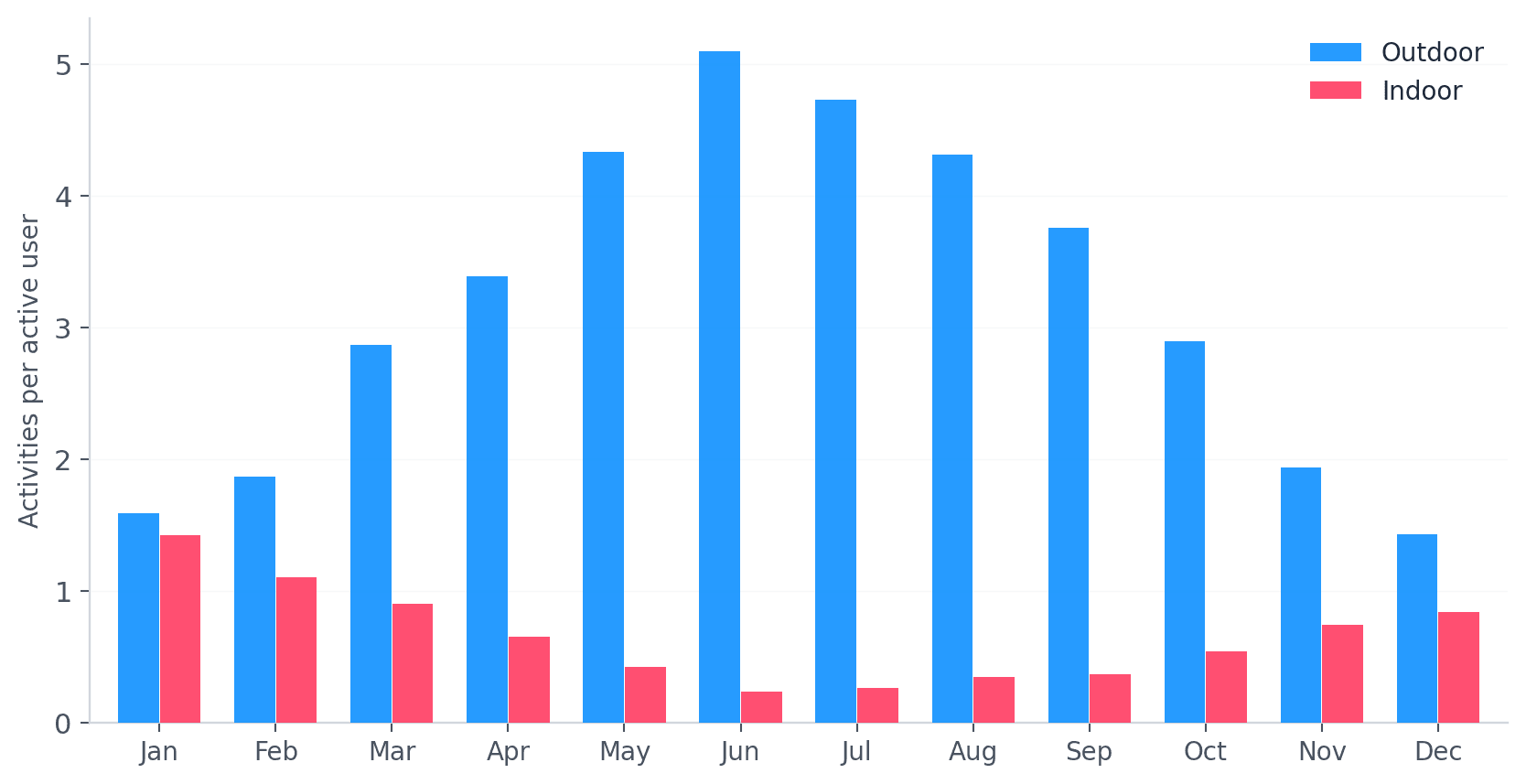
Figure 3: Indoor and outdoor cycling volumes show a near-perfect inverse seasonal relationship. As outdoor cycling peaks in June to August, indoor cycling drops to its minimum, and vice versa in winter.
Indoor and outdoor cycling volumes mirror each other almost symmetrically across the year. As outdoor cycling peaks in June to August, indoor cycling drops to its minimum, and the reverse in winter. It looks like a perfect substitution. Cyclists, you'd think, maintain their training load by switching venues rather than reducing volume.
But the numbers tell a different story. Indoor cycling replaces only 24% of the outdoor hours lost in winter. The outdoor drop from summer to winter is 21.8 hours per user per month. Indoor cycling gains just 5.2. The substitution pattern is visually seductive but quantitatively misleading; it fills about a quarter of the hole.
Which Sports Survive Winter?
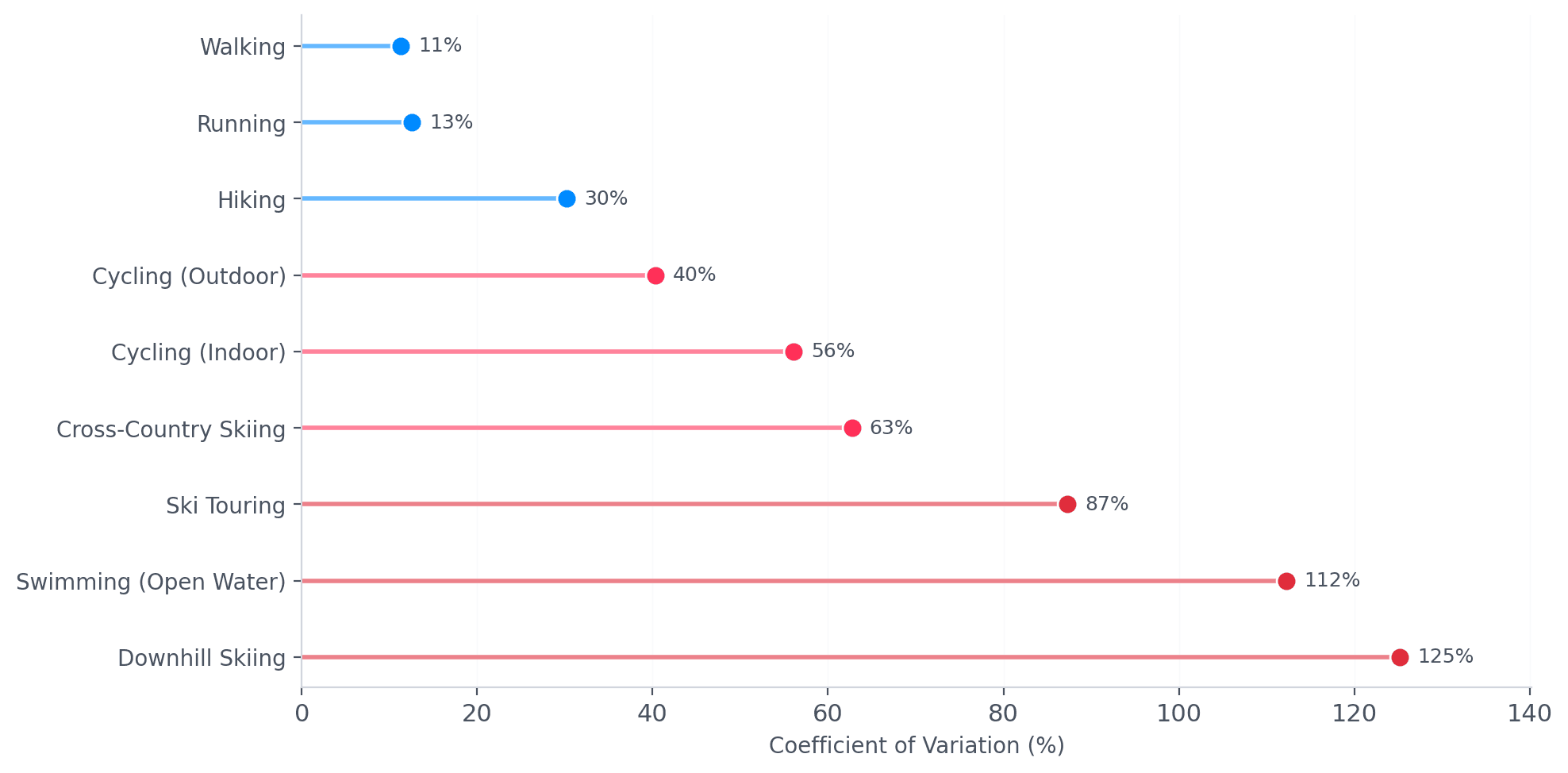
Figure 4: The CV measures how much a modality's volume swings across months. Walking (11%) and running (13%) are nearly year-round activities, while downhill skiing (125%) and open-water swimming (112%) are confined almost entirely to specific seasons.
The coefficient of variation across months reveals which modalities are most seasonally stable. Walking has the lowest CV (coefficient of variation can be seen as a measure of consistency here) at 11%, followed by running at 13%, these are the year-round backbone of European exercise. At the other extreme, downhill skiing (125%) and open-water swimming (112%) are almost entirely confined to specific seasons, as you would expect.
Indoor cycling sits at 56%, making it more seasonal than you might expect for a weather-independent activity, possibly a clue that it's used in structured blocks rather than year-round.
Heart Rate Doesn't Care About the Calendar
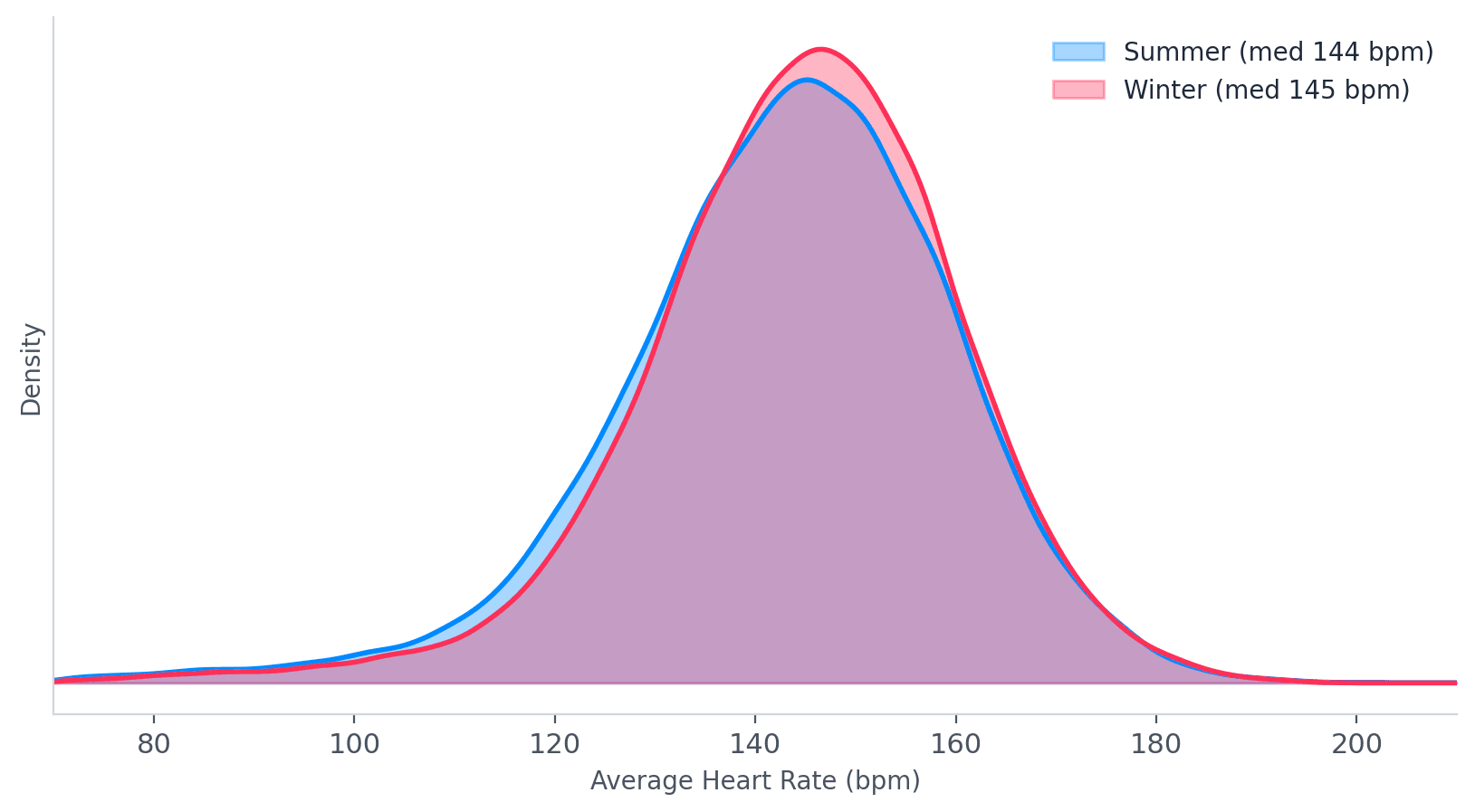
Figure 5: Running average heart rate distributions for summer and winter almost perfectly overlap. Median HR sits at 144 to 145 bpm regardless of season, suggesting runners pace by perceived effort rather than being driven by environmental conditions.
Running heart rate is remarkably stable throughout the year. Median average HR hovers between 144 and 145 bpm, whether it's July or January. The distributions almost perfectly overlap. Recreational runners self-regulate their intensity by perceived effort, maintaining a consistent cardiac output regardless of temperature, daylight, or training phase.
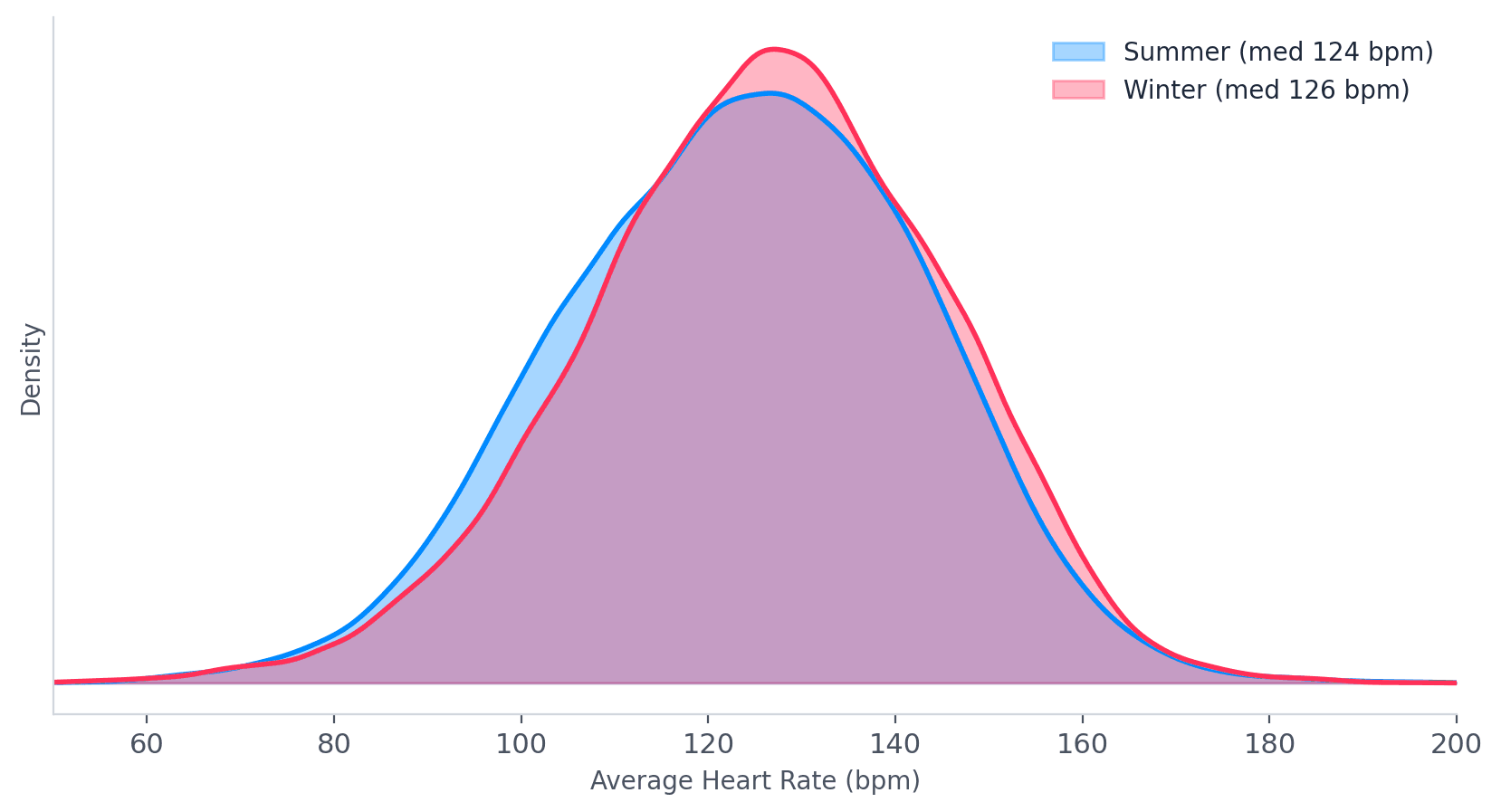
Figure 6: Cycling shows a small but consistent winter HR elevation (median 126 bpm vs 124 bpm in summer). This likely reflects self-selection, where only the most committed riders cycle outdoors in cold months, and they tend to push harder.
Cycling tells a slightly different story. Winter outdoor cycling shows a consistent 2 bpm elevation (median 126 vs 124 bpm in summer). This is likely a self-selection effect: riders who brave the cold are typically more committed and tend to ride at a higher relative intensity. Winter doesn't make people train easier; it just makes fewer people train. Or, people tend to ride at a higher intensity to stay warm!
Three Types of European Exercisers
All the above findings treat the user base as one population. But the data contains enormous individual variation. To move beyond averages, I clustered 3,305 users with sufficient activity history on 13 behavioral variables: monthly training volume in hours, seasonal consistency, modality composition, activity density, session duration, and volume trends over time. Each user was measured against their own active window; someone joining the platform in 2023 wasn't penalized against someone present since 2021.
Three distinct phenotypes emerged.
The Committed Multi-Sport Athlete (36%)
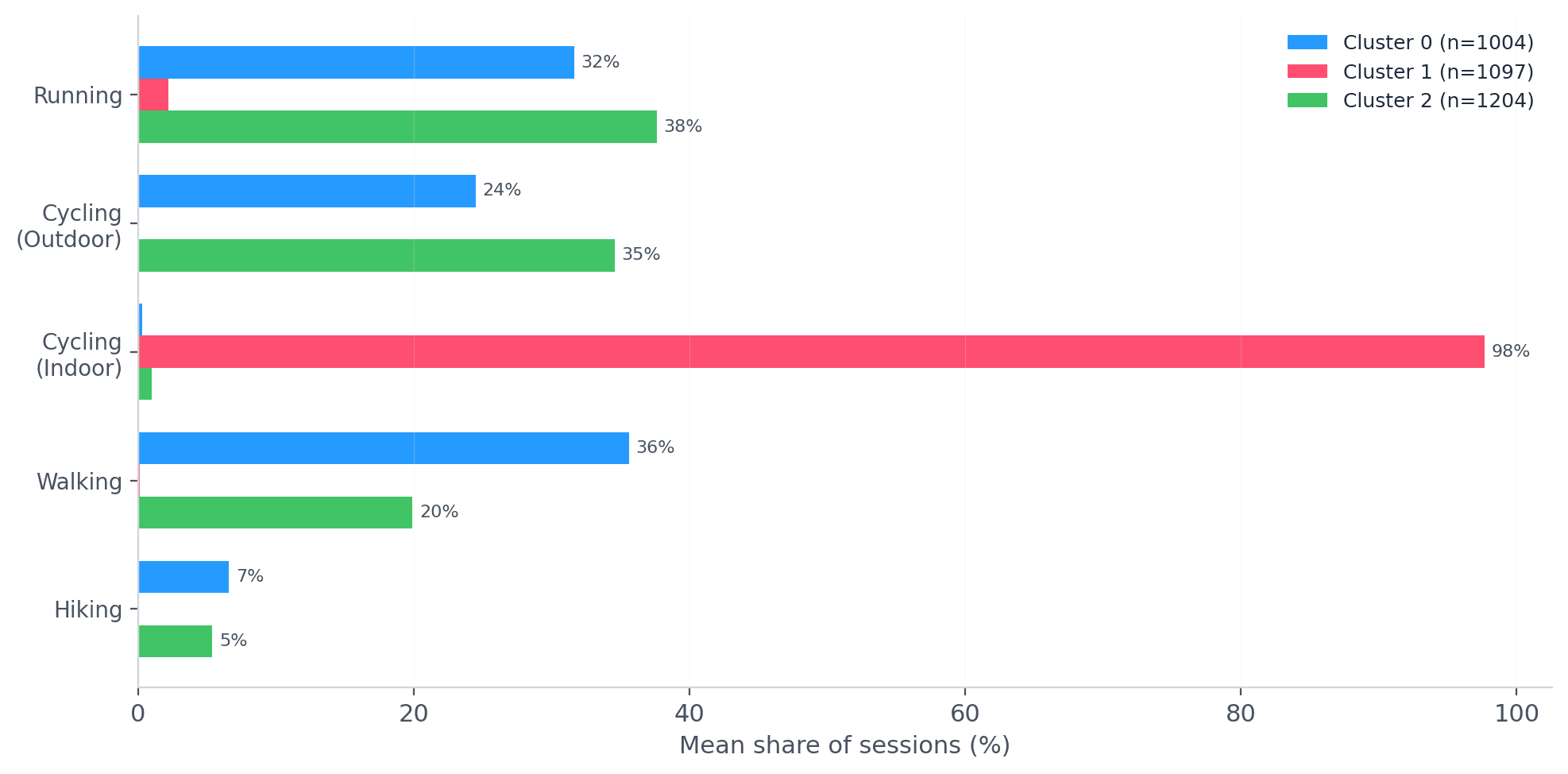
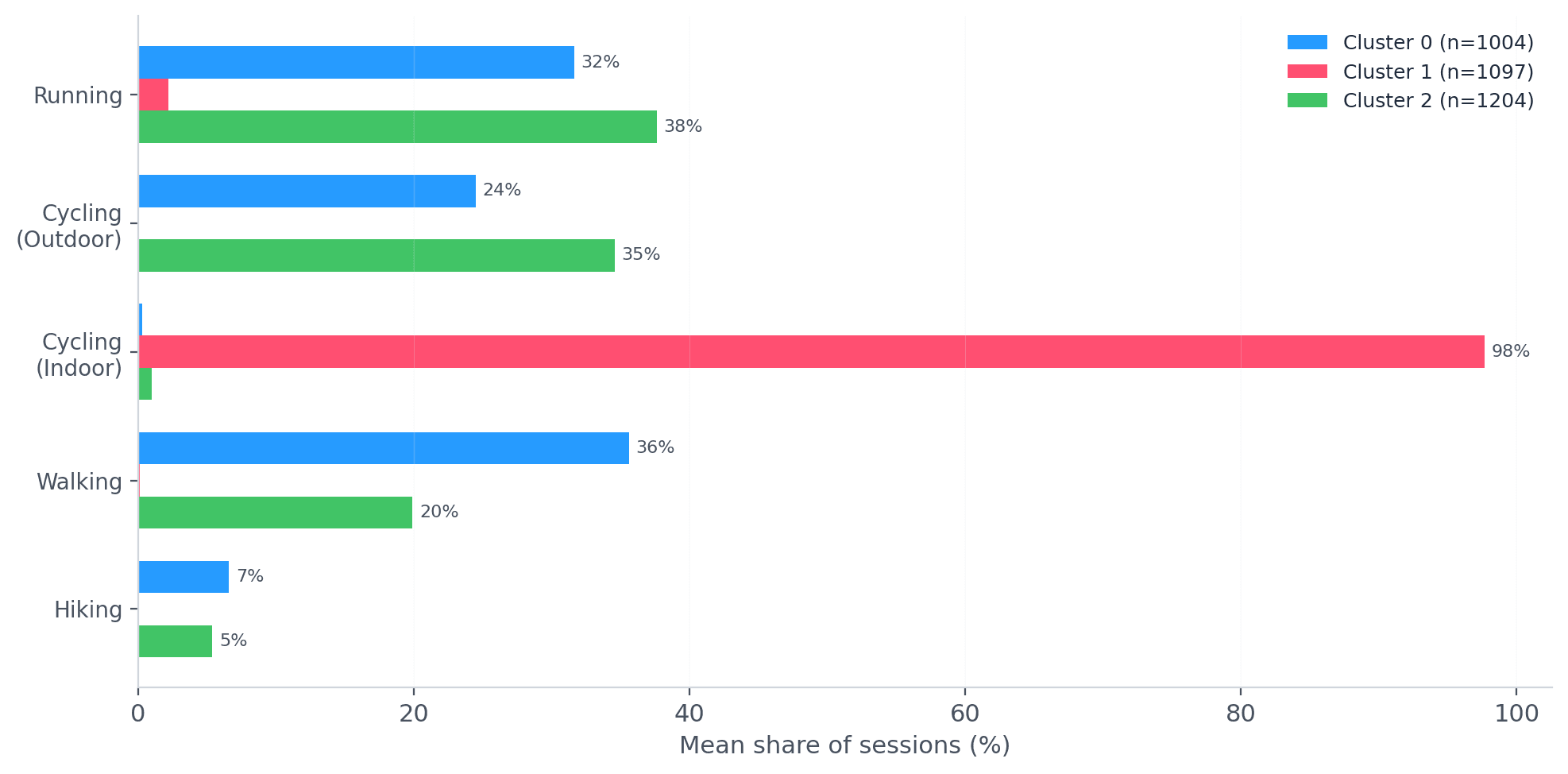
The largest group (1,204 users) logs a median of 10.4 active hours across roughly 10 sessions per month, and they show up in 96% of the months within their active window. Running dominates (32%), followed by outdoor cycling (22%) and walking (20%). Their seasonal coefficient of variation is just 0.46. They dip in winter but never disappear.
Figure 7: The three phenotypes occupy distinct volume ranges across the year. The committed group (green) operates on an entirely different scale; their winter trough still exceeds the other groups' summer peaks.
Their sessions are longer, too. At a median of 64 minutes, they outpace both the indoor cyclists (58 min) and summer casuals (52 min), even within the same modality. A committed runner averages 49 minutes per session; a casual runner, 39.
If you want to be consistent, routine is everything. I think that's clear in these clusters. The committed athletes in their lowest month (deep winter, December) still log 9.5 hours. The summer casuals peak at 4.5 hours in August. The committed group's winter floor exceeds the casual group's summer ceiling. That's not a seasonal difference. That's a structural one, built on habit.
The Indoor Cycling Specialist (33%)
Here is where the data surprised me. The second group (1,097 users) are almost exclusively indoor cyclists. The typical user in this group has never logged a single outdoor session. They don't train year-round either. They show up for structured winter blocks, peaking in January and disappearing by June, active in fewer than half of their months on the platform.
Figure 8: Each phenotype has a radically different sport mix. The indoor cycling specialists are almost entirely single-modality, while the committed and casual groups spread their hours across running, cycling, and walking.
When I looked at where their data comes from, the picture sharpened. Much of it traces back to Zwift. And this isn't a data artefact, the dataset links all activity through each user's platform ID, so if someone rode Garmin outdoors in summer and Zwift indoors in winter, both would appear under the same user. These people genuinely only log indoor cycling.
That reframes what this group represents. They're not outdoor cyclists who happen to train inside when the weather turns. Indoor cycling is an exercise identity. Zwift didn't digitize an existing behavior; it created one. A third of the committed exerciser cohort in this dataset is on a platform that didn't exist a decade ago, training in a pattern with no outdoor equivalent.
The Summer Casual (30%)
The remaining 1,004 users are weather-dependent exercisers. Walking leads at 36%, followed by running at 32% and outdoor cycling at 24%. Median volume is 2.2 hours per month across about 3 sessions, with a 37% winter drop. Sessions are shorter at 52 minutes, and hiking makes up 7%, suggesting weekend recreation rather than daily training. They don't vanish in winter, but they thin out.
The Turbo Trainer Question
This is what I really wanted to know. If you're one of the cyclists who owns a turbo trainer and rides Zwift in winter, does it actually protect your training volume?
I matched indoor and outdoor cyclists against outdoor-only cyclists with the same summer volume. Same fitness level. Same summer commitment. The winter drop was virtually identical: 50% vs 47%. The turbo trainer made no measurable difference to the seasonal decline.
But here's what did stand out. The cyclists who also train indoors ride 3.4 hours of outdoor cycling per winter month. Outdoor-only cyclists manage 0.9. The indoor group does nearly four times more outdoor riding in winter, too. They're not substituting indoor for outdoor. They're supplementing. The indoor hours sit atop a larger outdoor base that was already there.
The turbo trainer isn't the cause of their consistency. It's a symptom of it. They'd be training hard in winter regardless. The piece of equipment isn't the intervention. The person who buys it is.
What This Means
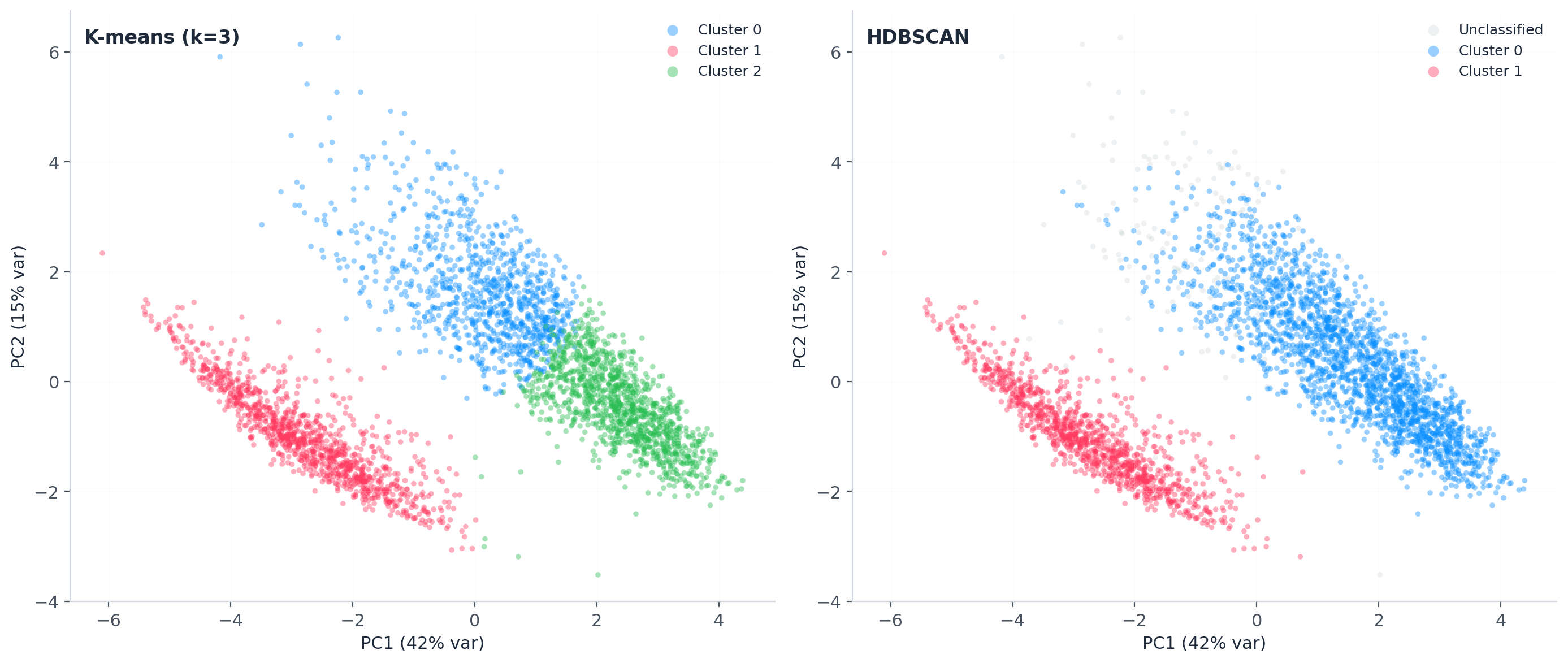
Figure 9: Principal component analysis projects each user's behavioral features into two dimensions. The indoor cycling specialists (pink) form a distinct island, while the committed athletes (blue) and summer casuals (green) separate along the volume and density axes.
European exercise isn't a spectrum, it's a landscape. The data don't arrange neatly from "lazy" to "fit." The indoor cycling specialists are low-volume by most measures. The summer casuals are moderate in volume but weather-dependent. These are different types of exercise behaviour, not different amounts.
Technology has created a new exercise phenotype. A third of this committed exerciser cohort exists almost entirely on Zwift. They exercise in blocks, don't engage with outdoor modalities, and represent a population that likely didn't exist in wearable datasets a decade ago. The indoor cycling specialist is not a seasonal athlete who happens to be indoors. They are a distinct behavioural archetype I think, one shaped as much by platform and technology as by physiology or climate.
Consistency is structural, not motivational. The committed athletes' winter floor exceeds the casuals' summer peak. That gap isn't built in January with good intentions. It's built over the years with routine. The data can't tell you how to become consistent, but it can show you, clearly, that the people who are consistent behave differently in every dimension: longer sessions, more modalities, higher density, flatter seasonal curves. Consistency is, undoubtedly, key.
The old Yorkshire wisdom, winter miles make summer smiles, assumed a single type of athlete on a single seasonal cycle. The data suggest something more complex: three different relationships with exercise, three different relationships with the calendar, and an entire phenotype invented by the connected turbo trainer.
Summary questions
Does using a turbo trainer actually protect my winter cycling volume?
No — and this was the most counterintuitive finding. When matched on summer volume, cyclists who also train indoors saw a 50% winter drop, virtually identical to the 47% drop for outdoor-only cyclists. The turbo trainer isn't the intervention; it's a marker of someone already committed enough to ride 3.4 outdoor hours per winter month vs 0.9 for outdoor-only riders.
How much of lost outdoor cycling does indoor cycling actually replace?
Only about a quarter. Outdoor cycling drops by 21.8 hours per user per month from summer to winter, while indoor cycling gains just 5.2 hours — roughly 24% substitution. The visually symmetric indoor-outdoor mirror in the data is quantitatively misleading; indoor riding fills a fraction of the hole, not the whole thing.
Why am I not training less in winter even though everyone else seems to?
Because seasonality is phenotype-dependent, not universal. Across 9,437 European users and 856,000 sessions, the committed multi-sport athletes (36% of clustered users) have a seasonal coefficient of variation of just 0.46 and log 9.5 hours even in their December trough — more than the summer casuals' August peak of 4.5 hours. Consistency is structural, built over years of routine, not a winter motivation problem.
Should I count workouts by sessions or by hours?
By hours, if you want an honest picture. The summer-to-winter swing is 25% in sessions but 35% in hours, because summer activities are longer per session — outdoor cycling averages 66 minutes, running 46, walking 36. A cyclist doing three sessions per week logs nearly as many hours as a runner doing five, so session counts systematically overstate runners and understate cyclists.
Does running in winter feel harder because of the cold?
Your heart rate says no. Running median average HR sits at 144–145 bpm whether it's July or January, and the summer and winter distributions almost perfectly overlap. Recreational runners self-regulate by perceived effort, holding cardiac output steady regardless of temperature or daylight — winter doesn't make people train harder, it just makes fewer people train.
Are indoor cyclists just outdoor cyclists waiting for spring?
No — they're a distinct exercise identity. Of the 1,097 users (33%) classified as indoor cycling specialists, the typical one has never logged a single outdoor session. They peak in January, disappear by June, and are active in fewer than half their months on platform. Zwift didn't digitize an existing behavior; it created an entirely new phenotype that wouldn't have existed in wearable datasets a decade ago.
Which activities are actually year-round versus seasonal?
Walking and running are the year-round backbone, with coefficients of variation of just 11% and 13% across months. Indoor cycling sits at 56% — more seasonal than its weather-independence suggests, hinting at structured winter blocks rather than continuous use. Downhill skiing (125%) and open-water swimming (112%) are essentially single-season activities.
Do winter outdoor cyclists ride harder than summer ones?
Slightly, yes. Median outdoor cycling HR is 126 bpm in winter vs 124 bpm in summer — a small but consistent 2 bpm elevation. This is most likely self-selection: only the most committed riders go outside in the cold, and they ride at a higher relative intensity (or push harder to stay warm).