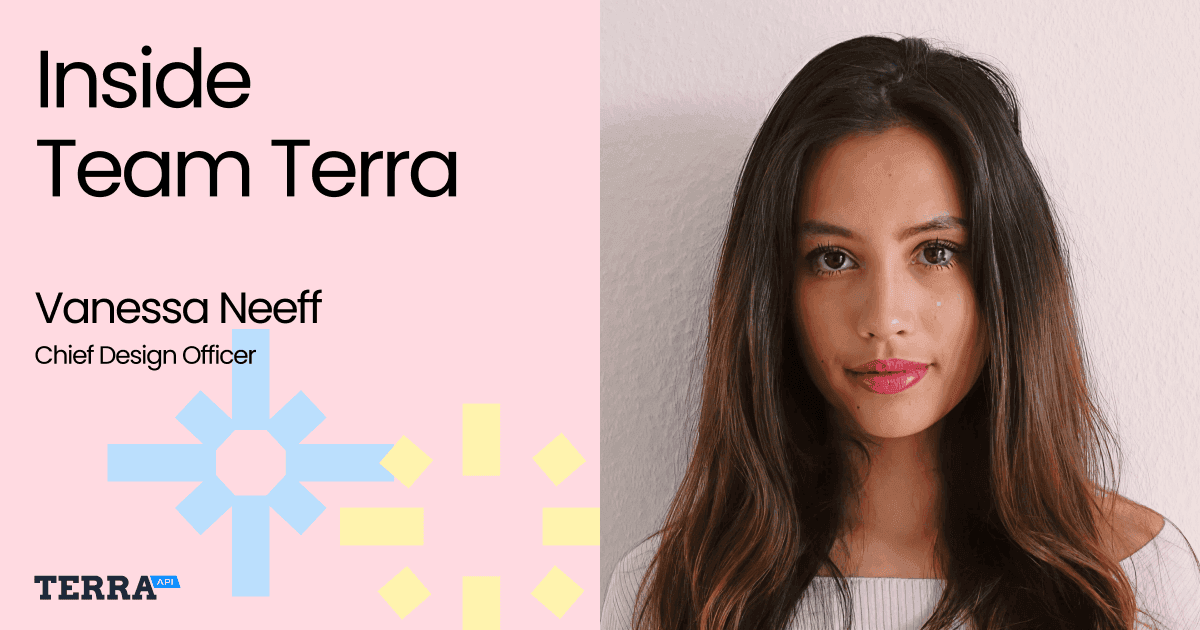





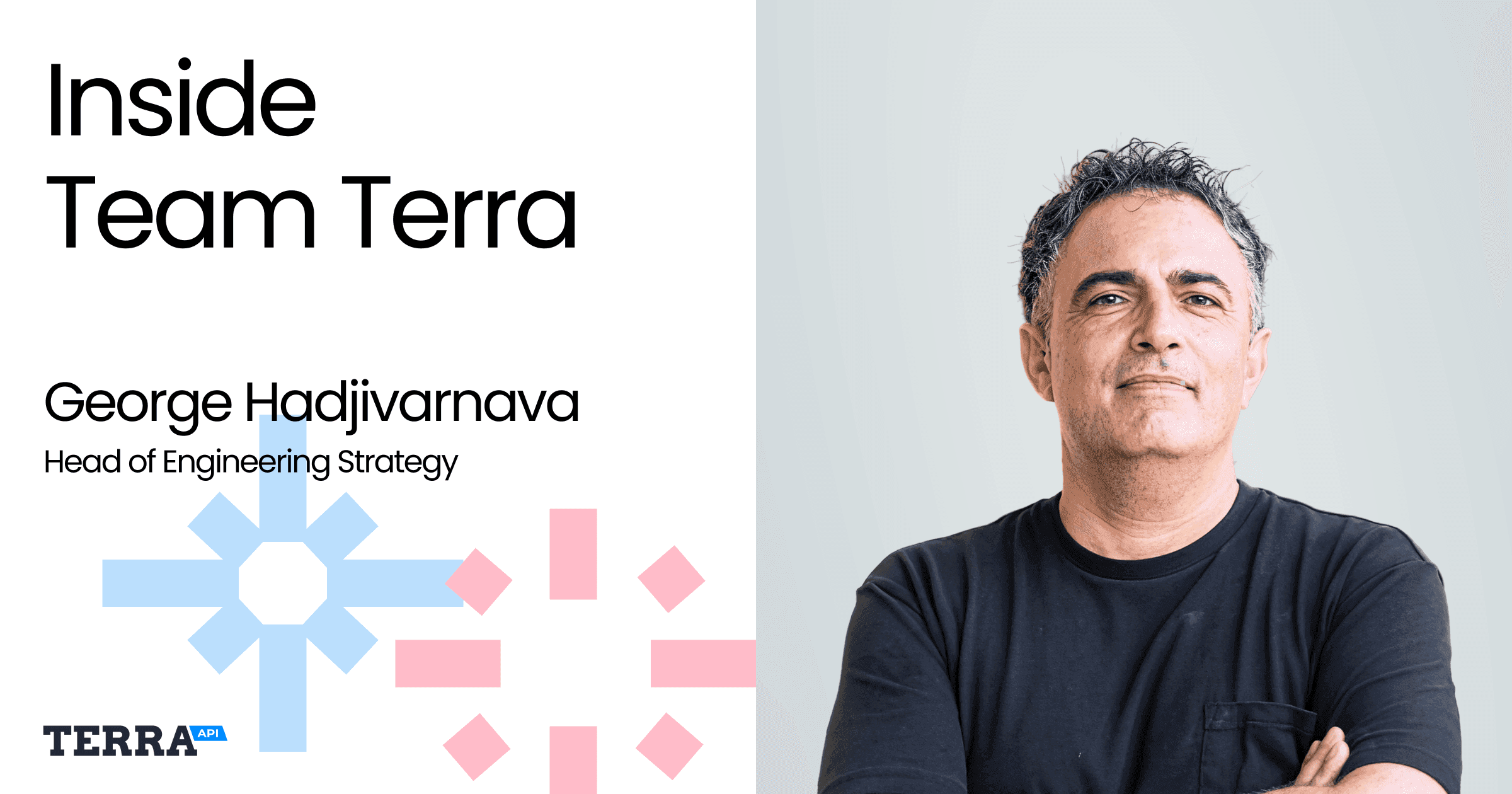
Inside Team Terra is our video series about the people building Terra's health data infrastructure. This time: George Hadjivarnava, Head of Engineering Strategy. George co-founded Foody, Cyprus's leading food delivery platform, scaled it to over 90% of the country's online food orders, and exited to Delivery Hero, where he served as director of engineering. In this conversation with Kyriakos, Terra's CEO, he talks about building Foody from phone calls and cash payments, scaling through an acquisition during COVID, joining Terra, and why your next customer will be an AI agent. Watch the full conversation below, or read the edited highlights.
What gave you the drive to build? Walk me through how it started.
I wasn't from an entrepreneurship family, and I didn't have this drive from my surroundings when I was young. I went to Imperial because it was the best university to go to, and I landed there like a rock. It was very hard for me, and I flunked the first year. So I had to spend a year in London, I had to somehow pay rent, and I wasn't even allowed to go to university. I had a lot of time, so I started finding ways to make money. That's how my whole web development journey started: there were a lot of property developers in Cyprus back then and nobody knew how to make websites or ordering systems, so that became my go-to. Just to make rent.
After university it was 2009, the global financial crisis had reached the UK, and my path was either an investment bank in London, which is where most computer science graduates ended up, or a secure job back home. I took the secure job in Cyprus, and it was not enough for me. I couldn't be in a place where I just look at the clock, because I couldn't innovate there. So with friends I kept doing different things on the side, from online ticket sales to listing marketplaces, and that's how I met my future co-founders. Joining them was hard, because I'd just had my first child and I had all that "stay secure" culture in me. I had an internal battle. But I knew I was going to get bored, so I made the step. Probably one of the best decisions of my life. Self-funded, no investments, and two years in we started building Foody as a pivot.
What did the first version of Foody look like?
The fundamentals were never there. The first version had no online payments, cash only, and at the beginning we were making the calls to the restaurants ourselves. You would order online, we'd get an email to our personal addresses, and we'd pick up the phone and place your order with the restaurant. We integrated Twilio to ring us whenever an order came in. Then came the first Excel-style back office, and we continued building on that. We launched in September 2015, and by 2017 we were already profitable.
Then you had to scale. What changed with the acquisition?
The technology shift at Foody was driven by scale, and the biggest one came during the acquisition. When you sell a company, the payout isn't one lump: you have earnout targets over the following years, and you get paid based on how much of the target you meet. So we had big targets to hit, and then COVID came. We had to go from a platform that handles a restaurant menu with 50 items to serving supermarkets with 5,000 or 10,000 items, plus all the traffic of a country in lockdown trying to eat. During those years we had 45 minutes of downtime in total, on one day during lockdown.
In 2019 you didn't have clusters readily available as automated tooling the way you do now. At one point we were still on bare metal servers, so we just bought RAM and installed it. Then we broke everything down into microservices, applied domain-driven design, and sat with everyone from the business at the drawing board to rethink how the system should work. With Delivery Hero we had to integrate deeply: payments, back office, orders, rider and fleet management, and the restaurants' own point-of-sale systems, so that processing an order added as little overhead as possible for the restaurant.
The deeper change was methodology. At the beginning, a startup is all about traction and iterating. In the middle, you're established and people allow you mistakes because you've shown value. But then you need to show you're an adult: reliable and resilient. You cannot have the YOLO ship-to-production thing on a Friday night just because you're a startup and you'll be excused.
You joined Terra at a point where it has customers in 120 countries and had just signed some of the biggest AI labs in the world. How do you survive the chaos?
I thrive on chaos, especially when it comes in spikes. At Delivery Hero I handled very big projects and big incidents, but in a big corporate structure it's totally different from being in the trenches, operating at the code level rather than the team-of-teams level. A big contract comes in, it shifts the needle, and the whole team focuses on it. Those are magic moments you only find in startups. They look like chaos, but if you look at a bigger timeline you see how the team comes together, all the mistakes appear, all the good things appear, and you know exactly where to focus next. For me that's the best thing about the job: you control the chaos, you tame it.
My first three weeks were the toughest and the funnest at the same time. I got to meet everyone in the team in that mode, which is the best place to build a relationship with your teammates. And the thing that amazed me was how deeply Terra knows the domain it operates in. Not just at the level of individual partners, but how everything comes together and how that knowledge applies to every use case, whether that's an AI lab or a simple app tracking health data. I could ask questions and get answers I would never expect to get on the spot.
The title of this conversation is "your next customer will be an AI agent". What do you mean?
Look at how the layers evolved. The interaction between the end user and the model was essentially established with the first ChatGPT. That's not the problem anymore. The problem is how an agent, on its own, in the background, communicates with the systems it needs, without having to go through documentation that was built for humans.
Today, when you instruct an agent in natural language, it translates that into its context, then into an API's documentation, then does the work the way a human developer would integrate, then communicates the outcome back in natural language. Every one of those steps is a transformation, and every time you transform, you lose context. So the next layer is not building more APIs and normalizing more data. The next layer is helping agents communicate with systems without losing context: a layer where you transfer the intent, the actual context of what you're trying to build, and the communication is iterative. An agent might work with a system for days, then need to come back and ask the user a question, or query another system, or get an approval. Those layers don't exist yet, and that's where the next shift is heading, on every industry, from payments to health data.
Most people consider MCPs useful today. Why do you say they're outdated?
MCPs aren't dead, they're tools, and they're used. But an MCP is essentially an API: a set of instructions and endpoints that give the agent context to query them. The gist is the same as before: I'm calling an API to perform a command. What's missing is a layer that says: my intent is to do this, here's the context I carry, here's what I'm trying to find out, and the system on the other side is built to receive that. If you transfer the intent, the system can optimize for you at runtime.
I have a story from my web development days that I always tell. The spec from a client was to make the images on an e-shop listing page smaller. So you do the natural thing: compress them, lossless, faster response times, a lot of work. The true intent, it turned out, was that the stakeholder wanted the images slightly blurry, to force people to click the zoom icon so they could measure interest in the product. The whole problem could have been solved with a CSS filter in five minutes. The spec arrived stripped of its intent. That's exactly what happens between agents and systems today.
How has AI changed how Terra runs internally?
Terra is not the biggest team, and the level we operate at now is completely different. Take hiring: an interview process that used to take roughly three weeks end to end can now be compacted, with AI evaluating most of the early stages, so a candidate can effectively go through it in a day and the final judgment stays with people. Building internal tooling, observability dashboards, reports, deep dives: work that used to take huge effort just to exist now gets done as a side effect. We have people in customer success pushing PRs that the team reviews. I've been with the team barely three months and I already see the difference in the confidence of people who aren't in engineering at all.
And there's a deeper thing: the artifacts these processes produce. There was never a decision log for how senior people make decisions. Now there is. You can know why a decision was made, what action was taken, and what the outcome was. If you keep feeding that context in, that's how you build the company's brain, and I think that's the biggest value that hasn't fully arrived yet. Which is also why I'll say: in two years' time, a large share of our customer base will be agents instead of developers, and the confidence we've built with these tools is what lets us build that layer for them.