


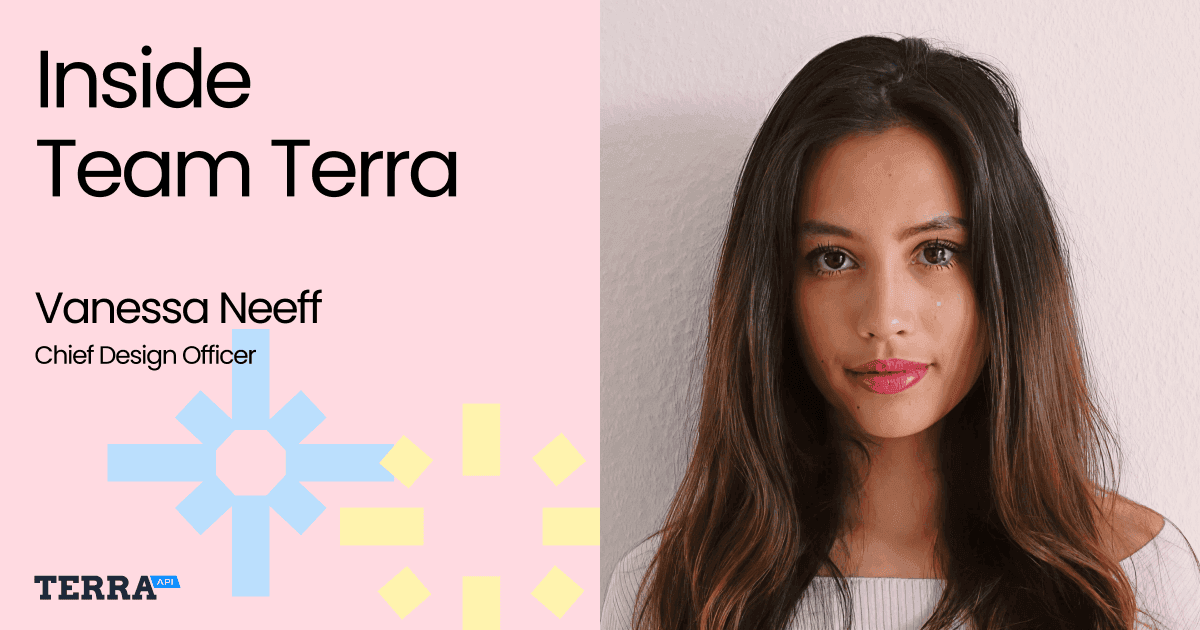
Inside Team Terra is our video series about the people building Terra's health data infrastructure. This time: Vanessa Neeff, Chief Design Officer. Vanessa joined when the team was 95% engineers and has rebuilt how design works at Terra since. Watch the conversation below, or read the edited transcript.
What is design at Terra? What makes it different from other companies?
It has evolved so much in the last year. For historical context: when I joined Terra we were 95% engineers, and design maturity wasn't very high. Most decisions were led by engineering, and design was the facelift you apply on top of decisions that have already been made. That has drastically changed. Most decisions now start from a design thinking perspective, and I don't mean the classic double-diamond process, which is completely outdated. We start by framing the problem and building a really high-resolution understanding of what users, and increasingly AI acting on behalf of users, are trying to solve.
Every designer you speak to at Terra is technically enabled. They can reproduce everything a developer can do, so we're our own super users. All of our designers ship in production, that's a given, and all of them are AI native. And the team is very analytical, with very good judgment. That makes my life easy, because it's always judgment over process. I don't have to police a design system to make sure everyone produces good outcomes. I can rely on the judgment of every single designer.
If you could condense the philosophy of design at Terra into as few words as possible, what would it be?
We want to do two things: move fast and make good calls. Traditionally, design teams enable this with a design system and a systems designer who makes sure everything adheres to the guidelines. We operate completely differently. We ship so fast that it's impossible to constantly double check against a system, so what we believe in is shared taste: can we constantly push our bar of taste higher so the outcomes are better by default? Can I trust every designer to produce good work independently? There's a shared practice of aligning our taste constantly, so everyone in the team agrees on what's good and what's probably bad.
How do you make good calls?
To me, taste is tacit knowledge. AI right now is extremely good at learning from explicit knowledge: patterns from the past that it can reproduce. But making good calls on design, which is a wicked problem with no right or wrong, requires tacit knowledge. Through experience you compress your learning until it feels like intuition. The best footballer in the world has the skill of scanning the field, and it's not analytical, it's ingrained through years of practice. Design taste is the same muscle. You've seen so many good and bad designs, and crucially you've seen their outcomes: something can look visually pleasing but not produce the emotion you wanted, or not convert, or not activate the user.
With code, everything you ship carries signals about whether it's good: you see the outcome, the patterns, whether people keep using it. Design artifacts carry far fewer explicit annotations about whether they achieved their goal. So to make good calls you need to be extremely observant and constantly exposed to really great design, including the first principles of it. Look at architecture. Look at the Sagrada Familia. Good design is something you develop intuition for.
What is the role of AI in design? What is it good at, what is it bad at, and where will it be in a few years?
Right now AI is assistive: exploration, experiments, trying different layouts. It doesn't do design end to end the way it increasingly does software. To think about where it's going, you have to ask two things: what makes design good, and what can't be commoditized?
Design has three roles for us. It needs to serve the user's goal, or the goal AI is completing on the user's behalf. It needs to be memorable and distinguishable. Everyone can build a church with four concrete walls; it serves its purpose, but nobody looks up in awe. Since everyone can now create artifacts with AI, the question becomes who actually captures attention. And third, maybe a personal preference: design should be delightful, even in B2B software. Our brains are wired to strive for novelty and joy.
Now map that against what AI can take over. Visual execution, meaning color, contrast, typography, spacing, layout, is pattern recognition, and AI will be exceptional at it. That's the outer layer most people think of when they hear "design". The next layers, information hierarchy and interaction, we're not there yet, but we will be, because that intent is context you can hand to AI. Then there are the layers that are genuinely hard: systems thinking and human psychology. Every design decision has second-order effects. Say you're redesigning onboarding to shorten time to value. Skip a few steps and you reduce friction, but you may also increase the share of low-quality users, which worsens churn and retention. Those trickle-down effects are the designer's responsibility, and they're very hard to simulate without launching the experiments. And the hardest thing of all, the real reason you hire a designer: understanding which problems are worth solving, and finding the most creative ways of solving them. As AI absorbs the earlier layers, that's where designers will spend their time.
With AI, features sometimes ship without a designer's direct input. How do you keep taste aligned across the whole team, not just design?
That's actually one of the main things designers will be hired for: extending their influence beyond the design team, because everyone is shipping designs now. When an engineer ships something a coding model produced, there's a connotation of "this must be good enough". What we're working on is passing the tacit knowledge along: helping everyone who ships understand the second-order effects of their designs, injecting human psychology, seeing past the first two or three interactions to how it affects the product as a whole. Does it feel consistent? Does it feel delightful? I think delightfulness will become a core metric, because functionality is a solved problem and memorability isn't.
The open question is whether we can compress all the taste designers have agreed on into something non-designers can build on top of: skills, annotations explaining why certain decisions were made and what outcomes they achieved. I call it design memory. I don't know the full answer yet, but I'm convinced there's something there.
How do you hire a good designer?
I'm looking for skills that can't be commoditized. Exceptional designers are extremely observant with high attention to craft. I test whether they have intuition for good design: can they spot that something is two pixels off, and can they see beyond the task they were given to the trickle-down effects on the business? Then, can they think of creative ways to solve what they observed? AI is exceptional at producing agreeable, safe outcomes, so I hire people who go the opposite way. There's always a risk of homogenization if you rely on AI for design, so I look for people who can produce outcomes that aren't necessarily agreeable to everyone, with taste coherent with the brand, who raise the taste of the whole team.
There's a trade-off between shipping fast and exceptional design. When is a design good enough?
For us, speed matters more than everything, and the rigorous upkeep of a design system is a tax on speed. You're paying that tax every time you have to check with whoever owns the system before changing something. The way to balance it is to make every designer an IC who can independently create good outcomes. It comes down to trust: trusting that a designer has good taste and can evaluate their own craft. The slowness you remove with AI: repeated feedback loops, evaluation, and testing whether something actually produces the outcome you wanted. For experimentation you can run a hundred variants at the same time and see which interaction actually performs.