We use cookies to enhance your browsing experience and analyse our traffic. By clicking “Accept All”, you consent to our use of cookies according to our Cookie Policy. You can change your mind any time by visiting out cookie policy.
Members choose which apps receive their Eight Sleep sleep stages, heart rate, HRV, respiratory rate, snoring and sleep score, delivered through Terra API's sleep model.
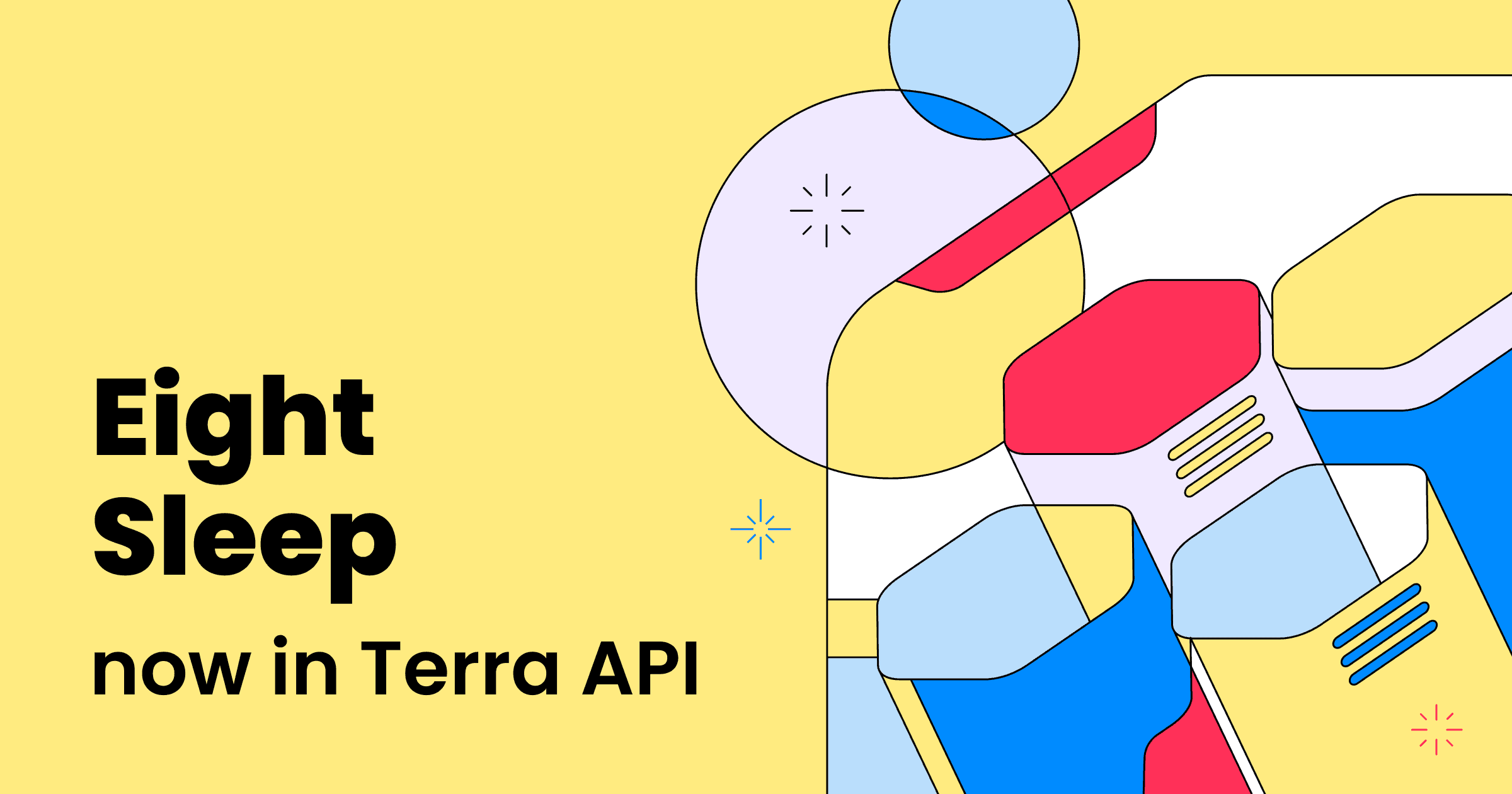
TL;DR: Your users can now securely connect their Eight Sleep data to your app through Terra API. Their sleep records arrive straight into your app, including sleep stages, heart rate, heart rate variability, respiratory rate, snoring and sleep efficiency data, with no new integration work on your side.
Eight Sleep members can now choose which apps receive their Eight Sleep sleep stages, heart rate, HRV, respiratory rate, snoring and sleep score, delivered through Terra API's sleep model. From today onwards, if your product is built on Terra API, your users can connect their Eight Sleep account. The Eight Sleep Pod measures from inside the bed, and that changes who you can measure and how often.
What the Eight Sleep integration means for developers
There is very little for you to do, which is what we were aiming for: Your user securely logs into their Eight Sleep account through Eight Sleep's own OAuth page, grants read access to their sleep data, and the connection is live. From then onwards, new nights are collected automatically and delivered to your webhook, database, or whichever destination you have configured.
The Pod's night arrives already standardised into Terra's sleep model, which means the fields you receive have the same names, units and timestamp handling as the rest of the sleep data your product works with. A dashboard, a training algorithm or a weekly report that already reads Terra sleep data will read an Eight Sleep night correctly the day you switch the integration on, with no schema changes and no parsing work.
Get the latest Terra Research reports and insights every week as soon as they're published.
Why sleep measured from the bed is worth building on
Any product that depends on overnight data eventually runs into the compliance problem, by which we mean user compliance rather than the regulatory kind. The measurement depends on somebody remembering to put a device on before bed, and that habit decays over the weeks and months that a health product actually needs to cover. Some people never take to sleeping with something on their wrist or finger in the first place. The ones who are happy to do it still have to take it off to charge it, and the nights that go missing tend not to be randomly distributed, because they cluster around travel, illness, late nights and stress, which are the nights you would most want to be looking at.
A bed that does the measuring takes that dependency out of the picture altogether. Nothing has to be remembered or charged, so the record tends to be a good deal more continuous over a long stretch of months than a worn device usually manages.
The opportunity we find more interesting, though, is a different one. Fortune reports that around 85% of Eight Sleep customers already own a wearable. That is a striking number, because it means the typical Pod owner is somebody who is already being measured during the day by something on their wrist, and is then measured again at night by the bed. Those two records describe the same person and the same twenty-four hours, and historically they have been held in two different apps with no relationship to one another. Through Terra you can hold both of them, which is what lets a recovery score, a readiness model or a coaching programme reason about the whole day rather than the portion a watch happened to be awake for.
Who Eight Sleep are
Eight Sleep was founded in 2014 by Matteo Franceschetti, Massimo Andreasi Bassi, Andrea Ballarini and Alexandra Zatarain, and the company describes itself as having pioneered what it calls sleep fitness, which is the idea that sleep is something you train and improve. Its stated mission, in the words of its chief executive, is to fuel human potential through optimal sleep.
The company has grown into one of the most successful hardware businesses in consumer health. It raised $100 million in August 2025, and followed that with a further $50 million in March 2026 at a $1.5 billion valuation. The Eight Sleep Pod now ships to more than 37 countries, and is trusted by professional athletes, business leaders and health-conscious consumers around the world. Their athlete roster runs from the NBA, NHL and MLB through to Formula 1, where they also partner with the Aston Martin Aramco team.
By the time of that 2025 raise, Eight Sleep had recorded more than one billion hours of sleep. They had also developed its staging model on a dataset of more than 5,700 people, each monitored with full polysomnography, which is the clinical overnight sleep study where technicians read brain-wave recordings to label each stage by hand. Measured against that benchmark the model classifies the correct stage about 78% of the time, which the company notes against a backdrop where trained human scorers reading the same recordings typically agree with each other between 80% and 90% of the time.
The hardware has kept pace with the data. The current generation, the Pod 6, launched in September 2026 with eighteen biometric sensors built into the Cover, up from two in the previous generation, and it measures each side of the bed independently.
Eight Sleep's co-founder and chief executive Matteo Franceschetti came on the Terra podcast to talk about building the company, which is worth an hour of your time if you want the background to all of this. You can listen to that episode here.
What sleep data you get from Eight Sleep through Terra API
Each completed sleep session, naps included, arrives as one Terra sleep record. Here is what it carries.
Data
What you get
Session timing
Start and end timestamps in the user's local time, time in bed, time asleep and time awake.
Sleep stages
Total durations for light, deep and REM sleep, plus a hypnogram, which is the minute-by-minute timeline showing which stage the sleeper was in as the night progressed.
Latencies
How long the user took to fall asleep after getting into bed, and how long they lay awake before getting up in the morning.
Sleep efficiency
The share of the time spent in bed that was actually spent asleep.
Nightly biometrics
Average heart rate, average heart rate variability (HRV, the variation in time between heartbeats, often read as a recovery signal) and average respiratory rate, attached to the night's main session.
Snoring
The number of snoring episodes recorded during the night and their total duration.
Sleep score
Eight Sleep's own 0 to 100 score for the night, delivered as the Terra sleep score.
How to connect Eight Sleep to your app
The connection is made with OAuth, which is the standard sign-in handoff where your user logs in and consents on Eight Sleep's own pages and never types their password into your product. It runs through the Eight Sleep API, by way of the partner relationship Terra maintains with them, and you can present it through the Terra widget or your own interface.
One detail worth knowing for shared beds: the Pod measures each side independently, and each sleeper has their own Eight Sleep account, so each person connects individually and your product receives each sleeper's nights under their own Terra user.
Historical data works the way it does everywhere else on Terra, which is to say that you request the date range you want and Terra handles the collection behind the scenes, including breaking a long range into the window sizes the source supports. A request covering two years goes out as a single call on your side.
There are some deliberate choices in how the integration handles edge cases, and they are worth knowing about. Sessions that Eight Sleep is still processing are held back until they are final, so the record you receive is the finalised one rather than a partial session you would have to reconcile afterwards. And when a sleeper gets out of bed partway through a session, the stage timeline can no longer be lined up minute by minute with the clock, so for those sessions Terra delivers the night's stage totals and leaves the hypnogram out, since a hypnogram with drifted timestamps would be worse than none.
Common questions about the Eight Sleep integration
Does the Eight Sleep integration include HRV?
Yes. Terra delivers an average heart rate variability value for the night, alongside average heart rate and average respiratory rate, attached to the night's main sleep session. These are nightly averages rather than a reading for every moment of the night, and they come with the main session rather than with naps.
Can both sleepers on a shared bed connect?
Yes, and each of them connects separately. The Pod tracks each side of the bed on its own, each sleeper has their own Eight Sleep account, and your product receives each sleeper's nights under their own Terra user.
Can you request historical Eight Sleep data?
Yes. Historical requests work the same way they do for the rest of Terra: you ask for the date range you want and Terra handles collecting it, including breaking a long range into the window sizes the source supports.
Getting started with Eight Sleep on Terra API
Eight Sleep is live now. If you already have a Terra integration, enable it from your dashboard and your users can start connecting today. If you are new to Terra, start with the Unified API overview, then turn Eight Sleep on once your environment is set up. We would genuinely love to see what you build on sleep data that comes from the bed itself, so tell us.