We use cookies to enhance your browsing experience and analyse our traffic. Nothing beyond essential cookies runs until you choose. You can change your mind any time in our Cookie Policy.
Last week a16z published The State of Longevity. They asked 500 Americans about their health, and about half of them wear a device. Three numbers jumped out at us:
83% check their wearable every day.
45% say their data made them change something or see a doctor.
Nearly 3 in 4 would add a second device if it measured something new.
Get the latest Terra Research reports and insights every week as soon as they're published.
We wanted to know, however, is this what people do, or what they remember doing? A survey can only ask. A wearable doesn't need to ask. It records every step and every night of sleep. So we went to the recorded data to see if the two match.
We weren't the first to wonder. A 2025 review of 23 trials found that trackers do get people moving, but the boost is biggest at the start and then fades. In one US health system, about 1 in 3 patients stopped using their wearable within a year. And a 2026 study of new owners in Korea found they said they were more active, which is still what people say, not what a sensor recorded. (Studies listed at the end.)
What we found
We looked at anonymised sleep and activity data from consenting people in US time zones who connected their wearables to health apps, January 2025 to October 2026.
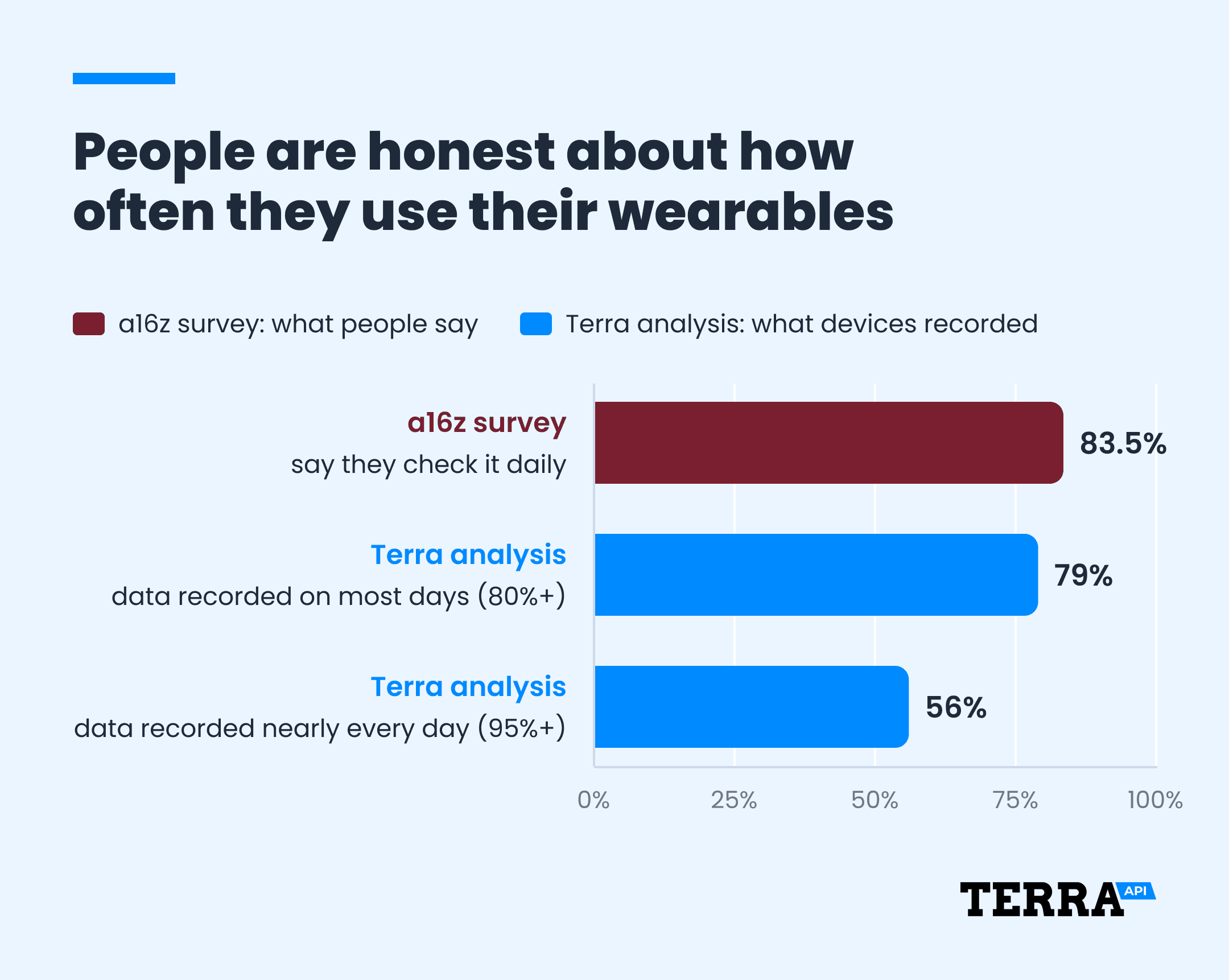
Daily use: said 83%, recorded 79%
This one holds up. 79% of new wearers had their device record data on most days (80% or more), and 56% on nearly every day. We counted any day with data, steps in the day or sleep at night, across 4,316 people with at least 12 weeks of data. The catch: a device recording isn't the same as someone opening the app. We can see wearing, not looking.
Share of wearable users who use their wearable daily. How to read: maroon = what people told a16z, blue = what we found in the recorded data. 83.5% say they check daily; 79% of devices recorded data on most days, and 56% on nearly every day. Sources: a16z, The State of Longevity (3 Nov 2026), ~270 US wearable users. Terra analysis of anonymised data from consenting wearers in US time zones, Jan 2025–Oct 2026.
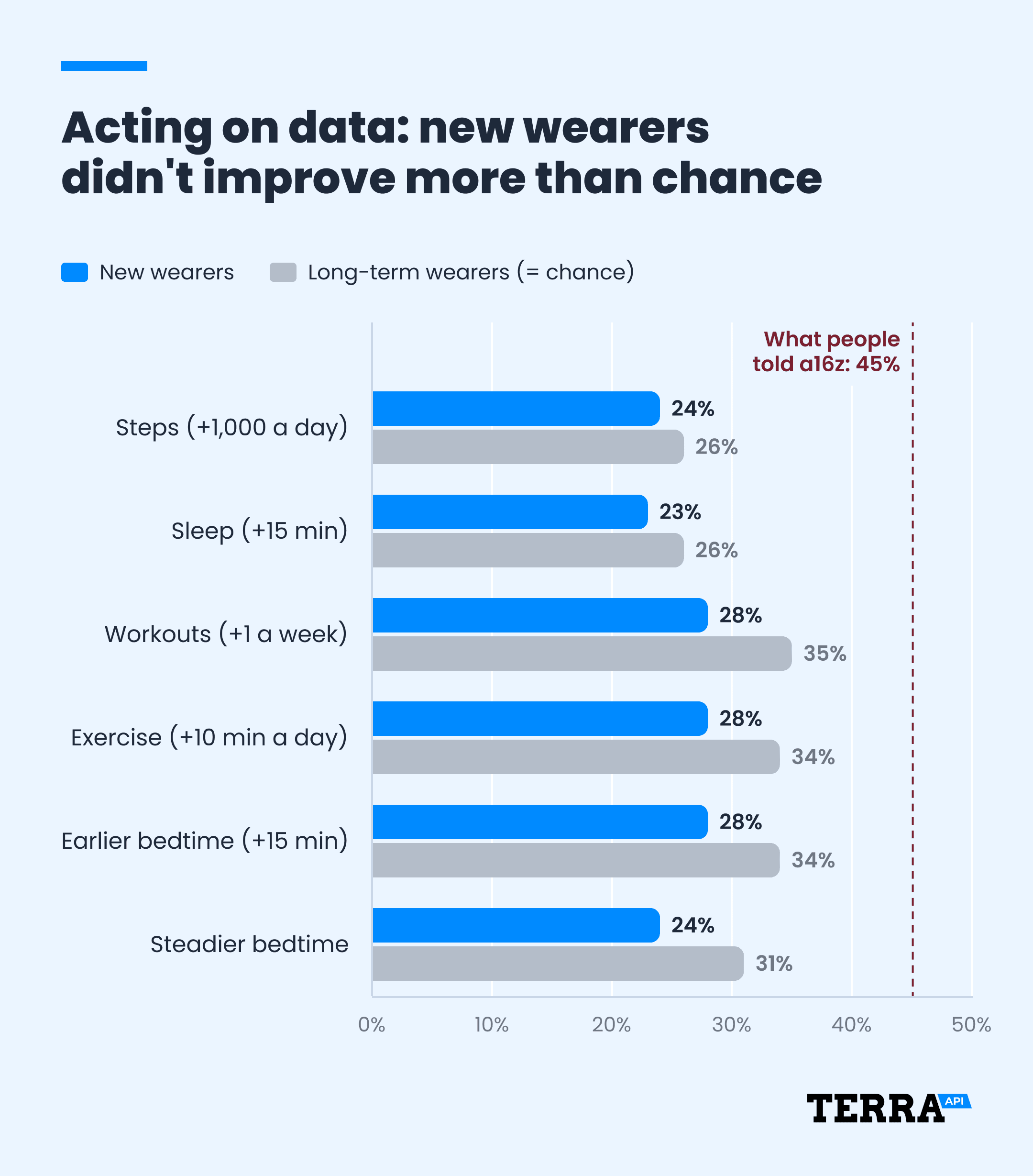
Acting on the data: said 45%, recorded no more than chance
This is the big gap. We checked six habits a wearable is meant to nudge: steps, sleep length, workouts, exercise minutes, bedtime, and how regular bedtime is. For about 7,500 new wearers, we compared their first month with months five and six. People's habits go up and down anyway, so we ran the same comparison on 513 long-term wearers over the same calendar weeks, which also cancels out seasons and holidays. For all six habits, new wearers were no more likely to improve than the long-term group. Workouts even fell: 49% recorded at least one fewer workout a week by month five, against 33% of the long-term group. People start strong, then drift back. Two caveats: we can't see life before the device, so a change made in month one that stuck wouldn't show; and the survey's 45% includes doctor visits, mindset and stress, which no sensor captures.
Share who improved each habit between month 1 and months 5–6. How to read: blue = new wearers; grey = long-term wearers over the same weeks, whose habits go up and down without a new device, which is what chance looks like. If wearing a device changed habits, blue would be longer than grey. It isn't, for any habit. Maroon dashed line = the 45% in a16z's survey who say their data changed what they do. Sources: a16z, The State of Longevity (3 Nov 2026). Terra analysis of anonymised data from consenting wearers in US time zones, Jan 2025–Oct 2026.
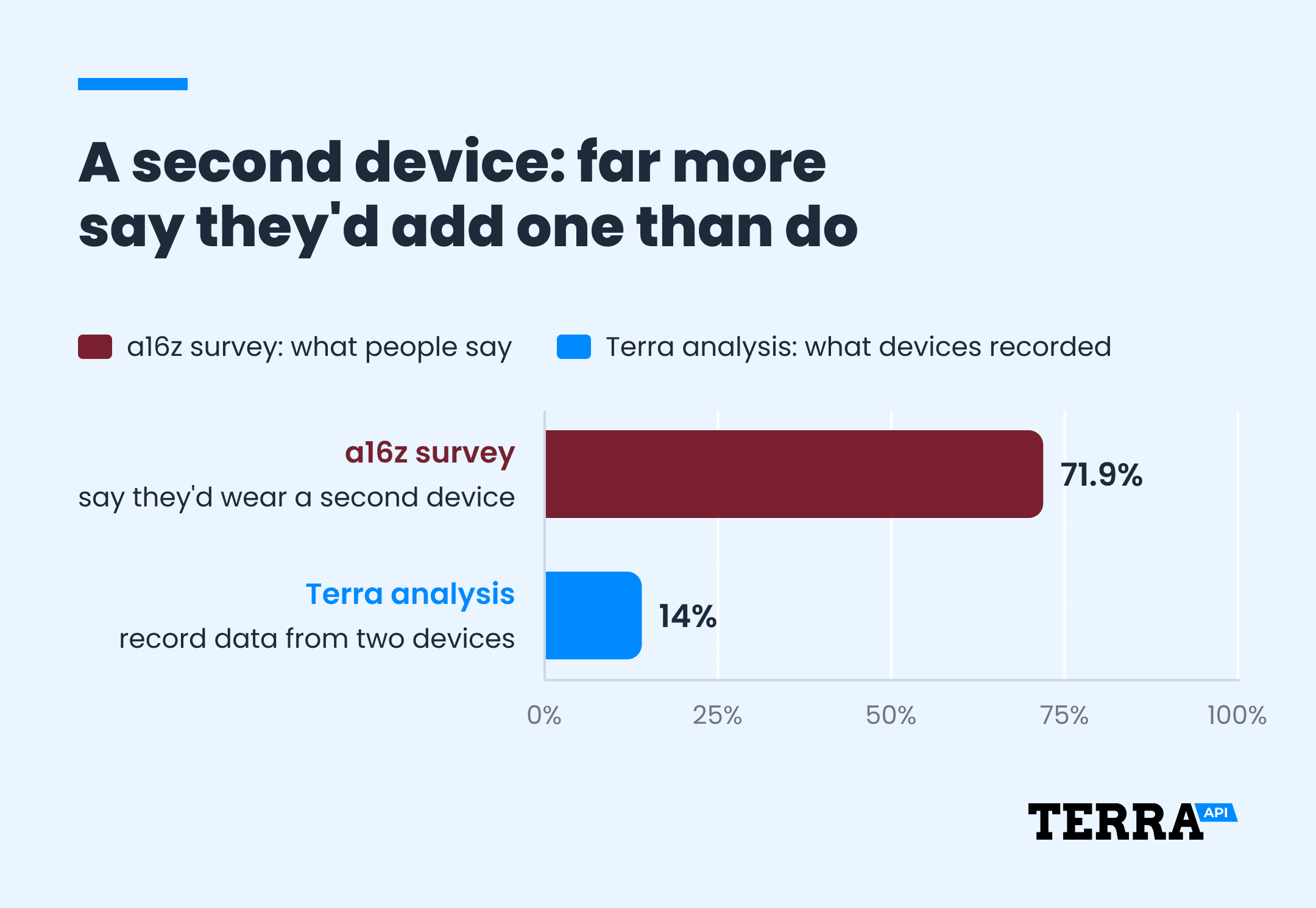
A second device: said 72%, recorded 14%
Intent outruns action. About 14% of the wearers we looked at record data from two devices, and most of them use both in the same month, so they add a device rather than swap. In most of these pairs, the extra device is one that adds sleep tracking. That's partly how we found them: sleep records are the only place we can spot a second device. What people actually use each device for, we can't know. So 14% is a floor, not a ceiling, and "would add one" may just mean "not yet".
Share of wearable users with a second device. How to read: maroon = what people told a16z, blue = what we found in the recorded data. 71.9% say they'd wear a second device; 14% actually record data from two. Sources: a16z, The State of Longevity (3 Nov 2026), ~270 US wearable users. Terra analysis of anonymised data from consenting wearers in US time zones, Jan 2025–Oct 2026.
What this can't tell you
Different people. a16z asked about 270 wearable users; we looked at thousands of others. We compare the two groups, not the same people.
US time zones, not the US. Records don't store a country, so our group also includes Canada, Mexico and parts of Latin America.
Only what sensors record. Doctor visits, diet, stress and mindset are invisible to us.
Not every device. Not all devices sold in the US were recorded for this analysis. The ideal study would cover the full range of devices people actually buy and wear.
What we want to know next
The question isn't whether people track. They do, nearly every day. It's what turns a number into a change that lasts past month one. Next, we want to look at whether people who get specific, personal guidance from their app change more than people who only see their data, and whether the holiday season moves the second-device number.
Our own work points the same way as a16z's. The wearables that win will bring every part of physiology into one place (sleep, activity, recovery, cycle) and turn it into clear next steps. Will that be one device that does it all, or several devices joined up by one app? We'll be here to find out.