We use cookies to enhance your browsing experience and analyse our traffic. By clicking “Accept All”, you consent to our use of cookies according to our Cookie Policy. You can change your mind any time by visiting out cookie policy.
Why do we remember some dreams and not others? We analyzed over 130,000 nights of sleep to find out what kind of nights, and days, make dream recall more likely.
Earlier bedtimes drive dreaming more than anything else — across every behavioral variable tested, going to bed earlier than a user's own baseline was the single strongest predictor of dream recall (p < 0.05, Cohen's d > 0.2). Longer sleep helped too, but the effect vanished once bedtime was controlled for.
Dreams follow our laziest days, not our hardest ones — rest time on the day before a dream was significantly higher than on non-dream days, with an effect size roughly five times larger than any other day-level factor. Dreaming clusters around stillness and low activity, not physical exertion.
Dream nights look like worse sleep, not better — recall nights had less deep sleep, more light sleep, and more time awake, while REM duration and total sleep time barely shifted. Dreaming appears to rearrange sleep architecture rather than improve it — and HRV stayed flat, so the lighter sleep didn't come at a recovery cost.
Dreaming has always been theorized to be a period of time where our brain processes difficult emotions, understands our subconscious feelings and consolidates knowledge[1]. Research around this topic has provided some evidence on improved mental performance and problem solving when we just “sleep on it” especially when dreaming about the task to be fulfilled, this is the famous 3D-maze experiment[2].
But enough theories on the cognitive aspect of dreaming, is there a physiological reason for dreaming?
In this study we analyzed over 130,000 nights of sleep, and looked for patterns in wearable data that suggest what kind of nights, and even what kind of days, make dream recall more likely. It is worth noting these are all self-reported dreaming events, meaning we are not analyzing whether individuals dreamt or not rather if they remembered when waking up.
Is dreaming a sign of good sleep?
While dreaming has studied benefits on cognition and mental performance, waking up with vivid memories of the dreams is not always a sign of good sleep or recovery, in fact the data tells us otherwise…
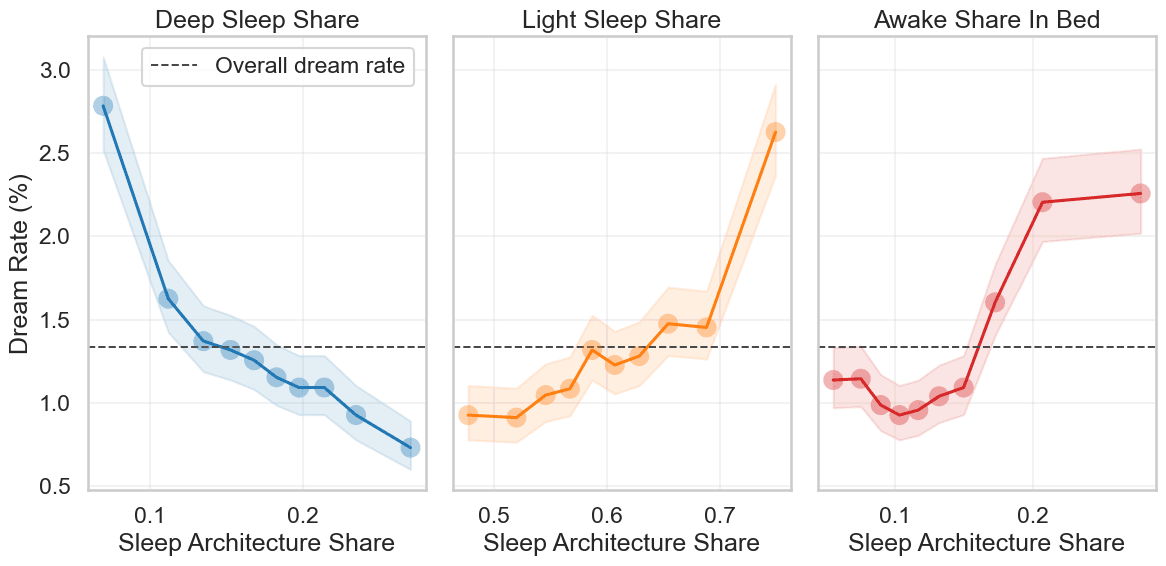
Nights where users were more likely to recall their dreams were actually nights with less deep sleep, more light sleep and more awake time. This findings aligns with the literature in that REM awakenings explain the higher dream recall frequency[3].
Surprisingly, there was no clean linear trend on REM time or total sleep duration. This suggests that dreaming might not affect total sleep phases time, but instead rearranges the sleep architecture[3].
Figure 1: Percentage of total sleep time that deep, light or awake phases occupied.
Motivated to understand if mental recovery comes at the cost of physical recovery, we also tested HRV (RMSSD) differences between nights were users recalled dreams and nights when they did not. Despite the lighter and more fragmented sleep, there was no evidence of a decrease or increase in HRV on dreaming nights.
Get the latest Terra Research reports and insights every week as soon as they're published.
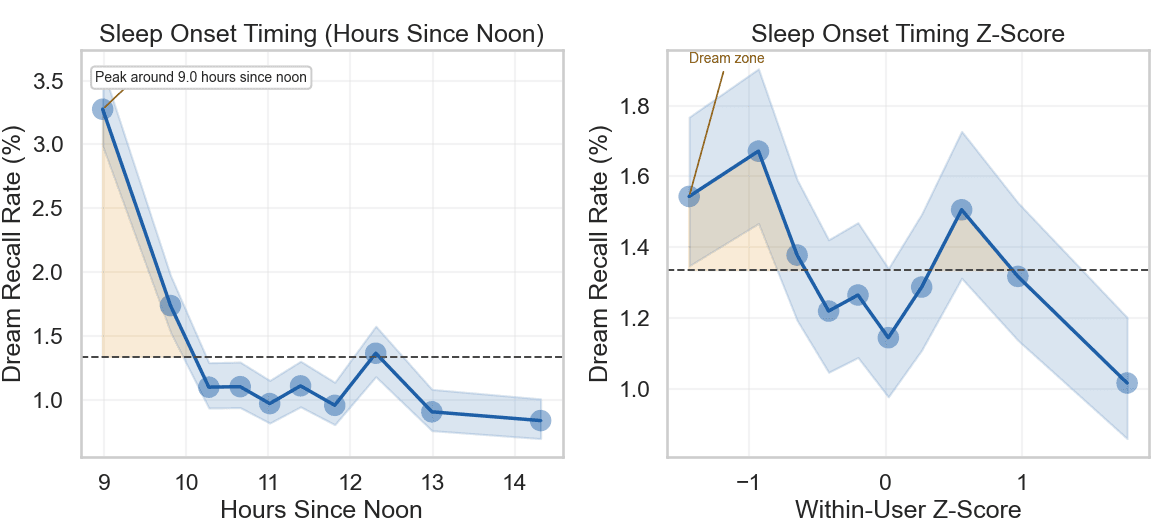
We analyzed which behaviors resulted in greater dreaming recall rates, and our results show something surprising. The strongest driving factor for increased dream recall was an earlier bed time, and an earlier than a user’s usual bed time.
Linear mixed effect models demonstrated these factors were statistically significant and meaningful (p < 0.05 and cohen d > 0.2). The models also showed that longer sleep duration also lead to greater dream recall, however when accounting for bed time the effects vanished. This is likely because earlier nights tend to become longer nights.
Figure 2: Sleep onset time, absolute (left) and relative to user baseline (right).
How much does our day determine if we dream
Again, dreaming helps process emotions and difficult psychological events so a natural deduction could be that dreams happen after our hardest days. Wearables are a great window into our physiology, but a bit less on our mental health.
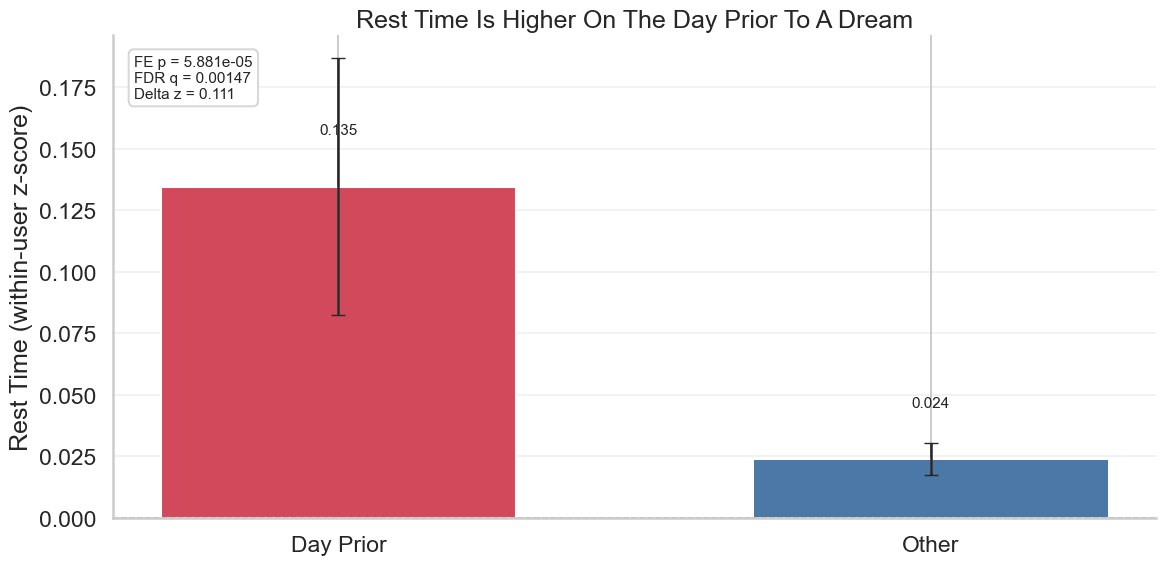
The nights were users recalled their dreams followed days where the rest time was significantly and statistically higher than usual. Now unlucky for us this can mean two very different things: an hard mental day with a lot of “low activity” or a day of rest, relaxation and mindfulness…
Figure 3: Bar plot of per user Z-score values for rest time on days preceding dreaming (red) and days not preceding the recall of dreams (blue).
References
George A. Christos (1996). Investigation of the Crick-Mitchison reverse-learning dream sleep hypothesis in a dynamical setting. Neural Networks: NN, 9(3), 427-434.https://doi.org/10.1016/0893-6080(95)00072-0.
Wamsley, E. J., Tucker, M., Payne, J. D., Benavides, J. A., & Stickgold, R. (2010). Dreaming of a learning task is associated with enhanced sleep-dependent memory consolidation. Current biology : CB, 20(9), 850–855. https://doi.org/10.1016/j.cub.2010.03.027
Ruby, P. et al. “Increased Awakenings From Non-rapid Eye Movement Sleep Explain Differences in Dream Recall Frequency in Healthy Individuals.” Frontiers in Human Neuroscience, 2019
Summary questions
Is remembering my dreams a sign I slept well?
No — it's actually the opposite. Across 130,000+ nights of wearable data, nights with higher dream recall had less deep sleep, more light sleep, and more awake time. Vivid dream memories typically reflect a more fragmented sleep architecture, not a more restorative one.
Does dreaming come at the cost of physical recovery?
It doesn't appear to. Despite lighter, more fragmented sleep on dream-recall nights, HRV (RMSSD) showed no statistically meaningful decrease or increase compared to non-dreaming nights. Mental processing during dreams doesn't seem to tax autonomic recovery.
How can I make myself dream more?
Go to bed earlier — especially earlier than your own typical bedtime. Linear mixed-effects models found earlier sleep onset was the strongest driver of dream recall (p < 0.05, Cohen's d > 0.2). Longer sleep duration also correlated with more dream recall, but that effect disappeared once bedtime was controlled for, since earlier nights are usually longer nights.
Does more REM sleep mean more dreams?
Not in this data. There was no clean linear relationship between REM time (or total sleep duration) and dream recall. The findings suggest dreaming rearranges sleep architecture — particularly through more NREM awakenings — rather than simply expanding REM, consistent with Ruby et al. (2019).
Do hard days make me dream more?
Maybe, but it's ambiguous. Days preceding dream-recall nights had significantly higher rest time than a user's baseline (per-user Z-scores). That could reflect either a mentally taxing low-activity day or a genuinely restful, mindful one — wearables can't yet distinguish between the two.
Why am I waking up remembering vivid dreams but feeling unrested?
Because dream recall is driven by awakenings, especially out of NREM sleep. The data shows recall-heavy nights contain more awake time and more light sleep at the expense of deep sleep. You're remembering dreams precisely because your sleep was more fragmented — the two go together.
Can wearable data really tell us what makes people dream?
Yes, at population scale. By analyzing over 130,000 self-reported dreaming events alongside sleep stage data, bedtime, duration, HRV, and prior-day activity, wearables surface physiological and behavioral signatures of dream-recall nights. The caveat is that this measures dream *recall*, not whether a dream occurred — but recall itself maps cleanly onto measurable sleep architecture.
What's the single most actionable thing I can do to dream more tonight?
Shift your bedtime earlier than usual. It was the only behavioral factor that was both statistically significant and produced a meaningful effect size (Cohen's d > 0.2) on dream recall. Forget chasing more REM — change when you go to bed.