We use cookies to enhance your browsing experience and analyse our traffic. Nothing beyond essential cookies runs until you choose. You can change your mind any time in our Cookie Policy.
What does a healthy night's sleep actually look like?
What 159,000 people's sleep reveals about the night linked to the lowest resting heart rate: about eight hours, a 10pm bedtime, and a regular schedule.
Sleep isn't one habit. It's three separate ones: duration, bedtime and regularity. Hold any one steady and the other two still shift both resting heart rate and daily steps.
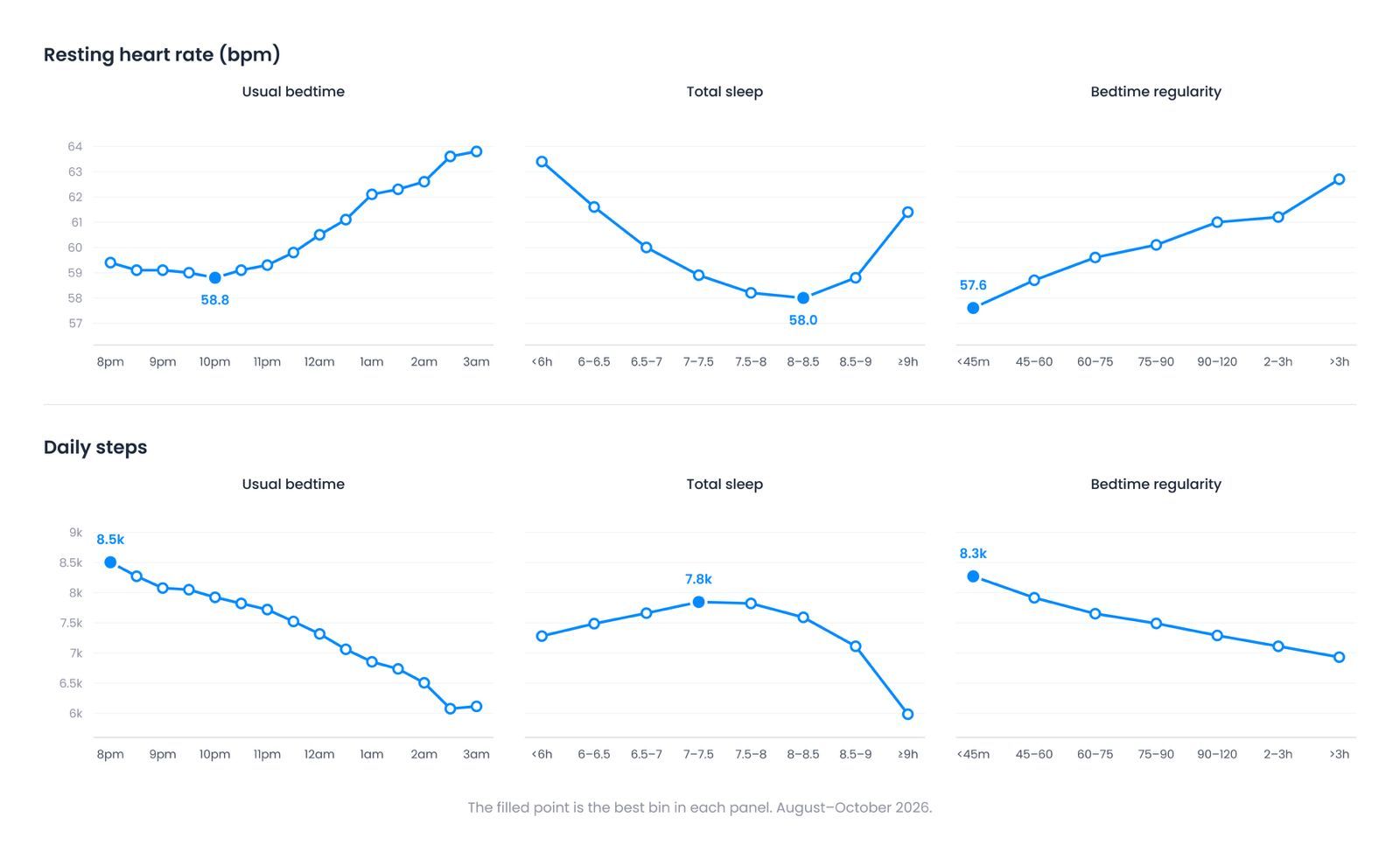
On duration and bedtime, the healthy patterns mostly agree. Resting heart rate is lowest at 8–8.5 hours (58.0 bpm) and a bedtime of about 10 pm. Raw daily steps peak a little earlier only because those people are awake longer; steps per waking hour peak at the same 8–8.5 hours.
Earlier bedtimes look better on both measures. You can't balance out a 2 am bedtime by sleeping eight hours.
Regularity is the cleanest of the three, and it keeps paying off down to a spread of about 30 minutes. You don't need a perfectly fixed bedtime to get almost all of the upside.
A career in triathlon is a constant trade-off. Which discipline do you optimise for? Do you focus on your weakest, or maximise your strongest? Should you react to the competition or be proactive? My solution was to keep all three in balance over time, carefully adjusting each as I went along, without focusing on one at the expense of another.
I worry that social media and plenty of other advice tell you that good health is one thing. It isn't. To an extent, we all know health is a trade-off. We could live a Bryan Johnson-esque monastic lifestyle, but what joys and experiences would we miss out on? Where we sit on this spectrum is probably something we all grapple with every day. But that's not quite the trade-off I'm interested in today.
I wanted to look at what a healthy night's sleep actually looks like, and whether duration, bedtime and regularity pull in the same direction. None of this proves causation; it's an association, and the variables are a bit of a mix of cause and effect.
I still think there is value in the picture. Healthy habits tend to form a virtuous cycle: good sleep makes it easier to be active, being active brings down resting HR, and both of these tend to feed back into better sleep. Looking at what those routines look like across about 159,000 people tells you something even when you can't untangle what caused what.
What I did
Like my last post, I wanted to look at healthy habits, not one unusual night. I took each person's median night and median day from about 159,000 people across August, September and October 2026. A person needed at least seven nights to go in, so one late Friday wouldn't swing the data too much. I left out naps, and anything under three hours or over fourteen.
Usual bedtime is that median start time, put in the half-hour slot it falls in. A 9 pm slot is medians from 9:00 up to 9:30. Total sleep is time asleep, not time in bed. Regularity is the standard deviation of their nightly bedtimes, in minutes. Someone whose nights sit at 9 pm, 10 pm and 11 pm has a spread of an hour.
Resting heart rate is the median of the daily resting value, on at least seven days. I use it here as a general marker, not a perfect proxy for health. Steps are the median daily count, and I display the average of those medians.
Get the latest Terra Research reports and insights every week as soon as they're published.
Duration and bedtime: mostly pointing the same way
Figure 1: The night that sits next to a lower heart rate, and next to more steps. Top row, resting heart rate. Bottom row, daily steps. The open circle is the “best” bin in that panel. Larger points are more people. August–October 2026.
Resting heart rate is lowest at eight to eight and a half hours, at 58.0 bpm, and at a bedtime of about 10 pm, around 58 bpm. Only slightly higher at 8 pm, and nearly 64 by 3 am.
Raw daily steps peak a bit earlier, at seven to seven and a half hours, about 7,850 steps. That is mostly because those people are awake for about an hour longer. To state the obvious, you can only take steps while you are awake, so I split each person's steps by the hours they are up: 24 minus time asleep. Steps per waking hour peak at the same eight to eight and a half hours, about 480 an hour.
Earlier bedtimes win on steps as well: about 8,500 at 8 pm, falling to about 6,100 at 3 am. Going to bed at 8 pm in this sample does not shorten the day, because those people tend to wake earlier too. The last post showed wake-up time shifting much less than bedtime, so a later bedtime usually means less sleep, not more.
Past nine hours, both the heart rate and the steps look worse. That is the classic J-curve. The right-hand rise is not evidence that too much sleep has negative consequences. It is quite probable that people who are slightly unwell, or less healthy, spend longer asleep, with the same poor health lifting the resting heart rate and cutting the steps.
It's the same problem that has plagued many large-scale health studies, especially alcohol. It can look as if drinking some is better for mortality than none. In fact, the statistics may reflect people who stopped because they were already ill and were then counted in the "none" group (Stockwell et al., 2016).
The National Sleep Foundation puts healthy adults at 7 to 9 hours (Hirshkowitz et al., 2015). The mortality research tends to look the same (Cappuccio et al., 2010). Short sleep and long sleep both track with higher risk, and the long arm is usually read as illness, not as a reason to sleep less.
Not one habit, three
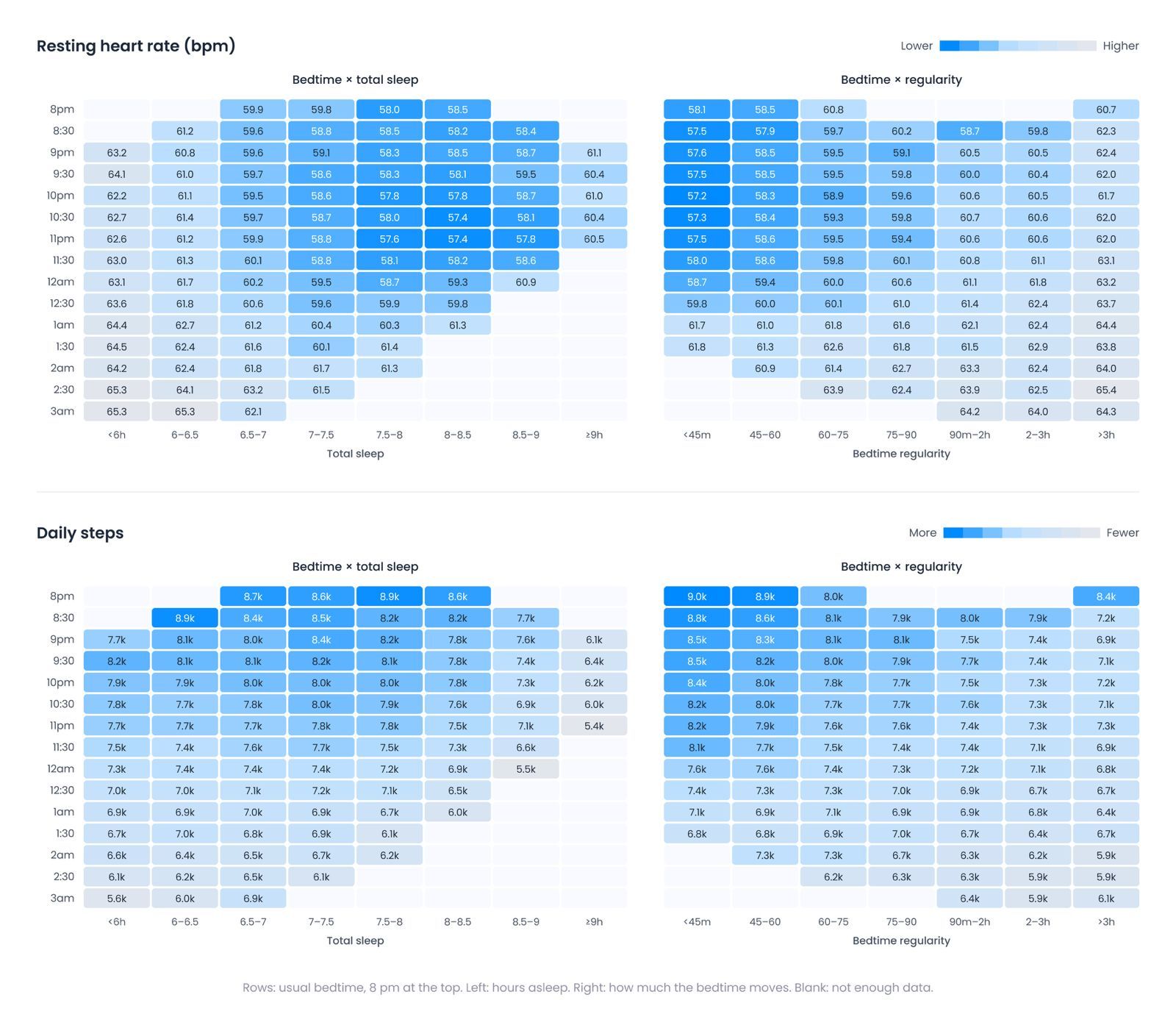
The worry is that I have counted the same person three times. Go to bed later and you also tend to sleep a bit less, and the bedtime moves around a bit more. If that was the whole story, any one of the three charts would do. The heat maps hold one still, so you can see whether the others are still there.
Figure 2: Bedtime against total sleep, and bedtime against regularity. Rows are the usual bedtime, 8 pm at the top. Across the top of the left pair, hours asleep. Across the top of the right pair, how much the bedtime moves. A blank cell has fewer than 100 people. Darker red is a higher resting heart rate. Darker blue is more steps.
Start on the left, with heart rate. The lower heart rates sit around 7.5 to 8.5 hours on almost every row, and the whole row gets worse once bedtime is past midnight. Eight hours at 10 pm and eight hours at 2 am are not the same. You can't cancel out a 2 am bedtime by sleeping eight hours, and an early bedtime does not make up for a very short night.
The steps map below it tells the same story: the most walking sits around 7 to 8 hours, in the earlier bedtimes, and fades when the night gets very long or bedtime gets later.
The right-hand pair has no best stripe down the middle. Heart rate gets worse as the bedtime wanders, and worse as it gets later. The busiest corner for steps is early and tight. An early bedtime that swings by three hours isn't the same as a steady one.
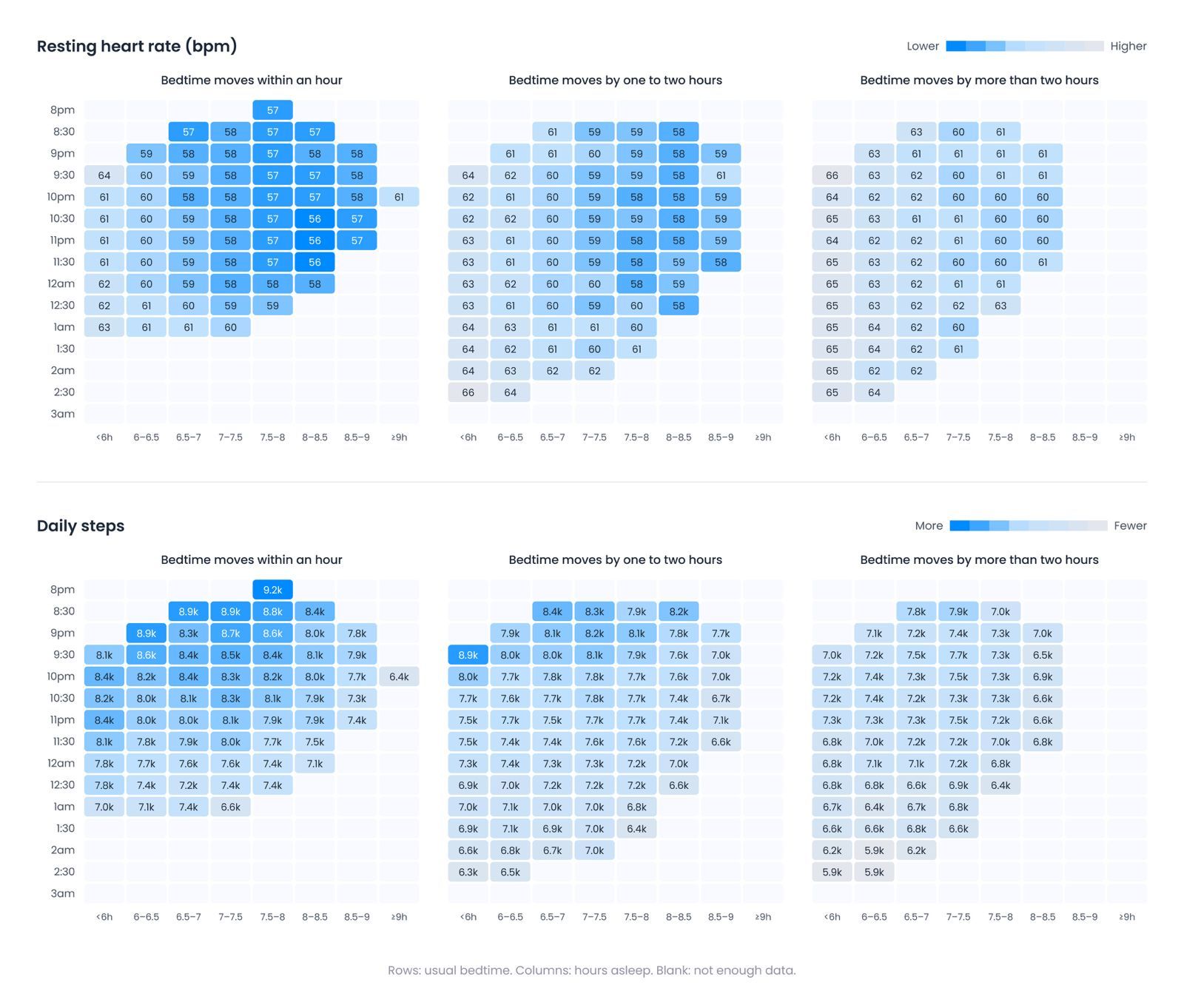
Figure 3: The same bedtime-by-sleep grid, split by how much the bedtime moves. Left, under one hour. Middle, one to two hours. Right, over two hours.
The valley in heart rate, and the hill in steps, are still there when you split the grid by regularity. Regularity does not create them. What it does is move the level of the whole grid. When the bedtime stays within an hour, heart rate sits lower and steps sit higher, at the same length of night. When it moves by more than two hours, the grid is warmer and the walking is thinner.
Regularity: the cleanest variable, and where good enough sits
Regularity is a straight line. More regular is better. I write that consistency is key in most of my blogs, but even I am surprised by how straight it actually is.
Sleep length and bedtime can both be too little and too much. Regularity is different. It is how many minutes the bedtime moves, and the smallest that number can be is zero, the same time every night. You cannot have a negative spread, so there is no point on the other side of zero where being even more regular starts to look worse.
Across the people in this sample, from about half an hour of spread out to about three hours, a wider spread just stays worse.
Moving from a spread of over three hours to under 45 minutes takes heart rate from 62.7 to 57.6 bpm, and steps from about 6,900 to about 8,300.
Bedtime spread
People
Resting heart rate
Steps
Under 15 min
231
56.7
9,506
15–20 min
601
57.4
8,517
20–25 min
1,438
57.1
8,517
25–30 min
3,166
57.1
8,534
30–35 min
5,329
57.3
8,366
35–40 min
7,722
57.7
8,213
40–45 min
10,164
58.1
8,094
45–60 min
36,918
58.7
7,915
Table 1. The tight end of bedtime regularity. Each row is how much that person's own bedtimes move.
From 45 minutes down to about 25, tighter still lines up with a lower heart rate and more steps. Between 15 and 30 minutes the two numbers level off, near 57 bpm and about 8,500 steps. The 231 people under 15 minutes look a bit better again. That group is too small to hang the conclusion on.
The gains flatten out once you're within about 30 minutes. That plateau might be a bit like the J-curve, or it might just be a small-sample effect at the very tight end. I also think it is a practical one. Most people in real life have some variation in their bedtime, and you don't need Bryan Johnson-level rigidity to get almost all of the upside.
What I'd take from it
None of this is a person changing tonight and watching these benefits appear tomorrow. The last post found that, for the same person, one late night barely moves the next morning. These are people who already live this way.
In my triathlon training, the answer was not to focus too much on one discipline. It was to keep all three in balance, and adjust whichever one had slipped. I would do the same here.
The wrong thing to do is to pick one night, or one number, and call it the protocol. Keep sleep around seven and a half to eight and a half hours, keep bedtime close to 10 pm, and as regular as possible.
FAQs
How much sleep is linked to the lowest resting heart rate?
Resting heart rate is lowest at eight to eight and a half hours, at 58.0 bpm.
Do people who sleep more walk more?
Not as a daily total. Daily steps peak at seven to seven and a half hours of sleep, about 7,850, mostly because those people are awake longer. Steps per waking hour peak at the same eight to eight and a half hours as the lowest heart rate, about 480 per hour. Past nine hours, the step count falls to about 6,000.
What is the best bedtime?
Heart rate is lowest at a 10 pm bedtime, at about 58 bpm, only slightly higher at 8 pm, and nearly 64 by 3 am. Steps are highest at 8 pm, at about 8,500, and fall to about 6,100 at 3 am.
How regular does bedtime need to be?
More regular looks better down to a spread of about half an hour. Moving from over three hours of spread to under 45 minutes takes heart rate from 62.7 to 57.6 bpm and steps from about 6,900 to about 8,300. Tighter than about 30 minutes, once the groups are large, there is no clear further gain.
How much sleep do I need?
There isn't one perfect night. The National Sleep Foundation puts healthy adults at 7 to 9 hours. In this data, heart rate and steps per waking hour look best at eight to eight and a half hours, with an earlier rather than later bedtime, and a regular window of about half an hour.
What's the ideal amount of sleep for a low resting heart rate?
Across roughly 159,000 people tracked August–October 2026, resting heart rate bottomed out at eight to eight and a half hours of sleep, sitting at 58.0 bpm. Shorter nights pushed it higher, and past nine hours it rose again — the classic J-curve, likely reflecting people who are unwell sleeping longer rather than long sleep itself being harmful. Aim for the 8-hour window, not more is better.
Does going to bed earlier actually mean I'll walk more the next day?
Yes. People with an 8 pm median bedtime averaged about 8,500 steps, falling to roughly 6,100 at a 3 am bedtime. Earlier sleepers aren't losing waking hours either — they tend to wake earlier too, so the day isn't shortened. A 10 pm bedtime also paired with the lowest resting heart rate at around 58 bpm.
Can I cancel out a late bedtime by sleeping a full eight hours?
No. The heat maps show eight hours at 10 pm and eight hours at 2 am are not equivalent — the entire row gets worse once bedtime pushes past midnight, regardless of total duration. Bedtime and duration contribute independently, so a long sleep starting at 2 am still tracks with a higher resting heart rate and fewer steps.
How regular does my bedtime actually need to be?
Regularity is the cleanest variable in the dataset — it's a straight line, with tighter always better down to about 30 minutes of spread. Moving from over three hours of bedtime variation to under 45 minutes dropped resting heart rate from 62.7 to 57.6 bpm and lifted steps from about 6,900 to 8,300. Below roughly 30 minutes of spread, the gains plateau around 57 bpm and 8,500 steps.
Do I need Bryan Johnson-level rigidity to get the benefits of regular sleep?
No. Once bedtime spread is within about 30 minutes, the heart rate and step benefits level off near 57 bpm and 8,500 steps — the 231 people under 15 minutes of spread looked marginally better but are too small a group to draw conclusions from. Most of the upside is available without extreme rigidity; a consistent half-hour window captures nearly all of it.
Why does sleeping more than nine hours look unhealthy in the data?
Past nine hours, resting heart rate rises and steps fall — but this is almost certainly reverse causation, not evidence long sleep is harmful. People who are unwell tend to sleep longer, and the same poor health lifts heart rate and cuts activity. It's the same confound that made moderate drinking look protective in mortality studies until former drinkers were removed from the abstainer group (Stockwell et al., 2016).
Does regularity override duration and bedtime, or do all three matter?
All three matter independently. When the grid is split by regularity, the valley in heart rate and the hill in steps around 8 hours and a 10 pm bedtime remain — regularity doesn't create them, it shifts the whole grid up or down. Bedtimes within an hour of spread pair with lower heart rate and higher steps at every duration, while swings over two hours warm up the whole map.
Will changing my sleep tonight show results tomorrow?
No — this data describes people who already live this way, not overnight changes. A previous analysis found one late night barely moved the next morning's numbers for the same person. The practical takeaway is to treat sleep like a balanced training program: aim for seven and a half to eight and a half hours, a bedtime near 10 pm, and a spread of about half an hour, adjusting whichever has slipped rather than optimising one at the expense of the others.




 Black Friday
 Save up to $499 and get your second month for free