We use cookies to enhance your browsing experience and analyse our traffic. Nothing beyond essential cookies runs until you choose. You can change your mind any time in our Cookie Policy.
What Time Do Morning Exercisers Go to Bed? Usually Before 10
We analyzed the routines of 192,000 people. In bed by 9pm, about one day in three has a morning workout; in bed at 2am, one in twenty, and the evening doesn’t close the gap.
People who are usually in bed before 10 pm are the most likely to exercise in the morning. About 3 in 10 of their days include a 6–10 am workout, falling to about 1 in 20 for people who usually go to bed at 2 am.
Late sleepers don’t make it up in the evening. A workout at any time of day falls from about half of days to about a third.
This is a lifestyle pattern, not a magic switch. For the same person, one late night barely moves the next morning.
A coach once told me that an hour in bed before midnight was twice as valuable for recovery as every hour after. Turns out he was directionally correct, but not entirely.
Sometimes in data science, the charts do the talking, and I think this is one of those times. So here is the story in three charts and a table.
Going to bed early will not make you exercise tomorrow morning. It is not a magic switch, and we know it’s not deterministic. If I decide to go to bed early tonight, there are still many reasons I might not exercise tomorrow, or at all.
This data story is best seen as part of a picture of what healthy habits look like, drawn from the routines of about 192,000 people tracked in August–October 2026. Unsurprisingly, people who are usually in bed before 10 pm are most likely to train at 7 and 8 am. For those with later bedtimes, the morning session becomes rare.
What did surprise me, is how clear this relationship is. And how strongly all this points to a simple fact. If you want a healthy lifestyle it probably starts with being in bed before 10.
The method
By usual bedtime I mean each person’s own typical bedtime. It is not a recommended bedtime, and it is not the time they went to bed last night.
I calculated their normal bedtime as the median sleep start time (the middle night after lining up the nights in order). One very late Friday does not pull them into a later group, which is what an average (mean) would do. This is because I wanted the research to be centred around a standard night in a person’s routine.
People whose median was after 6 am were left out, as were those with less than 7 days of data and naps. I then put that median into the half-hour slot it falls in.
I then played around with this data and experimented with ways to visualise it, which led me to heat maps. The colour gradient represents percentages, which are the average across the people in a slot, of each person’s own share of tracked nights. Fifteen percent means a night like that on about 15 of 100 nights. It is not 15 percent of the hour filled with exercise.
Get the latest Terra Research reports and insights every week as soon as they're published.
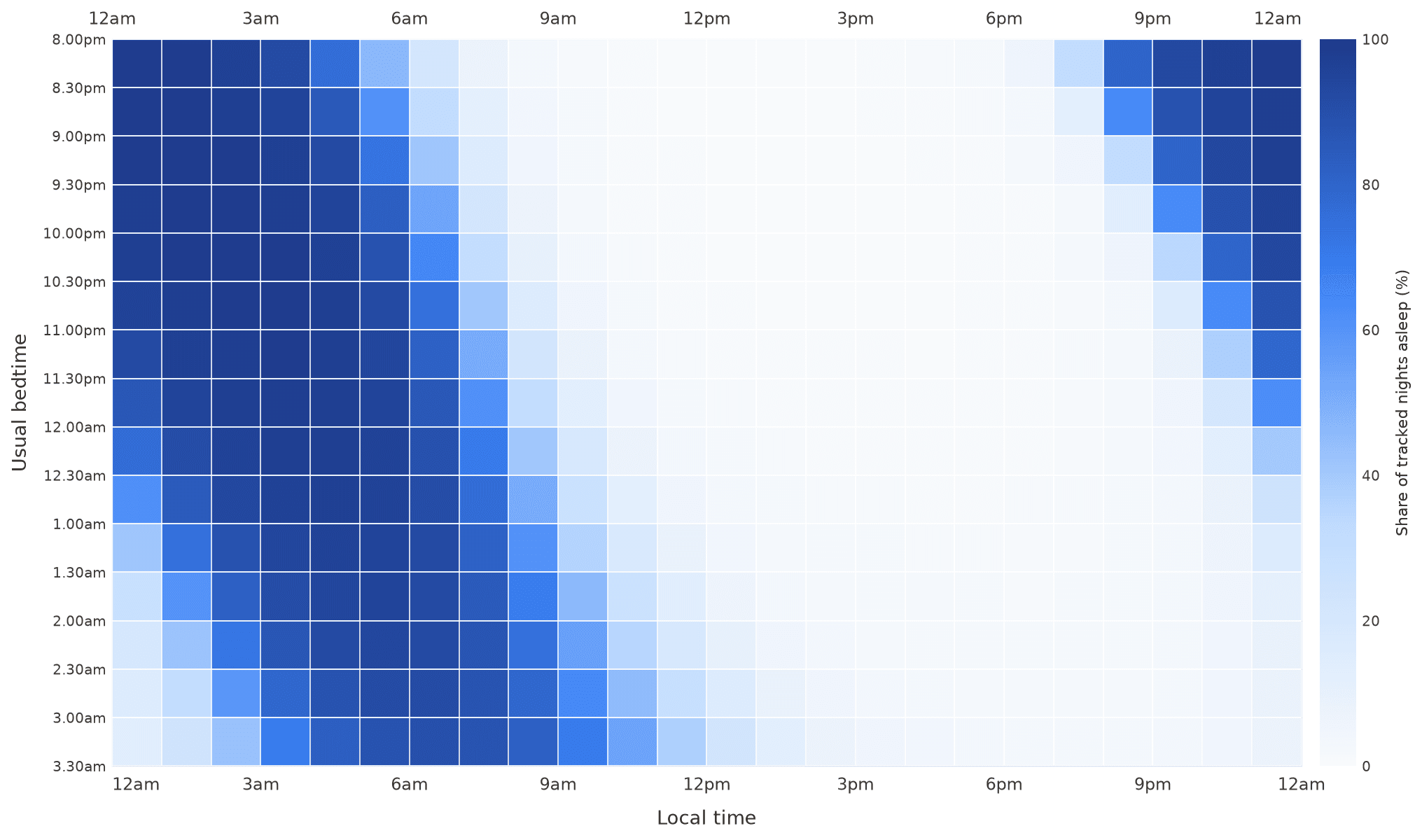
Figure 1 shows when each group is asleep. Each row is a bedtime slot, each column is an hour of the day, and dark blue means almost everyone in that box was asleep.
Figure 1. Sleep slides later as the usual bedtime does. A bedtime label is the line beside the box, and the box is the half hour between that line and the next. The clock labels along the top and the bottom are the edges of each hour.
Read it from the top. People in the 9 pm slot tend to be up before 6 am. Move down the chart, and the sleep band slides to the right. The 1 am slot wakes around 8.30 am and sleeps about six and a half hours. Wake-up time moves much less than sleep time, which means shorter sleeps for people who go to bed late.
What happens to activity
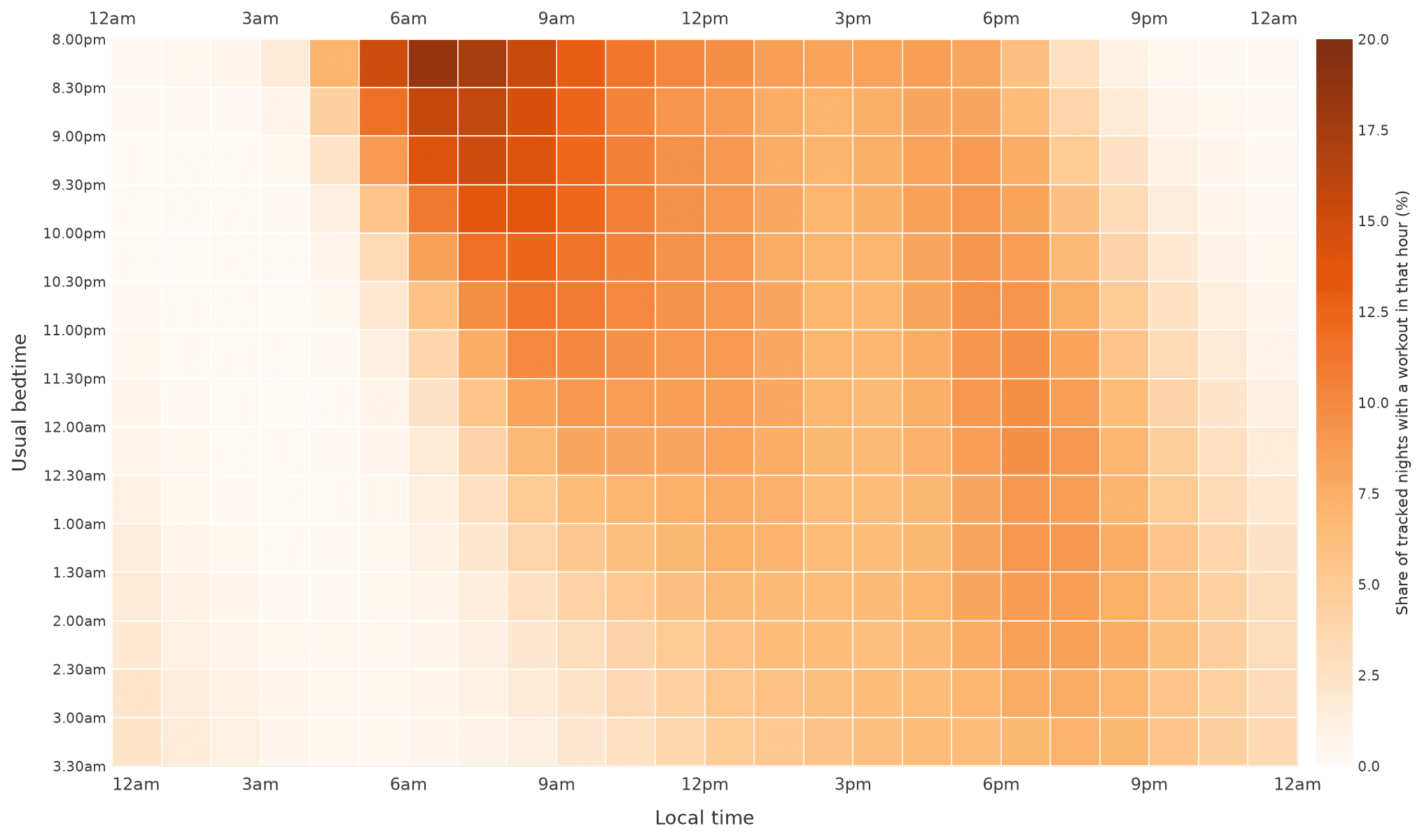
Figure 2 uses the same grid with a different question. Was there a recorded workout touching that hour?
A workout here is an activity with a start and an end, lasting from ten minutes to six hours. It counts in an hour if any part of it touches that hour. A run from 7.10 to 7.40 marks the 7.00 column. A longer one can mark two columns.
I used this method, because it shows both when the workout starts and also activity length.
Figure 2. Morning workouts fade as bedtime gets later. Same lines and boxes as Figure 1. Colour is the share of tracked nights with a recorded workout touching that hour. August–October 2026.
In the early rows, for the early sleepers, the darkest cells sit at 6, 7 and 8 am. In the 8 pm slot that morning peak is about 18 percent of nights. As we follow the same columns down the colour lightens and then disappears!
The most interesting finding here is that the increased evening activity (of late sleepers) does not make up for the lack of morning activity. Between 5 and 9 pm, the share of nights with a workout moves from about 15 percent in the 9 pm sleepers slot to about 19 percent in the midnight sleepers slot, and then it stops climbing. Any workout at all, at any hour, falls from about 49 per cent of nights to about 34 percent. People who go to bed later are not swapping a morning session for an evening one. They do a bit less, and when they do it it’s later.
Why the line is before 10
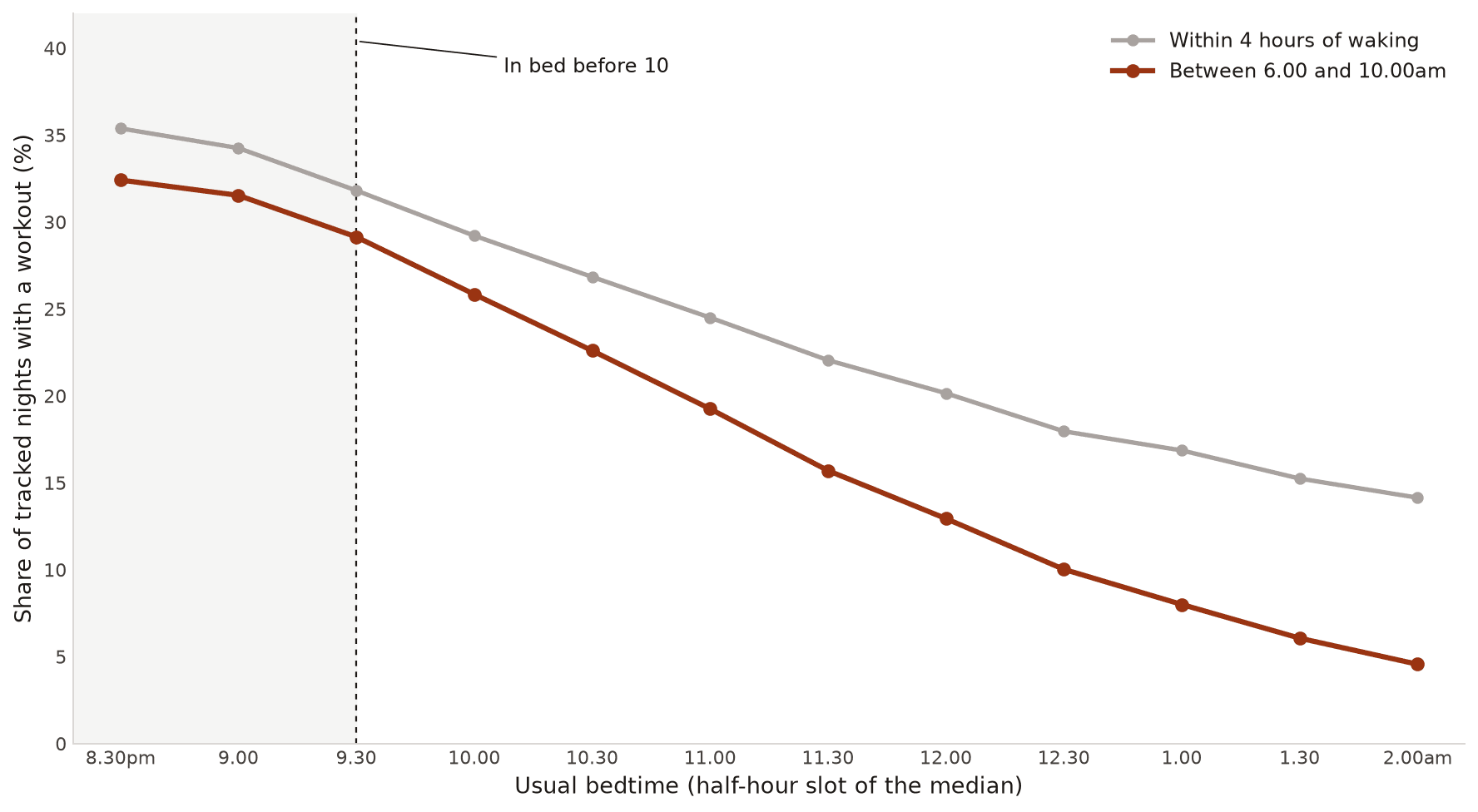
Figure 3. Morning exercise stays common if you are in bed before 10. The brown line is for morning workouts (6–10am). The grey line is a workout starting within four hours of waking.
The 9 pm sleepers slot holds about 32 per cent of nights with a workout in the 6–10 am window. Once the median falls in the 10 pm slot, the share is about 26 per cent, and from there the line is fairly straight: 19 per cent for 11 pm sleepers down to about 5 per cent for the 2.00 am sleepers. From the 9.30 pm sleepers slot to the midnight sleepers slot, that is about six and a half percentage points for each hour the median falls later. Across everyone, the fitted slope is about 5.6 percentage points per hour. So it turns out that midnight is not the magic number, it’s more like 10pm.
The grey line is a kind of control, because maybe someone can sleep well until 10 am and still exercise after waking. Someone still in bed at 8 am is clearly not training at 7 am. So the grey line asks the same question: how likely is it that someone went to bed at that time and worked out within 4 hours of waking up? The line turns in the same place, then falls more slowly: 34 per cent of nights in the 9 pm sleepers slot, 20 per cent for the midnight sleepers, 14 per cent in the 2 am sleepers. Later bedtimes come with less exercise even after the person is awake.
Usual bedtime
Workout 6.00–10.00am
Within 4 hours of waking
Any workout that day
9.00pm
31.5%
34.3%
49.2%
10.00pm
25.8%
29.2%
46.1%
11.00pm
19.3%
24.5%
43.0%
Midnight
12.9%
20.2%
39.2%
1.00am
8.0%
16.9%
36.3%
2.00am
4.6%
14.1%
33.7%
Table 1. Share of tracked nights with a workout, by usual bedtime. Each row is the half-hour slot that starts at that time. The columns are each person’s average across August, September, and October, not the morning after one night.
There is a clear practical problem here. Figure 1 shows that 1 am and 2 am sleepers mostly wake up before 9 am, and remember this is a median figure. So we can presume there is probably time pressure to get to work, or do something, which practically makes exercise harder. For me, this points to the original point of the research: what do healthy lifestyle habits look like in the data; those that prioritise healthy behaviours.
Summary questions
What time do morning exercisers actually go to bed?
Before 10 pm, consistently. Across roughly 192,000 people tracked August–October 2026, those whose median bedtime fell in the 9 pm slot recorded a morning workout (6–10 am) on 31.5% of nights, compared to just 12.9% for midnight sleepers and 4.6% for 2 am sleepers. The cutoff isn't midnight — it's 10 pm.
What time do morning exercisers actually go to bed?
Usually before 10 pm. Across about 192,000 people tracked from August to October 2026, those whose median bedtime fell in the 9 pm slot logged a morning workout (6–10 am) on 31.5% of nights, dropping to 25.8% for 10 pm sleepers and just 12.9% for midnight sleepers. The 10 pm threshold — not midnight — is where morning training starts to disappear.
Does going to bed late just shift my workout to the evening instead?
No, and this was the most surprising finding. Evening workouts (5–9 pm) only rise from about 15% of nights for 9 pm sleepers to about 19% for midnight sleepers, then plateau. Meanwhile, any workout at all drops from 49.2% of nights for 9 pm sleepers to 33.7% for 2 am sleepers — late sleepers aren't swapping sessions, they're simply doing less.
Do night owls make up for skipped morning workouts with evening sessions?
No. Evening workouts (5–9 pm) only rise from about 15% of nights for 9 pm sleepers to about 19% for midnight sleepers, then plateau. Meanwhile, the share of nights with any workout at all falls from 49.2% for 9 pm sleepers to 33.7% for 2 am sleepers. Late bedtimes mean less total exercise, not shifted exercise.
How much does each hour of later bedtime cost me in morning training?
About 5.6 percentage points per hour across the full dataset, and roughly 6.5 points per hour between the 9:30 pm and midnight slots. So moving your typical bedtime from 10 pm to 11 pm cuts your odds of a morning workout from about 26% of nights to 19%. The decline is steep and nearly linear.
How much does each hour of later bedtime cost me in morning workouts?
About 5.6 percentage points per hour across the full population, and roughly 6.5 points per hour between the 9:30 pm and midnight slots. So a person who normally goes to bed at 11 pm logs morning workouts on about 19.3% of nights, versus 31.5% for the 9 pm crowd — nearly a 40% relative drop for two hours of later bedtime.
Can't I just sleep in later and still exercise after waking?
Only partially. The "within 4 hours of waking" rate also declines with later bedtimes — from 34.3% of nights for 9 pm sleepers to 20.2% for midnight sleepers and 14.1% for 2 am sleepers. Later bedtimes come with less exercise even after you're awake, so sleeping in doesn't rescue the training.
Is it just that late sleepers wake up too late to train in the morning?
Partly, but not entirely. Even when you ask about workouts within four hours of waking — controlling for wake time — the pattern holds: 34.3% of nights for 9 pm sleepers, 20.2% for midnight sleepers, and 14.1% for 2 am sleepers. Later bedtimes come with less exercise even after the person is up and awake.
Why am I not getting more sleep even though I go to bed late?
Because wake-up time barely moves. The data shows sleep start time slides later hour by hour, but wake-up time shifts far less — 1 am sleepers are typically up by around 8:30 am, getting only about 6.5 hours. Life obligations anchor the morning, so late bedtimes mostly just subtract from total sleep.
Why am I not exercising in the morning even though I want to?
The data suggests your usual bedtime is the strongest signal. People with a median bedtime after 1 am mostly still wake before 9 am, leaving a compressed morning with real time pressure to get to work. Going to bed before 10 pm isn't a magic switch, but it's the bedtime slot where morning training remains a normal, repeated habit rather than a rare event.
Why use median bedtime instead of last night's bedtime?
Because the research is about habitual routines, not one-off nights. Using the median (middle value across lined-up nights) prevents a single late Friday from shifting someone into a later group, which a mean would do. People needed at least 7 days of data, naps were excluded, and medians after 6 am were dropped — the goal was each person's standard night.
How was "usual bedtime" calculated — is this just last night's sleep?
No. Each person's usual bedtime is their median sleep start time across the tracked period, placed into a half-hour slot. Using the median instead of the mean means one very late Friday doesn't shift someone into a later group. People with fewer than 7 nights of data, naps only, or medians after 6 am were excluded.
Does going to bed early guarantee I'll train in the morning?
No — it's not a magic switch, and it's not deterministic. Even in the earliest bedtime group, morning workouts happen on roughly 18–32% of nights, not every night. The point is that early bedtime is a reliable marker of healthy-habit clustering, not a single lever that produces tomorrow's workout.
Do late sleepers at least get more sleep by sleeping in?
No — they get less. Wake-up time moves much less than bedtime as you go down the chart, so late bedtimes compress total sleep. People in the 1 am slot wake around 8:30 am and sleep only about six and a half hours, substantially less than early-to-bed groups.
What does a healthy lifestyle actually look like in wearable data?
It clusters around an early bedtime. People with a usual bedtime before 10 pm log the most morning workouts, the most total workouts (49.2% of nights for 9 pm sleepers vs 33.7% for 2 am sleepers), and get longer sleep. If you're looking for the single behavioural anchor the data points to, it's being in bed before 10.
Can wearable data really show what a healthy lifestyle looks like?
Yes, and the signal here is unusually clean. With roughly 192,000 people and each person contributing their own multi-night median, the heat maps show an almost monotonic relationship between earlier bedtime and more exercise — both in the morning and across the full day. The practical takeaway: healthy routines cluster around being in bed before 10 pm, not around any specific workout time.