We use cookies to enhance your browsing experience and analyse our traffic. By clicking “Accept All”, you consent to our use of cookies according to our Cookie Policy. You can change your mind any time by visiting out cookie policy.
Photoperiod, not season, governs sleep duration. Each extra hour of daylight cost roughly 4.4 minutes of sleep; season labels added almost nothing once daylight was modeled.
Sensitivity to daylight does not scale with latitude. Equatorial and high-latitude populations responded to daylight in nearly equal measure.
Country and individual differences dominate. These explained more variance than any seasonal effect, implicating culture and behavior over geography.
Get the latest Terra Research reports and insights every week as soon as they're published.
Terra's research team has published a paper in npj Biological Timing and Sleep, a Nature Portfolio journal. The study, "Variation in sleep duration across latitudes and countries: a Bayesian hierarchical analysis of wearable data," looked at how sleep changes with daylight, latitude, season, and country across 697 people, 185,143 nights, and 49 countries.
The headline result: people sleep slightly less as days get longer, losing roughly 4.4 minutes of sleep for every extra hour of daylight.
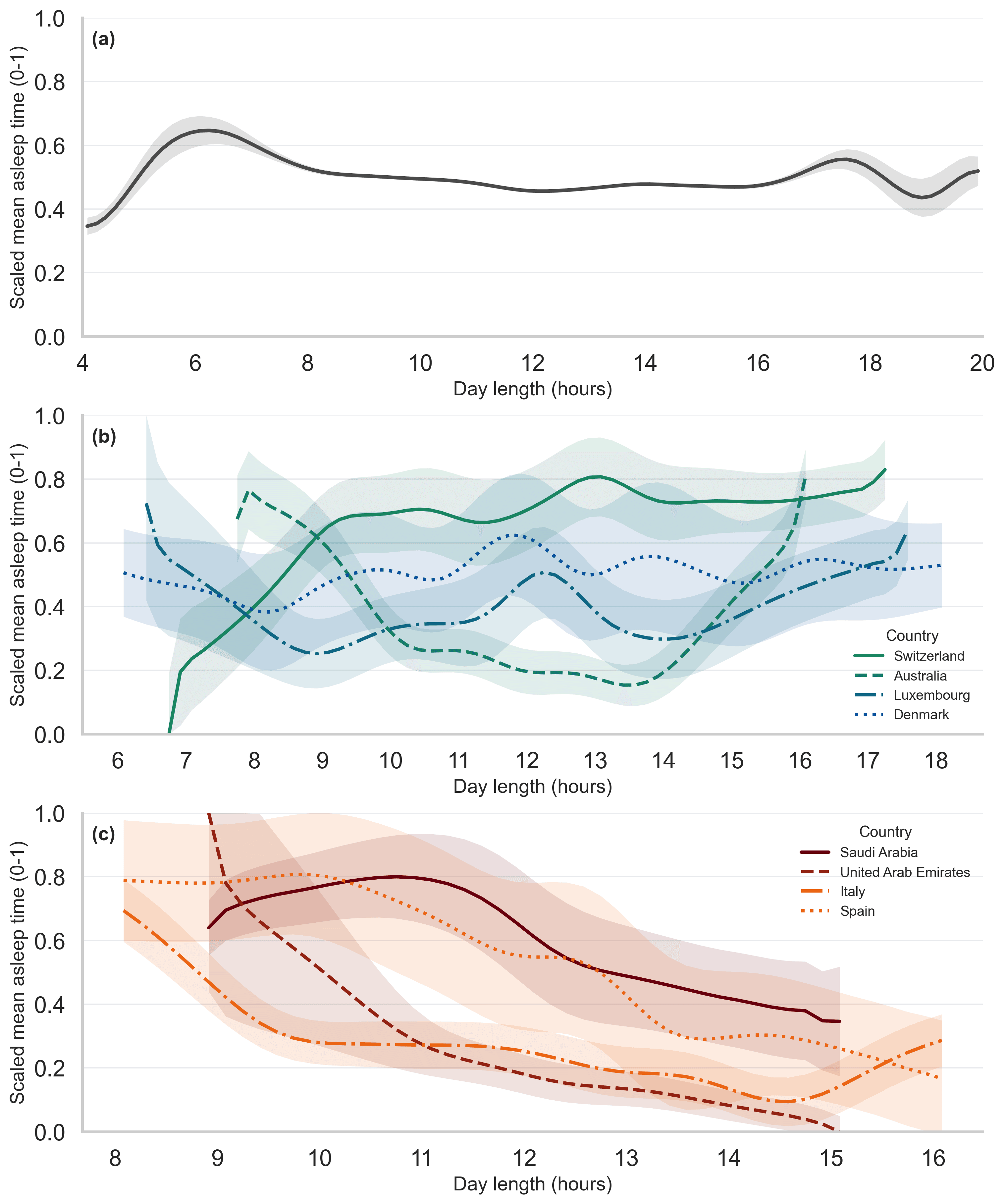
(a) The effect of day length on sleep time across the entire dataset. The absence of a clear trend here is expected, given the deeply hierarchical structure of the data. Estimated trends emerge once countries with significant offsets are examined individually. (b) Countries with positive b_k values, where trends begin to appear. (c) Countries whose country-specific offset runs in the same direction as the global trend, that is, a negative b_k value, where the trends are clearer still. In both (b) and (c), countries are listed in the legend in order of effect size.
The clearest signal in the data is light. As days got longer, people slept less, about 4.4 minutes for every extra hour of daylight. It is a small effect, but it held across the whole global sample. Once we accounted for daylight directly, the usual season labels stopped mattering. "Winter" and "summer" added almost nothing on their own. They were mostly standing in for how much light people were getting.
The bigger surprise was what we did not find. You would expect people near the Arctic Circle, who go from near-endless summer days to long dark winters, to react far more sharply to changing daylight than people near the equator. They did not. The response to daylight stayed almost flat across latitudes. Whatever is driving it looks like a shared human trait, not something that ramps up the further north you live.
What set people apart was where they lived and who they were. Differences between countries and between individuals explained more of the variation in sleep than any season effect. That points at culture, routine, and personal habit doing more work than geography alone.
Cite this article: Akhtar, F., Brownlee, A. & Crawford, C. Variation in sleep duration across latitudes and countries: a Bayesian hierarchical analysis of wearable data. npj Biol Timing Sleep3, 27 (2026). https://doi.org/10.1038/s44323-026-00092-2
Summary questions
Do longer days actually make me sleep less?
Yes, but only slightly. Across 697 people and 185,143 nights spanning 49 countries, sleep duration dropped by roughly 4.4 minutes for every additional hour of daylight. It's a small but consistent effect that held across the entire global sample.
Does the season I'm in affect my sleep, or is it really just about daylight?
It's the daylight. Once the model accounted directly for day length, season labels like 'winter' and 'summer' added almost nothing on their own. They were essentially proxies for how much light people were actually getting.
Do people near the Arctic Circle react more strongly to changing daylight than people near the equator?
Surprisingly, no. Despite enormous swings between near-endless summer days and dark winters at high latitudes, the response to daylight stayed almost flat across latitudes. Whatever drives the daylight-sleep link appears to be a shared human trait rather than something that intensifies with distance from the equator.
What explains more of my sleep variation — geography or personal habits?
Personal habits and country of residence dominated. Differences between countries and between individuals accounted for more variation in sleep than any season or daylight effect in the 49-country dataset. Culture, routine, and individual lifestyle do more work than latitude or season.
How robust is this finding given that people sleep so differently?
The study used a Bayesian hierarchical model on 185,143 nights from 697 people across 49 countries, which is specifically designed to separate global trends from country- and individual-level noise. Raw plots show no trend because of this deep hierarchy, but country-specific effects emerge clearly once the structure is modeled. The 4.4-minute-per-hour daylight effect survives this rigorous decomposition.
Can wearable data really detect something as subtle as a 4-minute sleep change?
Yes, at scale. With 185,143 nights of passively collected wearable data, the statistical power is high enough to resolve effects of just a few minutes per hour of daylight. Lab studies couldn't realistically capture year-round, cross-latitude sleep behavior at this resolution — wearables make population-scale chronobiology research tractable.
Should I worry about losing sleep in summer?
Probably not. A 4.4-minute reduction per extra hour of daylight is real but minor — even a 6-hour swing between winter and midsummer translates to under half an hour of lost sleep. Your routine, country, and personal habits matter far more for your sleep than the season does.
Where was this research published and who conducted it?
The paper, 'Variation in sleep duration across latitudes and countries: a Bayesian hierarchical analysis of wearable data,' was published June 22, 2026 in npj Biological Timing and Sleep, a Nature Portfolio journal. It was authored by Faraaz Akhtar, Alistair Brownlee, and Cameron Crawford, and is available at https://doi.org/10.1038/s44323-026-00092-2.