We use cookies to enhance your browsing experience and analyse our traffic. By clicking “Accept All”, you consent to our use of cookies according to our Cookie Policy. You can change your mind any time by visiting out cookie policy.
Why Mondays Might Be Your Healthiest Day: What 1,000+ Sleepers Taught Us About Recovery
At Terra, we recently ran an analysis on wearable data from over a thousand users, focusing on two key metrics: sleep duration and heart rate variability (HRV). We sought to gain insight into trends in recovery, stress, and overall well-being. What we found surprised us.
Mondays are biologically strong – despite being unpopular, Mondays consistently showed the highest average HRV across more than 1,000 users, suggesting that weekend rest doesn’t immediately register but instead boosts recovery early in the week.
Consistency beats quantity – people who slept longer and more consistently had significantly higher HRV, while those with short, variable sleep patterns had the lowest. Stability in sleep seems to matter as much as overall duration.
Weekends bring variability, not always recovery – while people slept the most on weekends, HRV often hit its lowest values on Saturday and Sunday, reflecting the accumulated strain of the week and the mixed effects of late nights, socialising, or lie-ins.
Why Mondays Might Be Your Healthiest Day: What 1,000+ Sleepers Taught Us About Recovery
There’s something strange that happens on Mondays. If you are anything like me, you probably don’t hate them but they are definitely not your most loved day of the week. But biologically? The data tells a different story.
At Terra, we recently ran an analysis on wearable data from over a thousand users, focusing on two key metrics: sleep duration and heart rate variability (HRV). We sought to gain insight into trends in recovery, stress, and overall well-being. What we found surprised us.
Get the latest Terra Research reports and insights every week as soon as they're published.
Across the entire dataset, the average sleep duration was 7.06 hours, with a standard deviation of 1.19 hours. The mean overnight HRV was 44.19 milliseconds, with a large standard deviation of 26.81 ms.
That spread tells us something important: people vary wildly, both in how long they sleep and how their autonomic nervous system behaves. We must note that this data is based on a 28-day sample of over 1,000 users, which provides insights into a population of wearable users rather than individuals.
Weekly Rhythms: The Hidden Patterns of Recovery
I was interested to see how the population trends would present when we looked at the data by day of the week. We include HRV delta here to demonstrate the change in the state of the nervous system between today and yesterday. More on this later, but if the world were simple; a good nights sleep would be accompanied by an improvement in HRV from yesterday.
Day
Avg Sleep (h)
Avg HRV (ms)
Avg HRV Δ (ms)
Monday
7.08
45.55
3.18
Tuesday
6.99
46.14
0.59
Wednesday
6.96
44.86
-1.28
Thursday
6.97
44.11
-0.75
Friday
6.94
43.67
-0.44
Saturday
7.18
42.48
-1.19
Sunday
7.28
42.37
-0.11
Table 1: Average sleep metrics
The pattern here is fascinating: on average that population sleep the most on Saturdays and Sundays (Friday and Saturday nights), but HRV peaks on Mondays and Tuesdays.
Why? Likely because HRV isn’t just about sleep. It is multifactorial (more on this later!) and reflects cumulative strain. If we’re running a sleep deficit all week, a Saturday lie-in doesn’t fully restore the baseline. The data suggests that the benefits of the weekends rest kicks in a day or two later — explaining why HRV is highest on Monday or Tuesday.
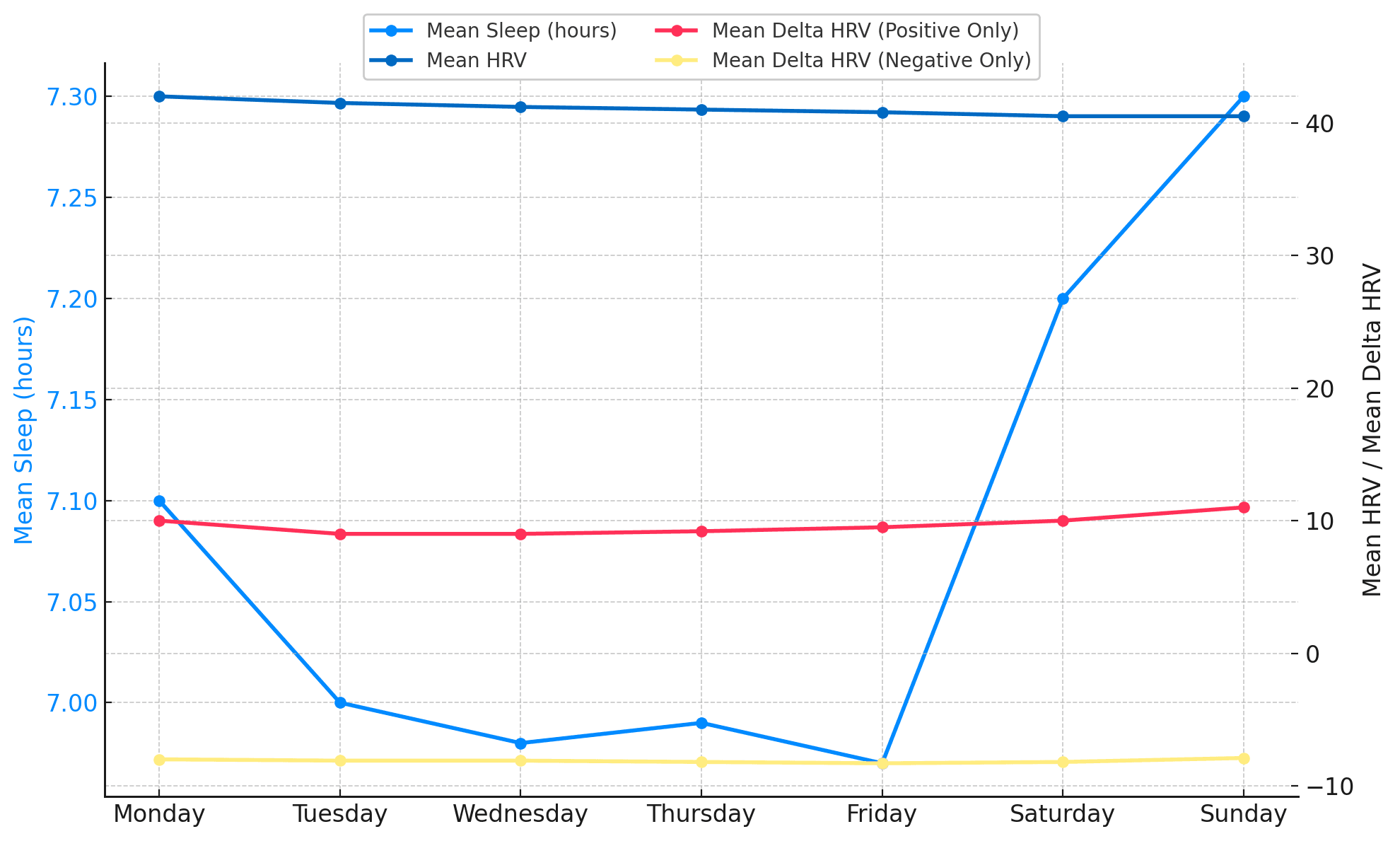
It’s also worth noting that HRV drops as the week wore on, hitting its lowest values by the weekend. That implies we’re not just tired before the weekend; we’re likely bringing a full week of accumulated load into it. This is nicely visualised in the graph below where we have distinguished between a positive and negative HRV delta.
You can see from Figure 1 that the mean HRV delta trends diverged over the weekend, both the mean of the positive and negative deltas increased, most probably demonstrating an increase in the variability of our weekend activities!
Figure 1: Sleep and HRV Weekly Trends
How Common Are Highs and Lows?
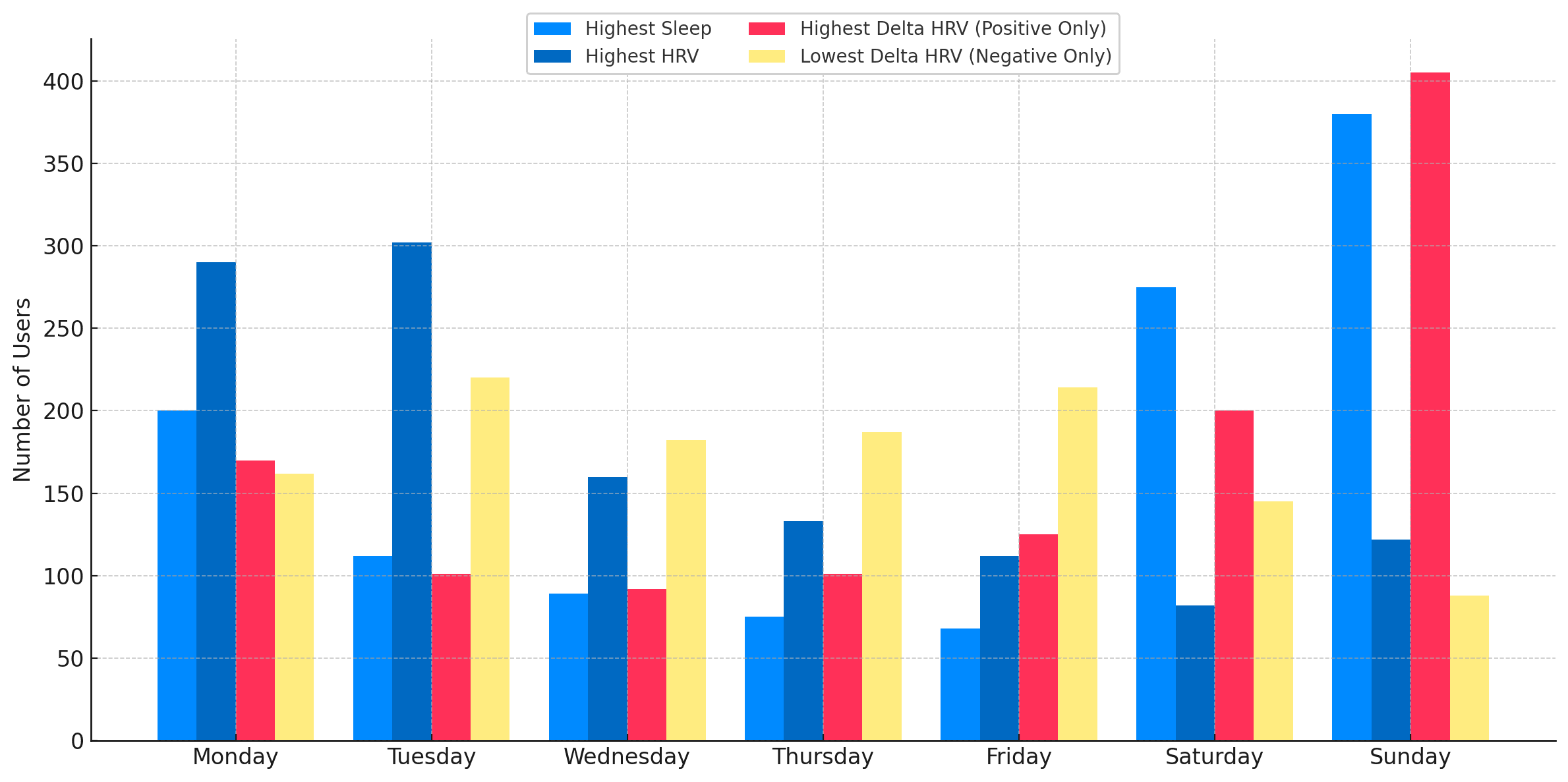
We also looked at how often people hit their personal highest or lowest HRV and sleep values on each day of the week.
Highest HRV by Day: Most common on Monday (295 users) and Tuesday (213)
Lowest HRV by Day: Most common on Sunday (293 users) and Saturday (253)
Highest Sleep by Day: Most common on Sunday (354 users) and Saturday (291)
Lowest Sleep by Day: Slightly more spread out, but Saturday (209) and Friday (196) lead
This confirms a simple but powerful (and some may say, obvious) insight: the weekend is when people try to recover, and early week is when their systems reflect this. But the weekend is when there is the most variability. We know this already, as it is when people have the most flexibility to choose how they sleep. We can chose to sleep and recover or enjoy ourselves on an evening!
Figure 2: Number of Users with Highest Sleep, HRV, or Delta HRV by Day
Sleep Archetypes: Three Types of Sleepers
Next we clustered users into three groups based on their average sleep and how variable it was. This is both interesting and a way to start to model data by learning about types of user.
Cluster
Description
Avg Sleep (h)
Std Dev (h)
1
Longer, more consistent
7.74
0.96
0
Average sleepers
7.01
1.01
2
Shorter, more variable
6.23
1.07
Table 2: Clusters of sleeper types
Not surprisingly, these groups showed differences in HRV:
Cluster
Mean HRV (ms)
Std HRV (ms)
1
45.01
11.01
0
44.12
10.12
2
42.03
9.03
Table 3: HRV by sleeper type cluster
A statistical test (ANOVA) confirmed these differences were significant. The longer, more consistent sleepers had the highest HRV, and the short, inconsistent sleepers had the lowest. This isn’t groundbreaking, we expect better sleep to accompany higher parasympathetic activity.
Zooming Out: A 28-Day Trend
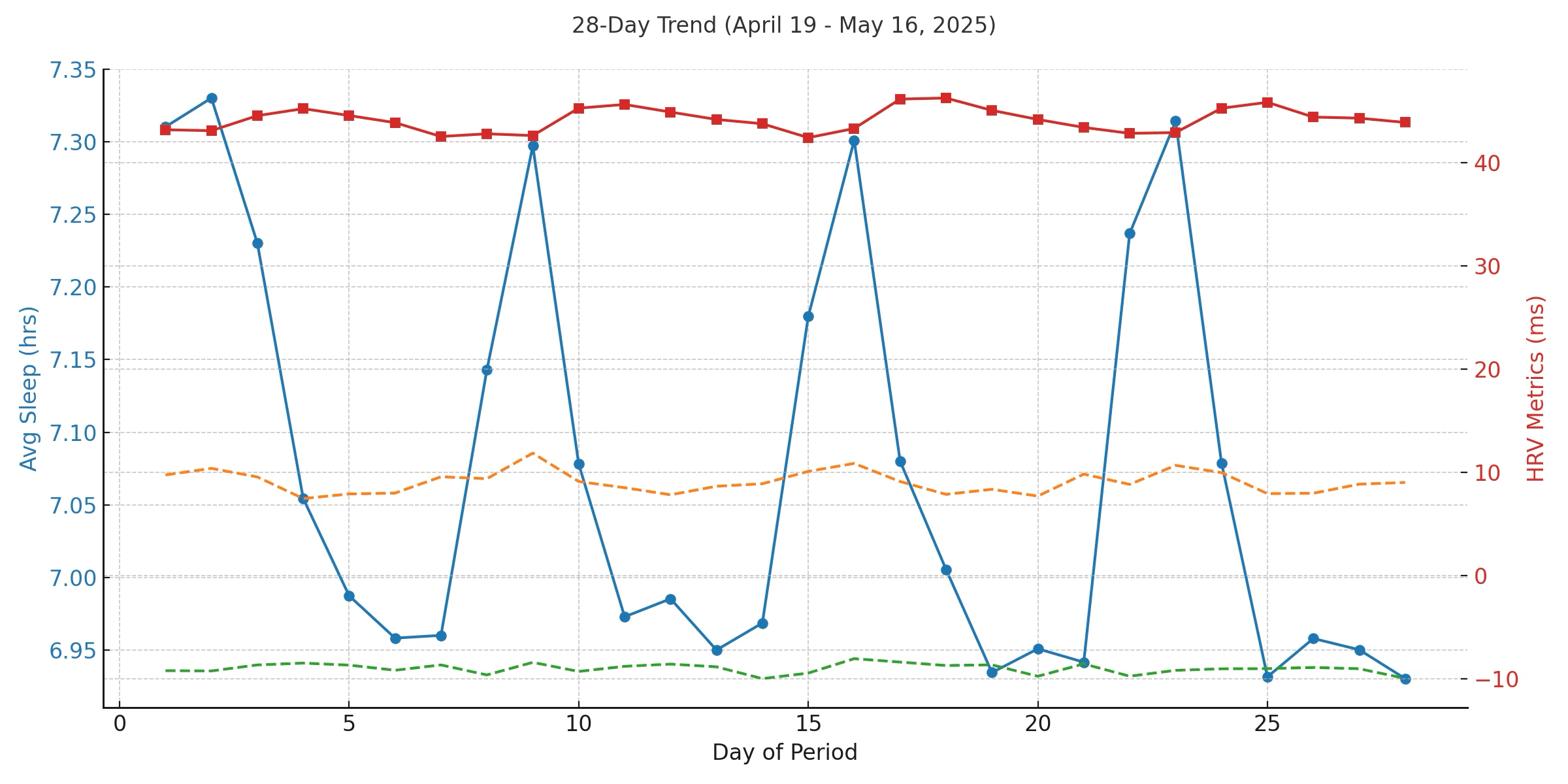
We also looked at 28 days of rolling trends, from April 19 to May 16, 2025, to see how these metrics evolved over time. Check out figure 3 to see how these patterns play out over a four week cycle. From a trend perspective over the 28 days:
Sleep duration showed a very slight decrease: -0.0061 hours/day
HRV showed a slight increase: +0.0248 ms/day
Positive delta HRV declined: -0.0130 ms/day
Negative delta HRV declined: -0.0125 ms/day
This suggests people may have been sleeping slightly less but experiencing slightly more stable recovery. We don’t know the location of the users, but its a good bet that most of them are in the northern hemisphere, and sleep less as the days get longer. We also see an increase in mean HRV with decreased deltas in both directions (variability). This could also be a seasonal effect.
Figure 3: 28-Day Trend of Sleep and HRV Metrics
So What Do We Take From This
Firstly, on average HRV rebounds early in the week. Don’t write off Mondays. They might be the most biologically resilient day we have! Secondly, sleep habits matter and it’s not just how much we sleep, but how consistently. Thirdly, the weekend is for recovery, but that recovery may not show up immediately. We can learn a lot from our patterns, not just our averages. Look at trends, not just snapshots. If your HRV is tanking on Sunday, it might be time to think about taking it a bit easier over the weekend (whatever that means for you!)
Over the next few weeks we will be analysing all the data we can find and publishing all of the insights. Is there anything you’d like to see?
Summary questions
Why is my HRV highest on Monday even though I worked all week?
Because HRV reflects cumulative recovery, not just last night's sleep. In an analysis of over 1,000 wearable users, HRV peaked on Mondays (45.55 ms) and Tuesdays (46.14 ms) — a day or two after the weekend's longer sleep on Saturday (7.18h) and Sunday (7.28h). The restorative effects of weekend rest show up on a lag, making early-week your most biologically resilient window.
How much do people actually sleep on average according to wearable data?
Across the 28-day dataset of 1,000+ users, average sleep duration was 7.06 hours with a standard deviation of 1.19 hours, and mean overnight HRV was 44.19 ms with a standard deviation of 26.81 ms. That wide HRV spread shows autonomic nervous system behavior varies enormously between individuals. Population averages are useful, but your personal baseline matters more than the group mean.
Does sleeping in on weekends actually fix a weekday sleep deficit?
Not immediately. Even though users slept the most on Saturday (7.18h) and Sunday (7.28h) nights, HRV actually hit its lowest values on those same days (42.48 ms and 42.37 ms) and only rebounded on Monday. A single lie-in doesn't fully reverse accumulated strain — recovery shows up 24-48 hours later.
Why does my HRV keep dropping as the week goes on?
The data shows HRV declines steadily from Tuesday (46.14 ms) through Sunday (42.37 ms), with HRV delta turning negative starting Wednesday. This suggests people carry a full week of accumulated load into the weekend rather than arriving fresh. If your HRV is tanking by Sunday, the issue may be cumulative weekday strain plus variable weekend behavior, not just one bad night.
Does sleep consistency actually matter more than sleep duration?
Both matter, and they cluster together. When users were grouped into three sleep archetypes, the longer-and-more-consistent sleepers (7.74h avg, 0.96h SD) had the highest mean HRV at 45.01 ms, while shorter-and-variable sleepers (6.23h avg, 1.07h SD) had the lowest at 42.03 ms. An ANOVA confirmed the differences were statistically significant — consistency tracks with parasympathetic recovery.
When are people most likely to hit their personal worst sleep and HRV?
Lowest HRV days clustered on Sunday (293 users) and Saturday (253 users), while lowest sleep days were most common on Saturday (209) and Friday (196). Meanwhile, highest sleep occurred on Sunday (354 users) and Saturday (291). The weekend is simultaneously when people try hardest to recover and when their systems show the most strain — likely because flexibility means more variable behavior.
Can wearable data really pick up seasonal or population-level recovery trends?
Yes. Over the 28-day window from April 19 to May 16, 2025, sleep duration drifted down by -0.0061 hours/day while HRV trended up by +0.0248 ms/day, and both positive and negative HRV deltas shrank. That pattern — less sleep but more stable recovery — is consistent with a northern-hemisphere spring effect as daylight increases. Population-scale wearable data can surface these shifts without any lab measurement.
What should I actually do with this information about weekly HRV patterns?
Stop judging your recovery by single nights and start watching weekly trends. If your HRV consistently bottoms out on Sunday, your weekend behavior — not Monday's workload — is likely the lever to pull. And don't write off Mondays: on average they're the day your nervous system is most recovered, which makes them a strong candidate for harder training or demanding work.