We use cookies to enhance your browsing experience and analyse our traffic. By clicking “Accept All”, you consent to our use of cookies according to our Cookie Policy. You can change your mind any time by visiting out cookie policy.
Runners Keep the Same Schedule All Year, Daylight or Not
We analyzed 2.6 million nights and 7,457 runners across 83 cities. The extra hour barely reaches your sleep, and once it’s dark, runners in UK cities use up to 36% less park.
We only sleep 15 minutes extra as the clocks go back when daylight savings end, bedtimes barely move so we wake up ‘early’ on the next day.
We keep exercising at the same clock times all year. When the clocks go back, evening sessions simply move into the dark.
In the dark, we change where we run. UK and Ireland cities run up to 36% less in park and green areas.
The clocks go back Sunday
This Sunday the clocks go back an hour across Europe and the UK, and a week later in the US and Canada. Autumn has been taking light out of our evenings a couple of minutes at a time since June. On Sunday, it takes a whole hour at once.
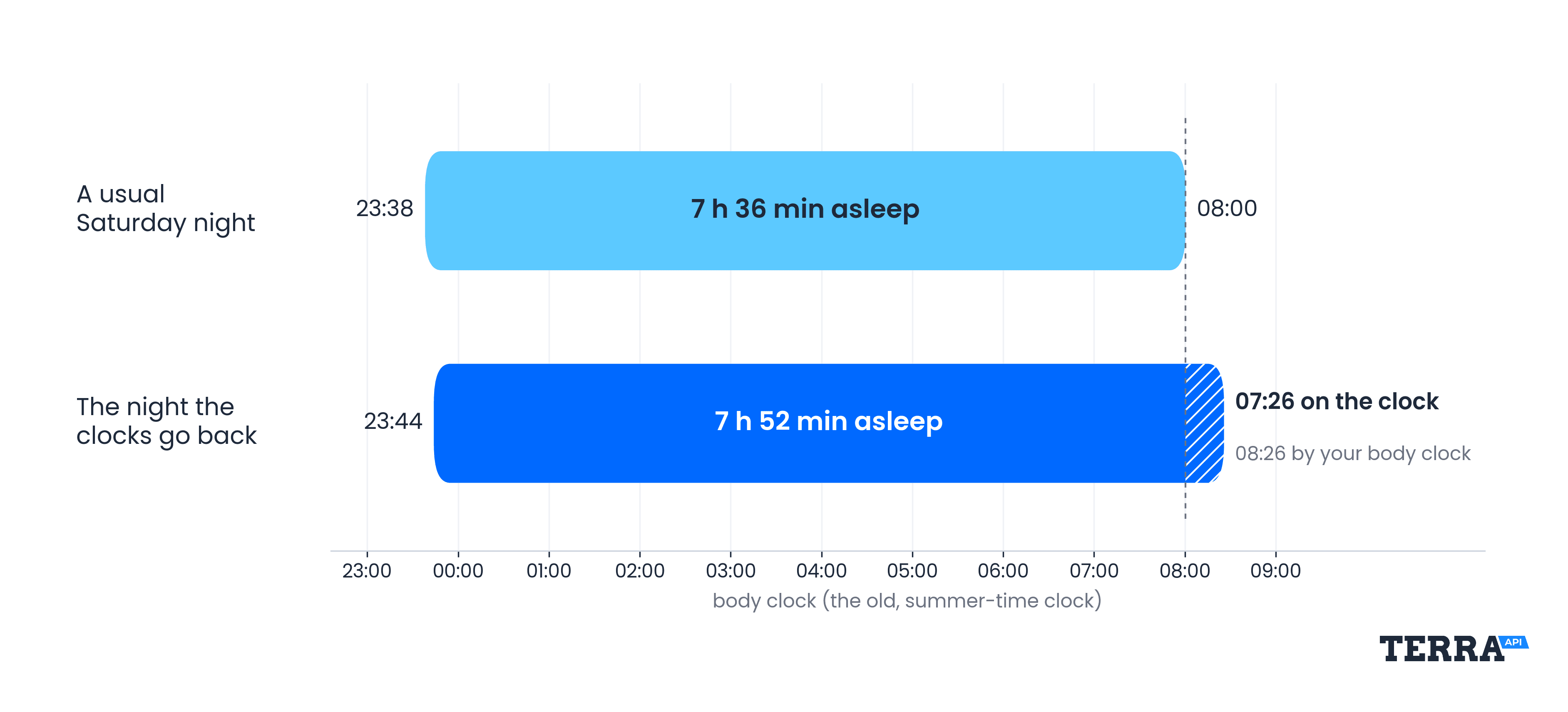
We analysed 2.6 million nights (Figure 1), and almost nobody stays up later to use that extra hour; bedtime is essentially unaffected compared to any other Saturday. Our biological clock wakes us up at the same rough hour as usual, only now our clocks read as we woke up an hour earlier.
On average, we only sleep about 15 minutes more than on a usual Saturday, in line with earlier wearable studies[1,2].
Figure 1: Average sleep session of a Saturday night in light blue, and below the average session on the night the clocks go back.
Get the latest Terra Research reports and insights every week as soon as they're published.
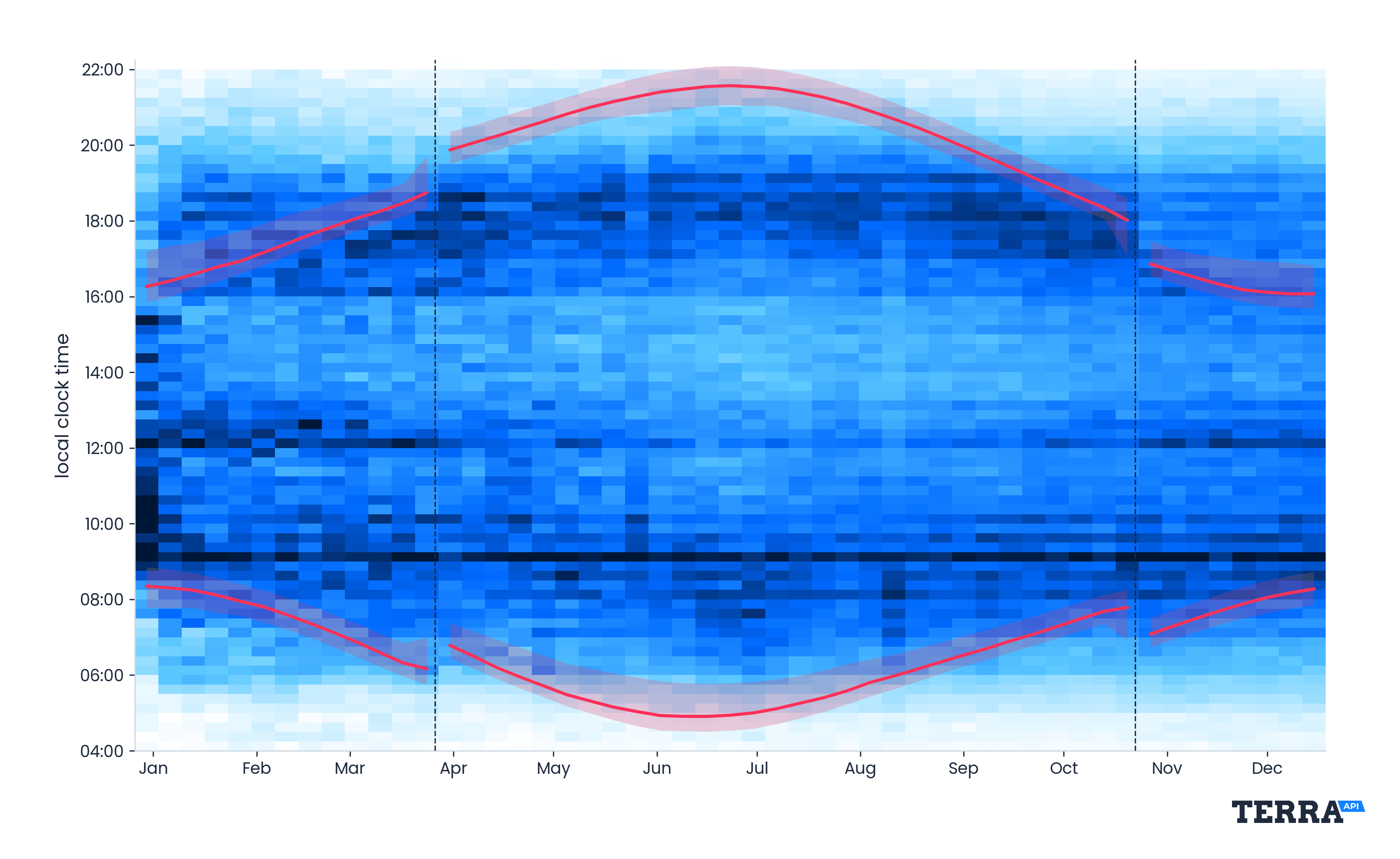
Across the year, sunrise and sunset move by hours, but the busy times for outdoor exercise barely move (Figure 2). When the clocks go back, sunset jumps an hour overnight, but evening workouts start only about 4 minutes earlier. People keep their time and go out in the dark instead.
Through 2025, sunset in Europe moved by five and a half hours, from about 21:30 in June to 16:05 in December, and half of all afternoon and evening outdoor sessions started before 18:10 in June and before 17:35 in December.
Figure 2: Activities throughout the year mostly don’t vary with sunlight, activities are anchored to busy life schedules instead and 9am is the most common exercise time in the morning. The red lines are sunrise (bottom) and sunset (top), with shading for how they vary across locations, and the dashed lines mark the two clock changes.
What we change is where we run
We compared each runner's runs in the dark with their own runs in daylight at the same clock hour, in every city where we had enough runners: 83 cities and 7,457 runners through 2025. In 19 of them, runners spend clearly less of their route in parks and other green spaces in the dark.
The eight biggest drops are all in the UK and Ireland: Belfast and Bournemouth (36% less green space on dark runs), Newcastle (35%), Nottingham (31%), Birmingham (30%), Southampton (29%), Sheffield (28%) and Glasgow (24%). In most cities near the equator and most US cities we saw no clear change. In five warm cities (Querétaro, Jakarta, San Juan, Puebla and Abu Dhabi), dark runs actually have more green space.
The maps (Figure 3) show where runners stop exercising after dark (in red), which alternative routes show up (in blue) and which remain in the dark (in green). In London, runners stop running in Richmond Park, Dulwich Park and Greenwich Park but keep running in Battersea Park and Hyde Park. In Paris, two thirds of the route through the Bois de Boulogne disappears in the dark, while the Bois de Vincennes stays busy.
In Dublin it's Marlay Park and Fairview Park, and in Manchester, Heaton Park and the playing fields around Hough End and Wythenshawe. In Austin, the parks along the eastern end of Lady Bird Lake empty out while the central lakeside trail stays busy. The interactive map below shows every city we looked at; hover over a city, or click it to enlarge its map.
This happens on dark mornings about as much as on dark evenings (6% and 8% less green space across the first 16 cities we checked).
Why these parks?
We can't tell from the data alone, but the parks people drop have something in common. Several of them lock their gates at dusk: Heaton Park closes at dusk[3], Greenwich Park closes around 6pm in winter[4], and Marlay Park closes at 5pm from November to January [5]. Others, like the Bois de Boulogne, stay open but are very large and dark, Richmond Park is defined as the darkest place in London at night[6]. Meanwhile, Hyde Park and the central lakeside trail in Austin keep their runners.
Before you head out in the dark:
Check your park's closing time. Once the clocks go back, many parks close before an after-work run.
Plan a lit route now, rather than finding out on Monday that your usual loop is dark or locked.
Morning runners too: dark mornings change routes as much as dark evenings.
References
de Lange MA, et al. The effects of daylight saving time clock changes on accelerometer-measured sleep duration in the UK Biobank. J Sleep Res 2025;34(3):e14335. doi:10.1111/jsr.14335
Heacock RM, et al. Sleep and alcohol use patterns during federal holidays and daylight saving time transitions in the United States. Front Physiol 2022;13:884154. doi:10.3389/fphys.2022.884154
Manchester City Council. Heaton Park: opening times and location. manchester.gov.uk
Dún Laoghaire-Rathdown County Council. Marlay Park. dlrcoco.ie
Friends of Richmond Park. London's dark sky reserve. frp.org.uk
OpenStreetMap contributors (2026). OpenStreetMap [street, path and green-space data]. Retrieved 9 and 12 October 2026 via the Overpass API. Available under the Open Database License (ODbL). https://www.openstreetmap.org/copyright
Overpass API (2026). Overpass API, version 0.7.62, used to query OpenStreetMap data. https://overpass-api.de (queries were served by the public mirror at maps.mail.ru)
Agafonkin, V. et al. (2022). Leaflet: an open-source JavaScript library for interactive maps, version 1.9.4. https://leafletjs.com
Summary questions
Do I actually sleep more when the clocks go back?
Barely. Across 2.6 million nights analyzed, people sleep only about 15 minutes more than a usual Saturday when clocks go back, consistent with earlier wearable studies. Bedtime stays essentially unchanged — your biological clock wakes you at the same time regardless of what the clock reads, so you gain a sliver of sleep rather than a full hour.
Why don't people shift their workout time when sunset moves earlier?
Exercise is anchored to work and life schedules, not daylight. When the clocks go back and sunset jumps an hour earlier overnight, evening workouts start only about 4 minutes earlier on average. Across 2025, European sunset moved by five and a half hours — from around 21:30 in June to 16:05 in December — but the median afternoon workout start time shifted by just 35 minutes.
Does running in the dark change where I run?
Yes, and dramatically in some cities. Across 83 cities and 7,457 runners, 19 cities showed clearly less green space on dark runs. The biggest drops were all in the UK and Ireland: Belfast and Bournemouth lost 36% of green space on dark runs, Newcastle 35%, Nottingham 31%, Birmingham 30%, Southampton 29%, Sheffield 28%, and Glasgow 24%.
Which specific parks do runners abandon after dark?
In London, runners drop Richmond Park, Dulwich Park, and Greenwich Park but stick with Battersea Park and Hyde Park. In Paris, two thirds of the Bois de Boulogne route disappears in the dark while Bois de Vincennes stays busy. Dublin runners drop Marlay Park and Fairview Park; Manchester runners abandon Heaton Park and the fields around Hough End and Wythenshawe.
Is this just an evening thing, or do dark mornings matter too?
Dark mornings matter about as much. Across the first 16 cities checked, runners used 6% less green space on dark mornings and 8% less on dark evenings — essentially the same effect. If you're a morning runner, the clock change will reshape your route just as much as it does for after-work runners.
Why do runners abandon some parks but not others?
The data points to access and lighting. Several abandoned parks lock their gates at dusk — Heaton Park closes at dusk, Greenwich Park around 6pm in winter, Marlay Park at 5pm from November to January. Others like Richmond Park and the Bois de Boulogne stay open but are famously dark; Richmond Park is officially London's darkest spot at night. Well-lit parks like Hyde Park keep their runners.
Do runners everywhere lose green space in winter, or is this a UK thing?
It's largely a UK and Ireland phenomenon. Most cities near the equator and most US cities showed no clear change in green-space use on dark runs. In five warm cities — Querétaro, Jakarta, San Juan, Puebla, and Abu Dhabi — dark runs actually had more green space than daylight runs, likely reflecting heat avoidance rather than light avoidance.
What should I do before the clocks go back this weekend?
Check your usual park's winter closing time now — many close before a typical after-work run once the clocks shift. Plan a lit alternative route in advance rather than discovering on Monday evening that your loop is dark or gated. The data shows runners overwhelmingly keep the same schedule when the clocks change, so the only thing you really control is where you go.