We use cookies to enhance your browsing experience and analyse our traffic. By clicking “Accept All”, you consent to our use of cookies according to our Cookie Policy. You can change your mind any time by visiting out cookie policy.
Sauna is the part that works. HRV rose and heart rate fell on every measure we looked at, both the night of and the night after, and the effect held up after we controlled for things like activity, illness, and alcohol.
Cold plunge on its own does very little. The numbers point the right way, but they're small and most of them could easily be chance. Only one of the six measures came out clearly, which isn't enough to lean on.
Stacking sauna and cold plunge doesn't beat the sauna alone. You get the same drop in heart rate and no extra gain in HRV. The cold plunge isn't adding anything the heat wasn't already giving you.
Why We Ran This Experiment
A lot of people do a sauna and a cold plunge in the same session because they assume the two add up. The heat does one thing, the cold does another, and together you get more than either on its own. It's a reasonable guess, and we wanted to know whether it was true.
A few weeks ago we published what saunas do to the body overnight, and it got more attention than we expected. The question that kept coming back was about the cold plunge. People wanted to know whether adding one made the sauna work better, or whether the cold was doing something by itself.
We pulled 31,424 days from people who logged a sauna, a cold plunge, or both, and looked at how their heart behaved that night and the night after. Can we prove with data the effects of each individually, and both of them together?
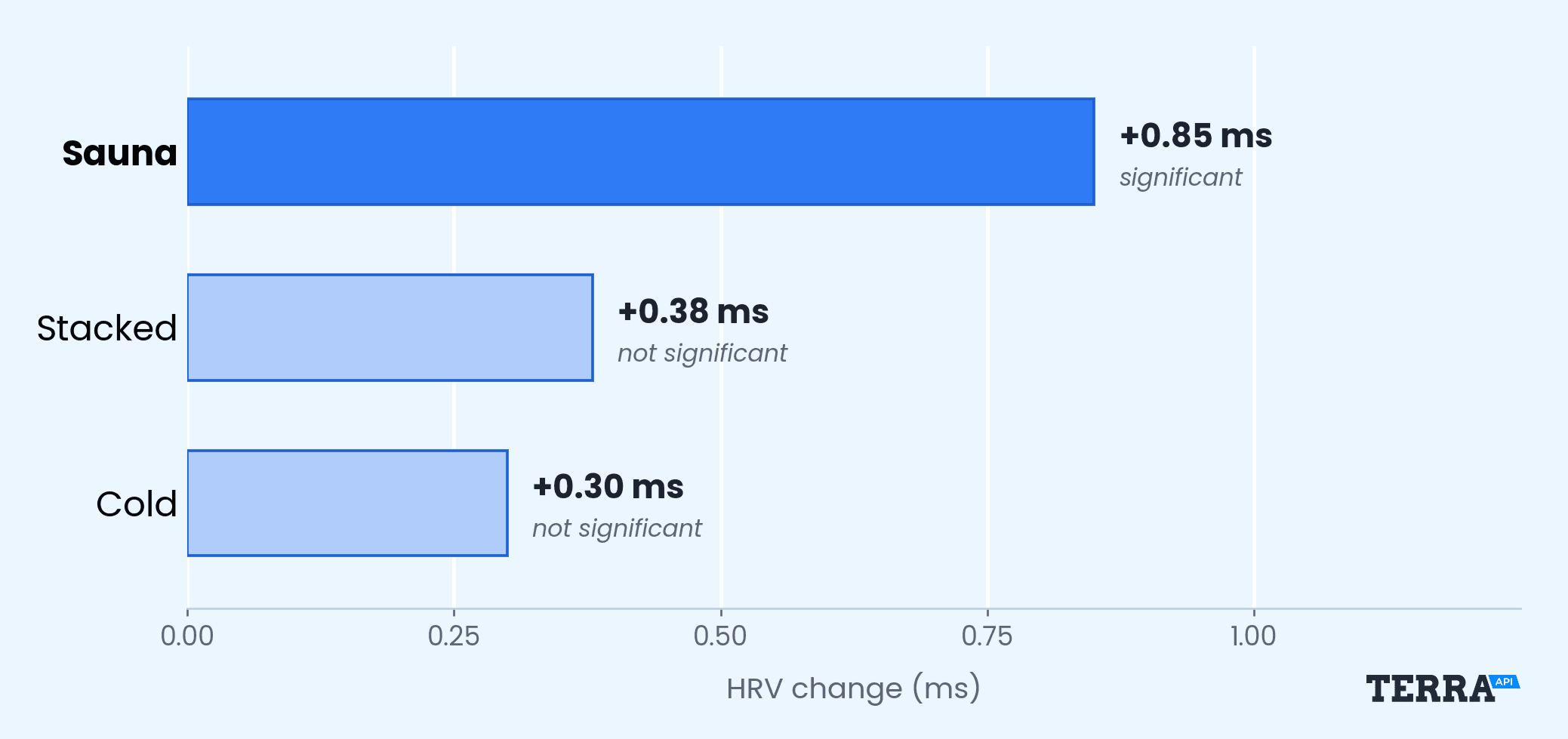
Figure 1: Overnight HRV change versus a normal day. Only the sauna reached significance. Adding a cold plunge, alone or stacked, did not.
The hard part of a question like this isn't running the numbers, but making sure you are measuring the thing you think you are measuring. If someone tends to sauna after a hard workout, the recovery you see that night might come from the workout rather than the sauna.
That's why we held a lot constant. We compared each person against their own baseline and accounted for the month, the day, and for illness, alcohol, caffeine, stress, travel, steps, time spent active, and how demanding the day was overall. We used only nights with a full sleep record. What remains is closer to the effect of the heat and the cold themselves.
We tracked two things that wearables read well overnight. One is HRV, where a higher number means better recovery. The other is heart rate, where lower is better.
Get the latest Terra Research reports and insights every week as soon as they're published.
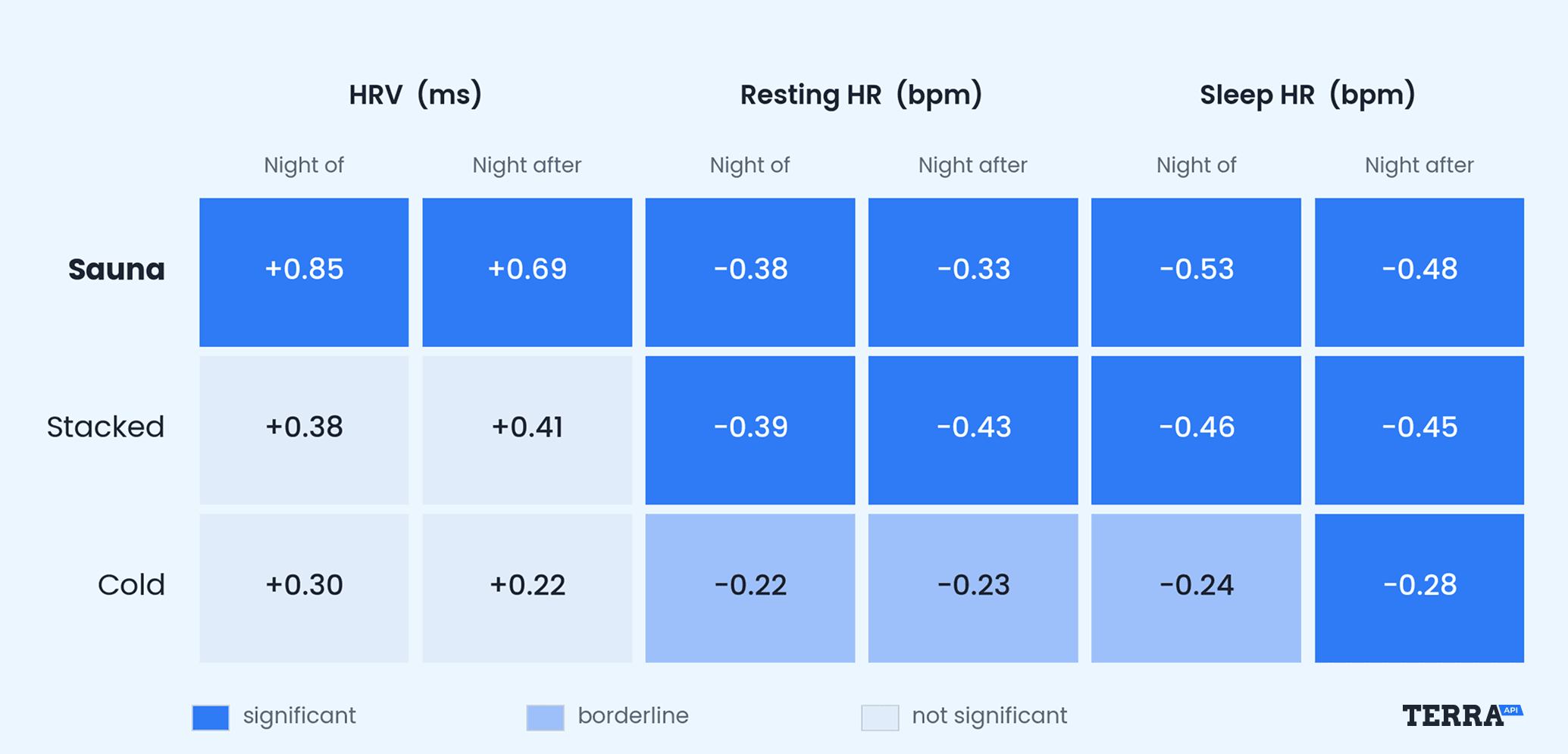
The sauna effect is clear. HRV rose and heart rate fell on every measure we looked at, on the night of the sauna and again the night after, and all of it was significant. HRV went up by about 0.85 ms the night of and 0.69 ms the night after. Resting and sleeping heart rate dropped by roughly half a beat per minute. None of it was borderline, and it survived every control we added.
Group
Total Days
Sauna
22,088
Cold Plunge
7,195
Sauna + Cold Plunge
2,141
Total days
31,424
Cold on its own is a different story. The numbers point the right way, but most of them are too small to trust. HRV rose a little, around 0.3 ms, though not by enough to rule out chance. Heart rate edged down, but the effect sat at the border of significance for almost every measure.
One result, sleeping heart rate the night after, came through cleanly. One out of six is not a pattern. The honest read is that cold plunging alone may do something, but this data cannot show it with any confidence.
Stacking is the case people care about most, because it is the thing they actually do. If the sauna helps and the cold helps, doing both should help more. It didn't. On heart rate, stacking worked about as well as the sauna alone, lowering it by a similar amount with the same confidence, but the HRV benefit faded.
With the cold plunge added, the HRV change was no longer significant, and nothing about the combined effect was clearly larger than the sauna by itself. Whatever the cold plunge contributes, it does not show up as extra recovery on top of the heat.
Figure 2: Effect of each protocol on six overnight measures, with color showing significance. Sauna is significant on all six. Stacking works on heart rate but not HRV, and cold lands once in six. n = 31,424 days.
Conclusions
The simplest way to put it is that the sauna is doing the work. It produces the strongest and most consistent signal in the data, higher HRV and lower overnight heart rate, and it does so reliably. Cold exposure on its own is hard to pin down. Stacking the two gives you the heart rate benefit but no clear gain in HRV over the sauna alone.
If you are doing both for recovery, the heat is the part that earns its place. The cold plunge is not hurting anything, and if you enjoy it there is no reason to stop. But the idea that adding it makes your sauna more effective does not hold up in the numbers we can measure.
It is worth being clear about what we measured and what we did not. This is observational data from wearables, not a controlled trial, and it covers overnight heart metrics rather than how you feel or perform the next day. Cold exposure may well do things a sleep tracker cannot see. For the question people kept asking, though, whether stacking improves the recovery numbers we can track, the answer is no.
Summary questions
Does adding a cold plunge to my sauna actually improve recovery?
No, not in any measurable way on overnight recovery metrics. Across 31,424 days of wearable data, stacking sauna and cold plunge lowered heart rate about as much as sauna alone, but the HRV benefit actually faded and became non-significant when cold was added. The popular assumption that the two effects add up doesn't hold up in the data.
How much does a sauna actually improve my overnight recovery?
The sauna effect is strong and consistent across all six metrics measured. HRV rose by about 0.85 ms the night of the sauna and 0.69 ms the night after, while resting and sleeping heart rate dropped by roughly half a beat per minute. Every result was statistically significant and survived controls for workouts, alcohol, caffeine, illness, stress, and activity load.
Does cold plunging on its own do anything measurable?
Probably something, but the data can't confirm it with confidence. HRV rose by only about 0.3 ms and heart rate effects hovered at the border of significance. Out of six overnight measures, only one — sleeping heart rate the night after — came through cleanly. That's not a reliable pattern.
If I'm going to do only one, sauna or cold plunge, which should I pick for recovery?
The sauna, clearly. It was the only protocol that produced significant improvements across all six overnight metrics in a dataset of 22,088 sauna days versus 7,195 cold plunge days. The heat is doing the work; the cold is not measurably adding to it overnight.
Why might the cold plunge cancel out some of the sauna's HRV benefit?
The data doesn't pin down a mechanism, but when cold was stacked on top of sauna (2,141 days), the HRV gain that sauna alone produces was no longer statistically significant. Heart rate improvements held up, but the autonomic recovery signal captured by HRV did not. Whatever the cold contributes, it isn't extra overnight recovery on top of the heat.
How did you separate the effect of the sauna itself from things like workouts or alcohol?
Each person was compared against their own baseline, and the model controlled for month, day, illness, alcohol, caffeine, stress, travel, steps, active time, and overall day demand. Only nights with a full sleep record were used. What remains is closer to the isolated effect of heat and cold rather than the lifestyle around them.
Can wearables really detect the difference between sauna and cold plunge effects?
Yes, at least for sauna. With 31,424 days of overnight HRV and heart rate data, the sauna signal was unmistakable and survived every control added. Cold exposure, by contrast, sat at the edge of detectability — which may mean its benefits show up somewhere a sleep tracker can't see, like next-day mood or perceived energy.
Should I stop cold plunging based on this?
No. The cold plunge isn't hurting your recovery numbers — it's just not boosting them beyond what the sauna already delivers. If you enjoy it or value it for reasons outside overnight HRV and heart rate, keep going. Just don't expect it to make your sauna session work harder.