We use cookies to enhance your browsing experience and analyse our traffic. By clicking “Accept All”, you consent to our use of cookies according to our Cookie Policy. You can change your mind any time by visiting out cookie policy.
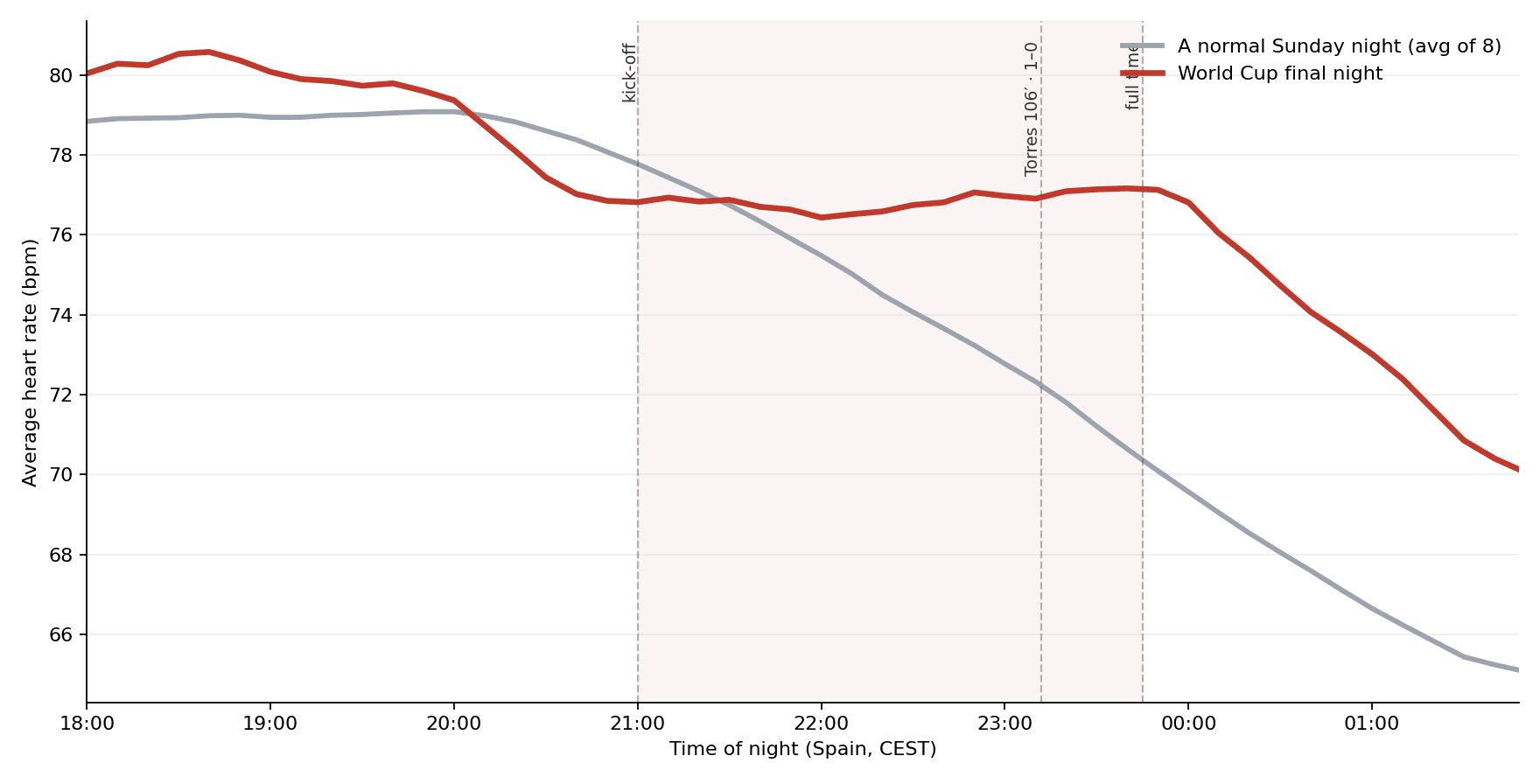
Heart rates ran ~7 bpm above a normal Sunday during the win, the largest response of any country studied.
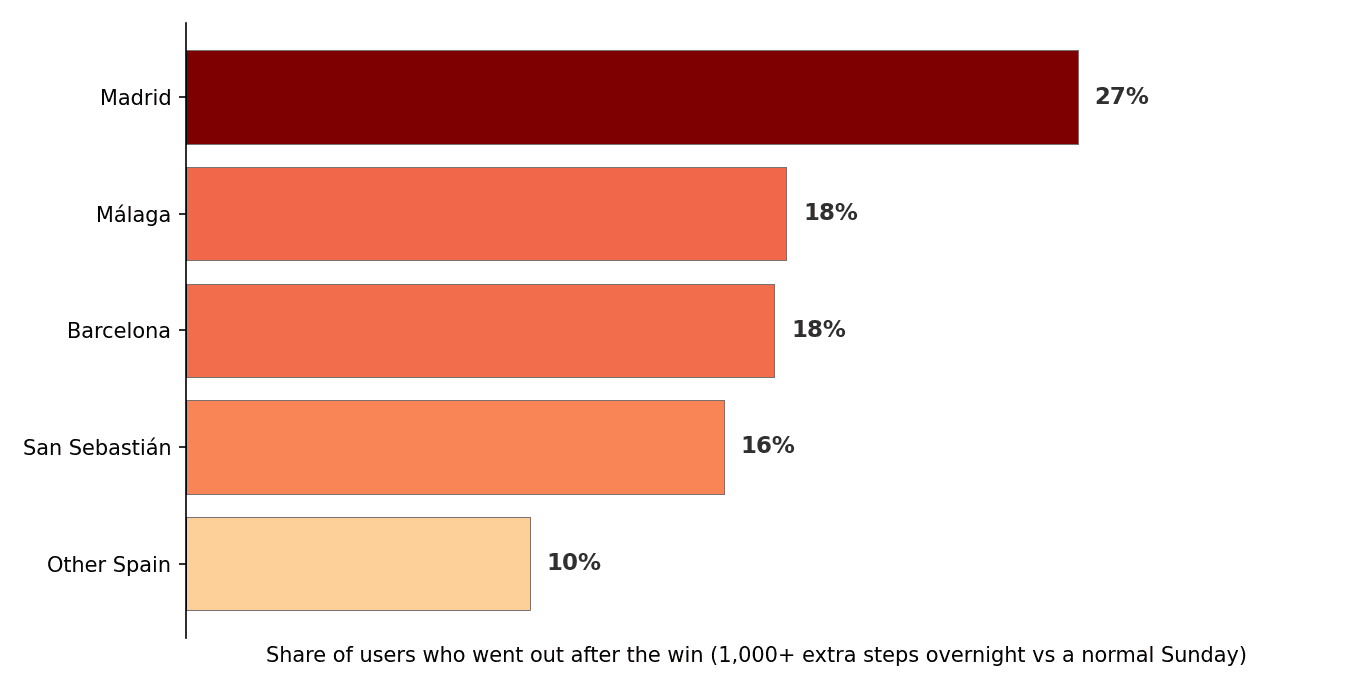
Celebrations spilled into the streets, with steps spiking over 1,000 above usual, clearest in Madrid and Málaga.
Winning has a hangover, with the nation barely moving the next morning as steps fell ~45%.
Spaniards took on the streets last Sunday to celebrate being world champions. Our excitement was clear through our heart rates during the game, our steps spiked as we went out to celebrate afterwards, and some of us had to take a day off from work the next day…
Game Adrenaline
On an average Sunday evening, heart rate usually declines steadily as we wind down before going to sleep. Last Sunday however, Spaniards stayed up to watch the game and the excitement kept our heart rates high. Over the whole match window, our heart rate was 1.63 bpm higher than normal, but as the whistle blew at full time our heart rates were more than 7 bpm higher than usual.
Figure 1: Average heart rate of Spaniards on a usual Sunday (in grey) and watching the world cup final (in red).
Get the latest Terra Research reports and insights every week as soon as they're published.
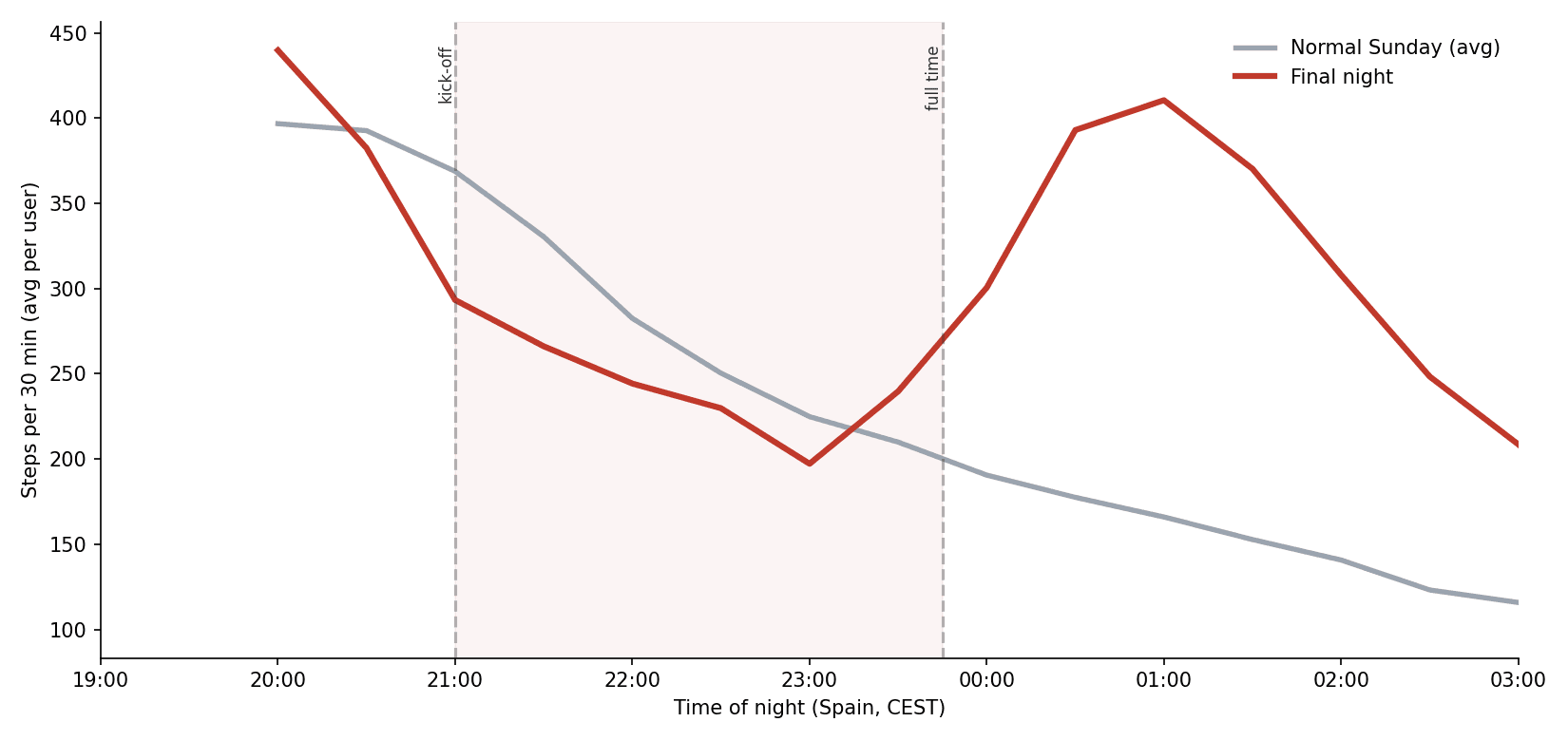
Spain moved less than usual during the match, around -100 steps/h compared to a normal Sunday, but erupted the moment it finished. The Spaniards took on the streets, and the average steps spiked around 1am.
Figure 2: Average steps throughout a normal Sunday evening (in grey) compared to the world cup final (in red).
The party wasn't spread evenly. Ranking cities by the share of users who went out afterwards, Madrid led, followed by Málaga, Barcelona and San Sebastian.
Figure 3: Spanish cities ranked by percentage of users who celebrated the world cup win after the match.
World Cup Final Viewers Across the Globe
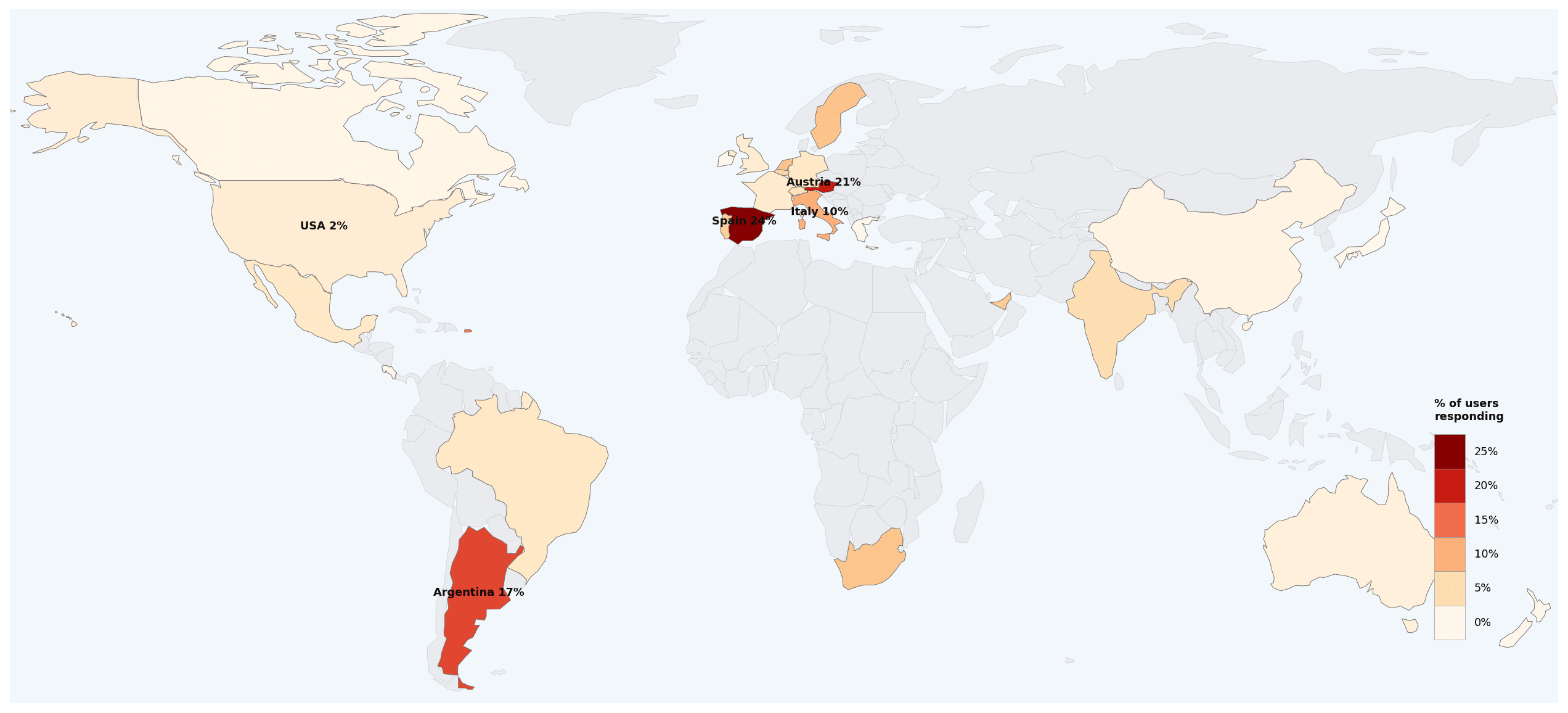
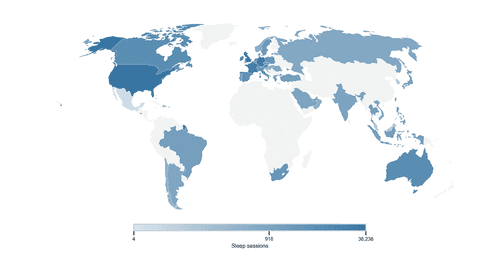
We use the high heart rate and step count over a usual Sunday as the signal to find users that were watching the final. Not surprisingly, Spain leads in percentage of viewers (followed by Argentina of course). Whether Argentinians had less viewers, or had a lower heart rate signal because they were less excited (sorry for the loss) we wont tell…
Interestingly, Austria and Italy came in third and fourth. Perhaps neighboring countries tend to support each other more strongly or Spaniards living abroad tend to chose European countries to move to. The USA, Mexico and Canada had a low percentage of viewers, but its also important to consider the vast population in the region and the signal of course being weaker as a result.
Figure 4: World map of countries, color coded by percentage of viewers.
Spaniards Called in… Sick…
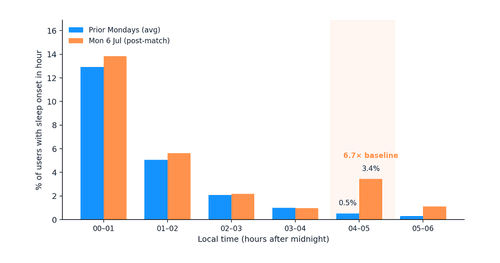
The average bedtime shift was 42 minutes later than usual, but this distribution had a long right tail with the top 25% of users going to bed 2 hours later or more.
Partying all night had a next-day cost and Monday steps fell by ~45%. Spaniards opted for working from home due to ‘transport restrictions’ or simply calling in ‘sick’ [1]. But at the end of the day- WE WON!
References
Excusas utilizadas el lunes para llegar tarde al trabajo tras la victoria de España en el Mundial [“The most-used excuses for turning up late to work the Monday after Spain's World Cup win”]. Marca (Tiramillas), 20 July 2026. — Spanish media on the wave of late arrivals and ‘sick’ days the Monday after the final; the newsroom echo of our ~45% drop in Monday steps.
Summary questions
How much did watching the World Cup final actually raise Spaniards' heart rates?
Across the full match window, average heart rate ran 1.63 bpm above a typical Sunday evening — but the real spike came at the final whistle, when heart rates were more than 7 bpm higher than usual. Instead of the normal pre-sleep wind-down, Spaniards' cardiovascular activity stayed elevated well into the night. The game effectively overrode the body's usual evening recovery pattern.
Did people move around during the match itself?
No — Spaniards were glued to their screens. Step counts during the match ran about 100 steps/hour below a normal Sunday, confirming near-total physical stillness during the 90+ minutes. The compensation came immediately after full time, when steps exploded as people poured into the streets.
When did the post-match celebrations actually peak?
Average step counts spiked around 1am, hours after the final whistle. This wasn't a quick cheer-and-bed reaction — it was a full-scale street celebration that reshaped the entire night's activity profile. The party ran deep into Monday morning for a large share of the population.
Which Spanish cities partied hardest after the win?
Madrid led the ranking by share of users who went out after the match, followed by Málaga, Barcelona, and San Sebastián. The celebration wasn't uniform across Spain — the capital drove the biggest post-match mobilization, but southern and northern coastal cities weren't far behind. Regional differences in going-out behavior were clearly visible in the wearable signal.
Can wearable data actually identify who was watching the match?
Yes. By combining elevated heart rate during the match window with the characteristic step-count spike immediately afterward, viewership can be inferred without any self-report. Spain topped the global ranking as expected, followed by Argentina, with Austria and Italy landing surprisingly high in third and fourth — likely reflecting neighboring-country support or Spanish expat clusters.
Why did the USA, Mexico and Canada show such low viewership rates?
Partly real, partly methodological. These countries have much larger overall populations, so the percentage of users showing the match-viewing signal is diluted. The heart-rate and step-count signal is also weaker in regions with less intense engagement in the final, making detection less reliable than in Spain or Argentina.
How much later did Spaniards go to bed after the final?
The average bedtime shift was 42 minutes later than usual, but the distribution was heavily skewed — the top 25% of users went to bed at least 2 hours later than normal. That long right tail is the signature of an all-night celebration rather than a modest late night for everyone.
Did the celebration actually cost people their Monday?
Clearly yes. Monday step counts dropped by roughly 45% compared to a normal Monday, consistent with widespread late arrivals, working from home, or calling in sick — patterns also picked up by Spanish media coverage of post-final absenteeism. The wearable data quantified what the country already suspected: winning the World Cup effectively cancelled the next working day.