We use cookies to enhance your browsing experience and analyse our traffic. By clicking “Accept All”, you consent to our use of cookies according to our Cookie Policy. You can change your mind any time by visiting out cookie policy.
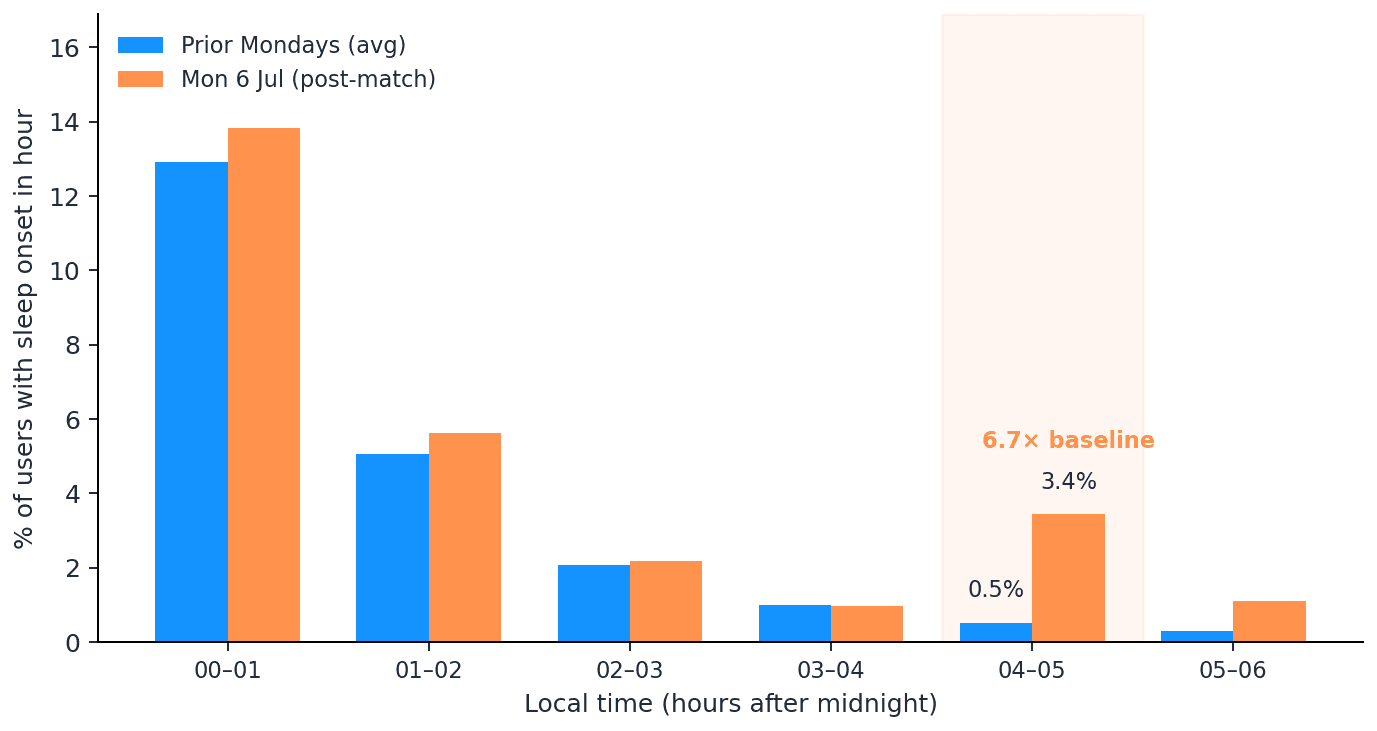
Bedtimes between 4am and 5am hit 6.7x baseline. On a typical Monday, 0.5% of users fall asleep in that hour. After England vs Mexico it was 3.4%, and the spike came after the final whistle, not during the match.
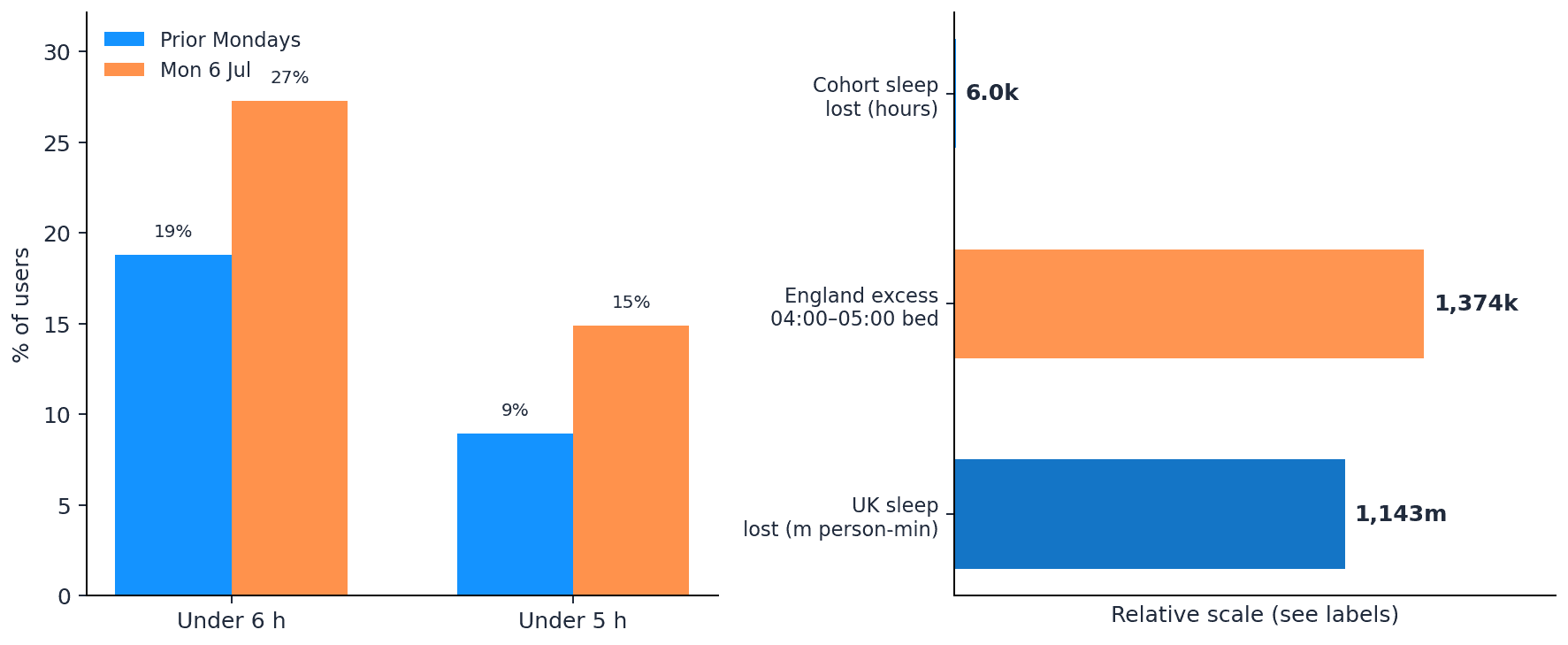
The UK lost 21 minutes of sleep at population level. Mean sleep fell from 7.04 to 6.69 hours versus the previous four Mondays, and the share of users sleeping under 6 hours jumped from 19% to 27%.
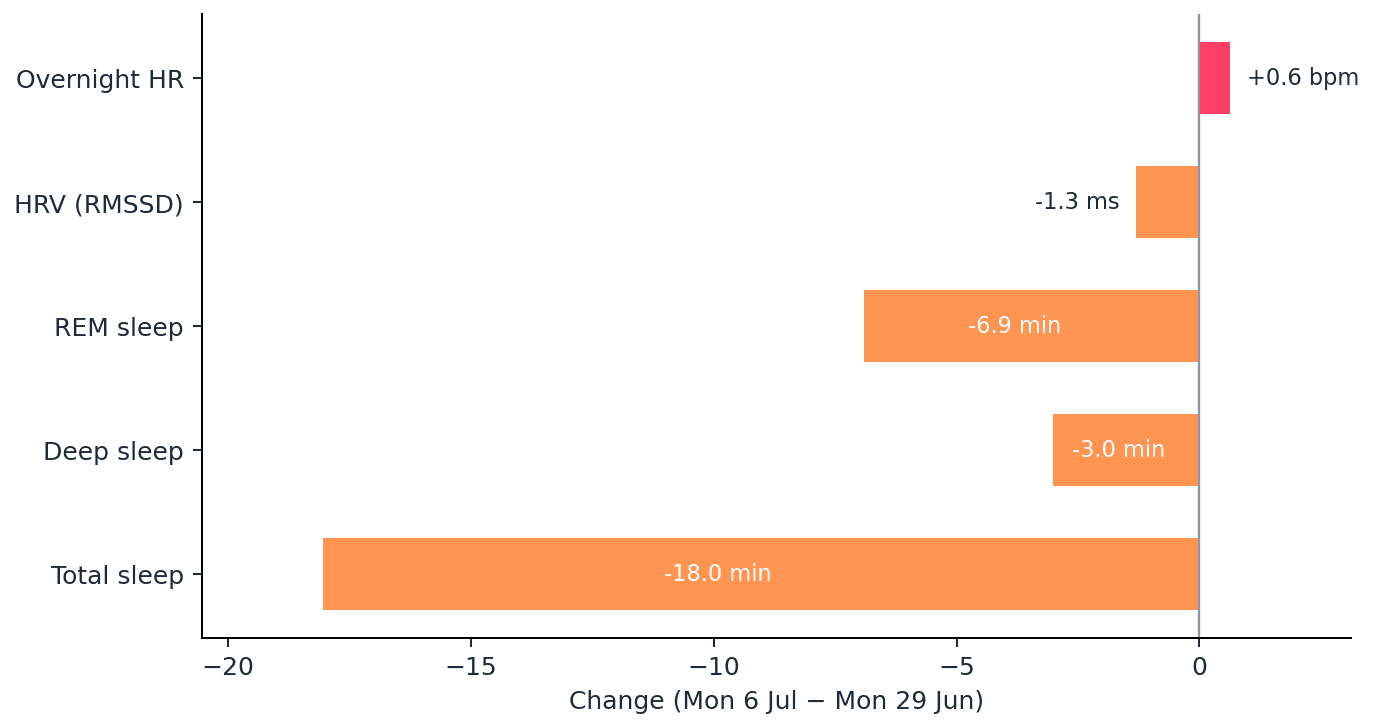
Recovery markers moved in the expected direction. Among 12,777 users tracked on both Mondays, deep sleep fell 3 minutes, REM fell 7 minutes, and HRV dropped 1.3 ms, the signature of a short, stimulated night.
After England’s nail-biting 3-2 World Cup thriller against Mexico on Monday morning, the nation woke up not just buzzing, but probably a little bleary-eyed.
Jude Bellingham was reported telling fans to: “Text your bosses and tell them you’re not coming in, simple as that… Kids stay off school, parents don’t go to work, enjoy your day, have the day off if you can, these nights don’t come often.”
The Times was predicting the inevitable “great British skive off,” and The Telegraph warned that “Bosses are bracing for a deluge of sickies,” with HR chiefs predicting more than 500,000 employees would call in after the late-night drama, pub extensions to 5am, and collective hangovers.
According to the press it was peak British chaos. So, I wondered, did the collective national hangover turn up in the data.
I used wearable data from 17,134 UK users to ask the research question: Is there a detectable Monday-morning hangover?
Important framing point: this is observational data from people who track sleep. We cannot see who watched the match. But the timing of the disruption lines up well with a 1am kickoff and a match that ran late into the night. It’s also worth pointing out that this data is not representative of the wider British Public.
Figure 1: Bedtime hour bands. Grouped bar chart of the % of UK wearable users whose sleep onset fell in each hour from midnight to 6am. Blue bars = average of prior Mondays; orange bars = Monday 6 July (sleep on Sunday night).
The clearest behavioral signal is a clear increase in the promotion of people going to bed in the post match band. Fans who stayed up through the final whistle and the aftermath show up an hour later. On a typical Monday, about 0.5% of users fall asleep between 04:00 and 05:00. After England vs Mexico, that rose to 3.4% roughly 6.7× the baseline.
That's 589 people in our cohort alone, or about 501 more than we'd expect on a normal Monday. The 03:00–04:00 band did not spike, which fits the story: people rarely crash out at full time. They stayed up through the adrenaline, the replays, and the group chat.
What the Match Cost in Sleep
Compared with the previous four Mondays, mean total sleep on 6 July fell from 7.04 to 6.69 hours, a fairly small drop of 21 minutes at population level.
Among 12,777 users tracked on both Mondays, the median person lost 12 minutes (95% CI roughly 12–20 minutes). That is a small individual effect, but it compounds across a the population
But population means don’t tell us that much and the extreme matter more:
27% of users slept under 6 hours (vs 19% on typical Mondays)
15% slept under 5 hours (vs 9%)
Get the latest Terra Research reports and insights every week as soon as they're published.
Figure 2: Sleep and recovery deltas, horizontal bar chart of within-user changes (Mon 6 Jul minus Mon 29 Jun, n = 12,777).
Sleep duration is only half the story, what about other recovery signals? Among the same users week-on-week:
Deep sleep fell by 3 minutes on average
REM sleep fell by 7 minutes
HRV (RMSSD) dipped 1.3 ms a sign of reduced overnight recovery
Average overnight heart rate rose 0.6 bpm
The pattern is what you'd expect after a short, stimulated night: less restorative sleep architecture and a slightly more activated autonomic system.
But what about the sample of users who we think stayed up to watch the match? The 04:00–05:00 bedtime cohort averaged just 3.8 hours of sleep. Their HRV averaged 47 ms vs 54 ms across all Monday nights.
Heart rate variability is one of the cleaner recovery readouts in consumer wearables: higher RMSSD generally means a more rested parasympathetic nervous system. Losing an hour of sleep after a rollercoaster match is exactly what you'd expect.
Fun Facts: Scaling It Up
Take these with a pinch of salt, I am scaling wearable-user patterns to the whole adult population, which assumes our cohort is representative. It almost certainly is not, I’d imagine it’s actually a generally healthier, less football-watching sample, than the population. But as a thought experiment, the numbers get fun fast:
1,143 million person-minutes of sleep "lost" if every UK adult experienced the same 21-minute deficit we measured
That's about 19 million person-hours, equivalent to roughly 794 thousand full 24-hour days of sleep, stacked together
1.4 million extra adults in England might have gone to bed between 4am and 5am who wouldn't have on a normal Monday (based on 501 excess bedtimes in our sample)
In our cohort alone, users collectively lost about 6,043 hours of sleep compared with a typical Monday, enough for 755 full workdays at 8 hours each
For context: Wembley Stadium holds about 90,000 people. Our extrapolated 1,374,000 4am bedders would fill Wembley 15 times over, a small city's worth of people!
Short Sleep and Country-Scale Extrapolation
Figure 3: Short sleep and national scale: Two-panel chart. Left: grouped bars comparing % of users sleeping under 6 hours and under 5 hours on Mon 6 Jul vs prior Mondays (27% vs 19%, and 15% vs 9%).
The left panel shows how many more users crossed into short-sleep territory. The right panel translates cohort findings into national-scale illustrations. Interesting and a bit of fun, but nothing more!
What We Can and Cannot Say
We can say:
There was a statistically detectable Monday sleep disruption aligned with the match timeline
The signature is a delayed bedtime spike (~04:00–05:00), not immediate post-whistle sleep
Recovery metrics (deep sleep, REM, HRV, HR) moved in the expected direction
We cannot say:
Who watched the match (no viewing data)
Whether non-wearable-users behaved the same
References
Zhao R, Wang J, Li Y, et al. Effects of sleep deprivation on heart rate variability: a systematic review and meta-analysis. Frontiers in Neuroscience. 2025. https://pmc.ncbi.nlm.nih.gov/articles/PMC12394884/
Chua ECP, Tan WQ, Yeo SC, et al. Cardiac autonomic modulation and sleepiness: Physiological consequences of sleep deprivation due to 40 h of prolonged wakefulness. Physiology & Behavior. 2013;120:216-224. doi:10.1016/j.physbeh.2013.08.026
Fjell AM, Sørensen Ø, Wang Y, et al. Is short sleep bad for the brain? Brain structure and cognitive function in short sleepers. Journal of Neuroscience. 2023;43(28):5241-5250. doi:10.1523/JNEUROSCI.2153-22.2023
Caliandro R, Streng AA, van Kerkhof LWM, et al. Social jetlag and related risks for human health: a timely review. Nutrients. 2021;13(12):4543. doi:10.3390/nu13124543
Summary questions
Did England vs Mexico actually cause a measurable national hangover?
Yes, and the signal was clear in wearable data from 17,134 UK users. Mean total sleep on Monday 6 July fell from 7.04 to 6.69 hours versus the previous four Mondays — a 21-minute population-level drop — and among 12,777 users tracked both weeks, the median person lost 12 minutes. Small individually, but a genuine, statistically detectable disruption aligned with the match timeline.
How many people stayed up unusually late after the match?
On a typical Monday, about 0.5% of users fall asleep between 04:00 and 05:00. After England vs Mexico, that jumped to 3.4% — roughly 6.7× the baseline, or 589 people in the cohort versus about 88 expected. Notably, the 03:00–04:00 band didn't spike, meaning fans didn't crash at full time; they stayed up through the adrenaline and replays before finally going to bed.
Why am I feeling so wrecked after only losing 20 minutes of sleep?
Because the population average hides the extremes. On the night of the match, 27% of users slept under 6 hours (vs 19% on typical Mondays) and 15% slept under 5 hours (vs 9%). If you were one of the fans who went to bed between 4am and 5am, you averaged just 3.8 hours of sleep — that's the group actually carrying the hangover.
Did the match affect more than just sleep duration?
Yes, recovery metrics moved in the expected direction across the 12,777 matched users. Deep sleep fell by 3 minutes, REM sleep by 7 minutes, HRV (RMSSD) dropped 1.3 ms, and average overnight heart rate rose 0.6 bpm. The late-bedtime cohort showed a sharper HRV hit — 47 ms versus 54 ms across all Monday nights — consistent with a short, stimulated night and reduced parasympathetic recovery.
Can wearable data really detect a one-off national event like a football match?
Yes — the timing signature is unmistakable. A 6.7× spike in 4–5am bedtimes on the exact night of a 1am kickoff, combined with coherent shifts in HRV, heart rate, and sleep architecture, is exactly the fingerprint you'd expect. Wearables can't tell you who watched the match, but the behavioral and physiological patterns line up too precisely with the event timeline to be coincidence.
How much sleep did the country lose overall?
Within the cohort alone, users collectively lost about 6,043 hours of sleep compared with a typical Monday — the equivalent of 755 full 8-hour workdays. Extrapolated (loosely) to the whole UK adult population at the same 21-minute deficit, that's roughly 1,143 million person-minutes, or 19 million person-hours of sleep lost. An estimated 1.4 million extra adults may have gone to bed between 4am and 5am — enough to fill Wembley 15 times.
Why didn't people just fall asleep right after the final whistle?
Because adrenaline doesn't switch off at 90 minutes. The 03:00–04:00 bedtime band didn't spike at all — only the 04:00–05:00 window did, at 6.7× normal. Fans stayed up through the aftermath, the replays, and the group chats before winding down, which is why the sleep debt was so concentrated in the ultra-late-night crowd.
Does this data represent the whole UK population?
No, and that's an important caveat. The 17,134 users are people who choose to track their sleep with wearables — likely a healthier, possibly less football-watching sample than the general public. If anything, the true national impact is probably larger than what shows up here, which makes the detectable 21-minute drop and 6.7× late-bedtime spike more striking, not less.