We use cookies to enhance your browsing experience and analyse our traffic. Nothing beyond essential cookies runs until you choose. You can change your mind any time in our Cookie Policy.
We analyzed 33,000 clock changes across 107,000 people. The hour back bought about 22 minutes of extra sleep in the first week, almost all of it on the first night.
Three weeks on, the body still hadn’t adjusted. Bedtimes were 7 minutes earlier on the clock than before the change, compared with people whose clocks stayed put.
Spring is the mirror image, and harder. When the clocks went forward, people lost 22 minutes of sleep in the first week, and night owls lost 6.9 minutes a night versus 2.9 for early birds.
A Natural Experiment, Twice a Year
All the clocks have now gone back: on 25 October in Europe and on 1 November in the US. Twice a year, around a quarter of the world's population moves its clocks by an hour [1]. The clock changes overnight. The sun doesn't.
That matters because light sets the body clock. In autumn, an hour of daylight moves from the evening back to the morning. In spring it moves the other way, and evening light pushes the body clock later. Sleep researchers have argued for years that summer time pushes body clocks later, often ones that were already running late [1, 2]. Light also reaches further than our eyes. Zimmerman and Reiter point out that the near-infrared part of sunlight travels deep into the body, and argue that its effects on melatonin go well beyond the brain [3]. Moving daylight around the clock moves more than we might think.
Wearables let us watch this happen. We looked at de-identified sleep data from about 107,000 people who wear sleep-tracking devices, January 2025 to October 2026. When someone's wearable reported a one-hour jump in time zone on the night the clocks changed, we knew they had switched: more than 33,000 clock changes in the US and Europe. We left out people who crossed time zones within three weeks of the change, about a third of them, because jet lag would have muddied the picture. We also left out anyone with less than a week of nights on either side, and devices whose time-zone records couldn't be trusted.
For each person, we compared bedtime and sleep in the two weeks before the change with the three weeks after. Then we subtracted the change over the same nights in people whose clocks didn't move, such as people in Arizona, or Europeans in the weeks before their own change. What's left is the effect of the clock change itself, not the weather, school holidays or shortening days.
Get the latest Terra Research reports and insights every week as soon as they're published.
If our bodies followed the clock perfectly, bedtimes on the clock wouldn't move at all. If they ignored it completely, people would have fallen asleep a full hour earlier on the clock. After the clocks went back last year, people fell asleep about 9 minutes earlier on the clock in the first week (95% interval: 7–11). Bodies took up most of the hour straight away, but not all of it. Three weeks later, bedtimes were still about 7 minutes earlier. We checked this the careful way: we explored part of the data first, wrote down what we expected, and then confirmed it on people we hadn't looked at.
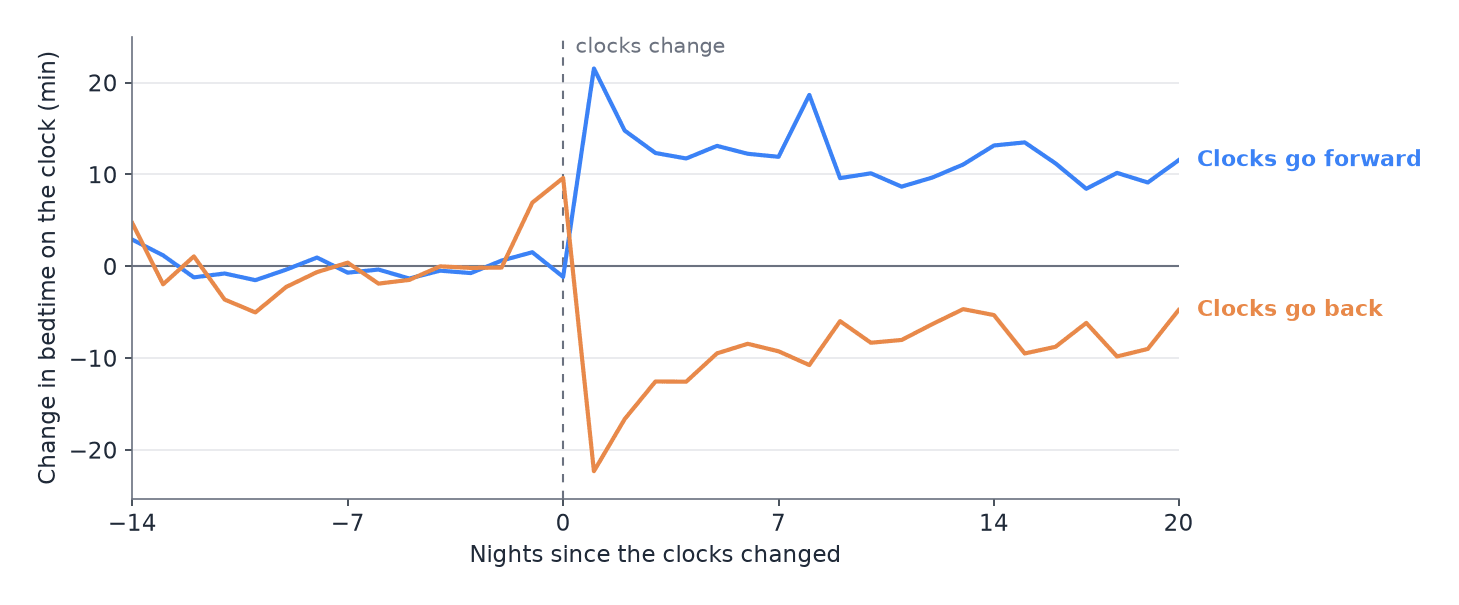
Figure 1 shows the same picture in both directions. In the two weeks before a change, bedtimes barely moved, which also tells us the comparison works. Straight after the change, the lines split. When the clocks went back (autumn 2025), people fell asleep about 22 minutes earlier on the clock on the first night, then settled at around 5–13 minutes earlier for the rest of the three weeks. When the clocks went forward (spring 2025 and 2026), it was the reverse: about 22 minutes later on the first night, then around 10 minutes later for three weeks. Neither line made it back to zero. One more detail: on the nights just before the clocks went back, people went to bed later than usual, perhaps making the most of the hour they knew was coming. In the US, Halloween also fell on the Friday before.
Figure 1: Change in bedtime on the clock around the clock change, compared with each person's own two weeks before and with people whose clocks didn't change. About 11,800 autumn and 21,300 spring clock changes in the US and Europe, 2025–2026. Night 0 is the night of the change itself.
Did We Get the Extra Hour of Sleep?
About a third of it, and mostly in one go. People slept 19 minutes longer on the night the clocks went back. After that, sleep was back to normal within days. Over the whole first week, people slept about 22 minutes more in total. Heart rate variability and resting heart rate barely moved: changes of a fraction of a millisecond and a fraction of a beat per minute.
It Isn't Just the Alarm Clock
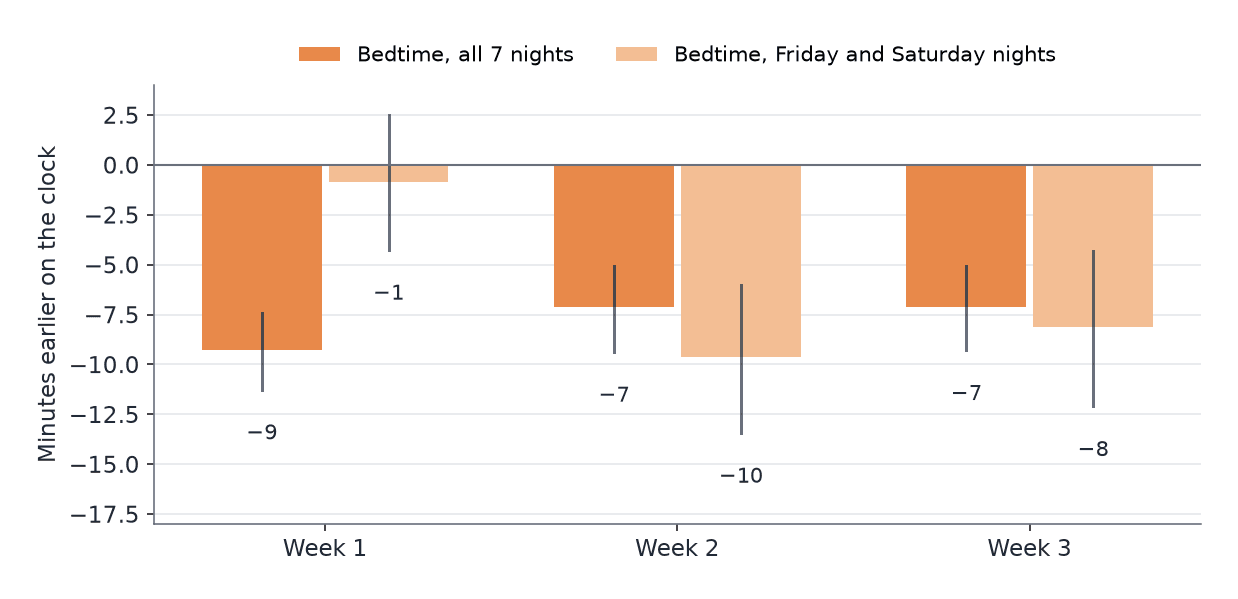
On weekdays, alarms push everyone onto clock time, so we also looked at Friday and Saturday nights, when most people don't have to be up early the next morning. If the lag were only about alarms, weekend bedtimes would have snapped to the new time. However, they didn't, as two and three weeks after the change, weekend bedtimes were 8–10 minutes earlier on the clock, about the same as on other nights. That means that our bodies lag the change. In the first week, though, the two weekend nights cancel out: on the Saturday of the change people stayed up about 10 minutes later, before their clocks went back, and the following Friday they went to bed about 8 minutes earlier.
Figure 2: How much earlier people fell asleep on the clock in the three weeks after the clocks went back in autumn 2025, on all nights and on Friday and Saturday nights only. Lines show 95% intervals. In week 1, the weekend nights include the night of the change itself. If bodies ignored the clock entirely, every bar would read −60.
And in Spring?
Spring was the mirror image, and a bit harder. In the first week after the clocks went forward, people fell asleep 12 minutes later on the clock (95% interval: 11–13), and still 11 minutes later in the third week. People slept about 17 minutes less on the night of the change, and about 22 minutes less over the whole first week.
Do Night Owls Pay More? A Little, Yes
The argument goes that summer time hits hardest for people whose body clock already runs late. So we grouped people by when they usually fell asleep at weekends, 2–8 weeks before the change. Early birds fall asleep before midnight (about three in four people). A middle group falls asleep between midnight and 1 am. Night owls fall asleep after 1 am: about one in ten people, typically asleep at 1:40 am and up at 9:45. Each group was compared with people of the same type whose clocks didn't change.
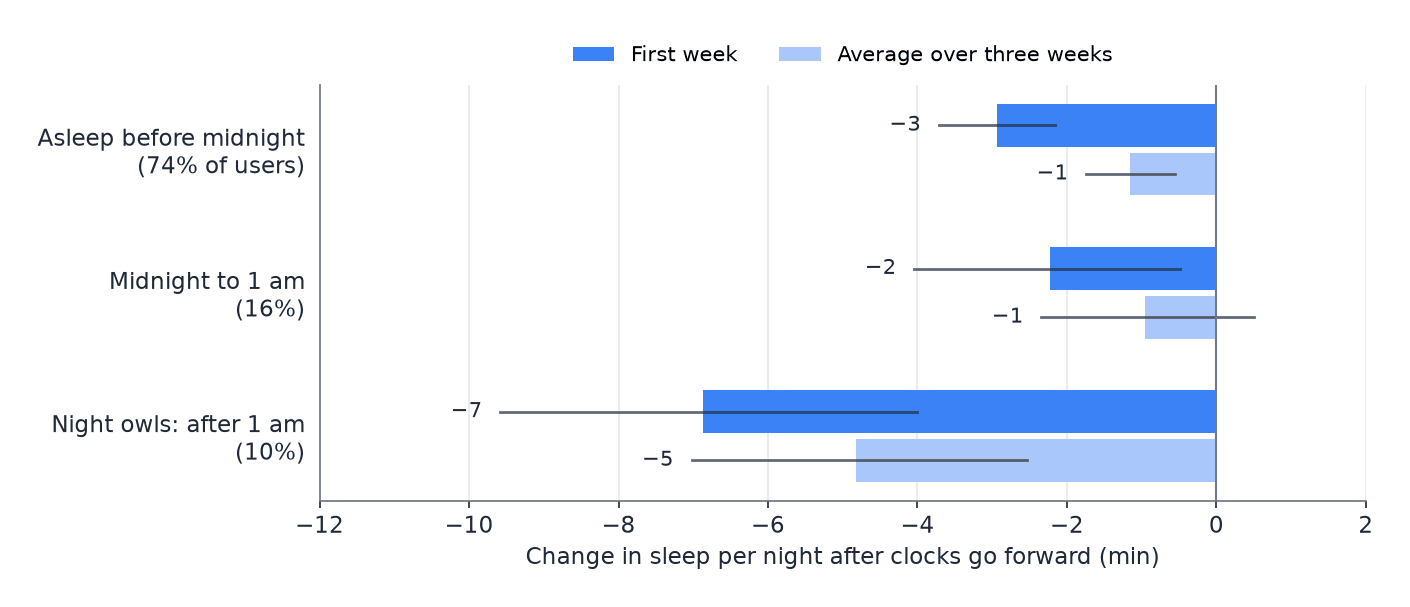
Across the first week after the clocks went forward, night owls lost 6.9 minutes of sleep a night on average, against 2.9 for early birds. Three weeks on, early birds had mostly recovered (−1.2 minutes a night), while night owls were still losing about 5. In autumn, night owls also gained a little more sleep than early birds, but too little to be sure. A stricter test we had planned in advance, on people we hadn't looked at, fell just short of our bar. So we call this likely rather than certain.
Our reading: night owls probably do pay a little more, and for a little longer. That's a few minutes a night, not an hour.
Figure 3: Change in sleep per night after the clocks went forward, by usual weekend bedtime measured 2–8 weeks before the change (12,749 early-bird, 2,765 in-between and 1,750 night-owl clock changes). Lines show 95% intervals.
So, What About Last Week?
Before the clocks went back on 25 October and 1 November, we wrote down what we expected from last year's results: bedtimes about 9 minutes earlier on the clock in the first week, and still around 7 minutes earlier three weeks on. Once three weeks of nights are in, we'll check those predictions against what actually happened and report back. If last year is a guide, the extra hour was mostly a one-night gift, and your body is still running a few minutes behind the clock.
Limitations: This is observational data, so it shows what happened around the clock changes, not why. We have no light sensor or hormone data, so we tested what the light theory predicts, not the light itself. "Bedtime" is when the wearable thinks you fell asleep, not when you went to bed. We know people's time zones but not their exact location, age or sex. The results are averages, and individual responses vary widely.
References
Kantermann T, Juda M, Merrow M, Roenneberg T. The human circadian clock's seasonal adjustment is disrupted by daylight saving time. Current Biology. 2007;17(22):1996–2000.
Rishi MA, Cheng JY, Strang AR, et al. Permanent standard time is the optimal choice for health and safety: an American Academy of Sleep Medicine position statement. Journal of Clinical Sleep Medicine. 2024;20(1):121–125.
Zimmerman S, Reiter RJ. Melatonin and the optics of the human body. Melatonin Research. 2019;2(1):138–160.
Summary questions
Do I actually get an extra hour of sleep when the clocks fall back?
Only about a third of it. On the night the clocks went back, people slept 19 minutes longer, and about 22 minutes more across the whole first week — then sleep returned to normal within days. The 'extra hour' is mostly a one-night gift, not a week-long recovery.
How long does it take my body to adjust to the clock change?
Longer than three weeks. After the autumn change, bedtimes were still about 7 minutes earlier on the clock three weeks later, and after the spring change people were still falling asleep 11 minutes later on the clock at the three-week mark. Neither direction fully snapped back to the new time within the study window.
Are night owls really hit harder by daylight saving time?
Yes, modestly. In the first week after the clocks went forward, night owls lost 6.9 minutes of sleep per night versus 2.9 minutes for early birds. Three weeks on, early birds had largely recovered (−1.2 minutes), while night owls were still losing about 5 minutes a night — a real but small penalty, measured in minutes, not hours.
Is the lag just because of work alarms, or do our bodies really resist the clock change?
It's the body, not just the alarm. On Friday and Saturday nights two to three weeks after the autumn change — when most people have no alarm — bedtimes were still 8–10 minutes earlier on the clock, essentially the same as weekday nights. If alarms were doing all the work, weekend bedtimes would have snapped straight to the new time.
Is the spring forward worse than the fall back?
Yes. People slept about 17 minutes less on the night the clocks went forward and 22 minutes less across the first week, and bedtimes stayed 11–12 minutes later on the clock for three weeks. The autumn change shifted bedtimes by a similar magnitude in the opposite direction, but came with extra sleep rather than a deficit.
Does the clock change affect my heart rate or HRV?
Barely at all. Across more than 33,000 clock changes, resting heart rate and heart rate variability moved by only a fraction of a beat per minute and a fraction of a millisecond respectively. The disruption shows up clearly in sleep timing and duration, but not in these cardiovascular markers at the population level.
Can wearables actually measure how our body clocks respond to DST?
Yes, and at a scale lab studies can't match. By tracking de-identified sleep data from ~107,000 people and detecting the one-hour time-zone jump on the night of the change, this analysis isolated more than 33,000 clock changes and compared each person to controls whose clocks didn't move (like Arizonans). That design strips out weather, holidays and shortening days — leaving the clock change itself.
Why do people stay up later the night before the clocks go back?
They appear to cash in the hour early. On the Saturday of the autumn change, people stayed up about 10 minutes later than usual, likely because they knew the clocks were about to shift back. In the US in 2025 this was amplified by Halloween falling on the same Friday — a reminder that behaviour around DST isn't purely biological.