We use cookies to enhance your browsing experience and analyse our traffic. By clicking “Accept All”, you consent to our use of cookies according to our Cookie Policy. You can change your mind any time by visiting out cookie policy.
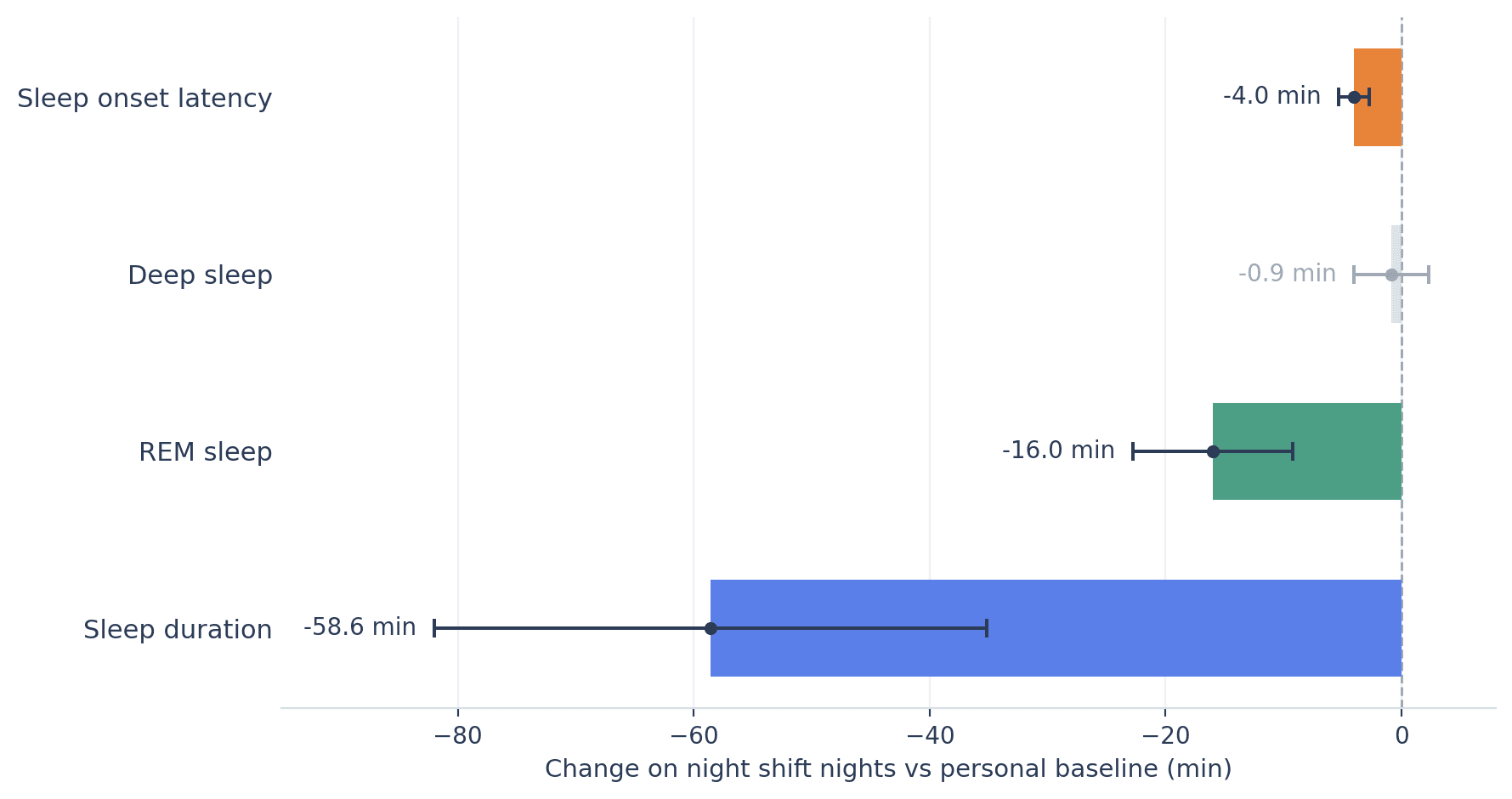
A night shift costs nearly an hour of sleep. Total sleep drops about 60 minutes against personal baseline and REM falls 16 minutes, while deep sleep barely moves.
You fall asleep faster, not slower. Shift nights are exhausting, and sleep onset comes about 4 minutes quicker than usual.
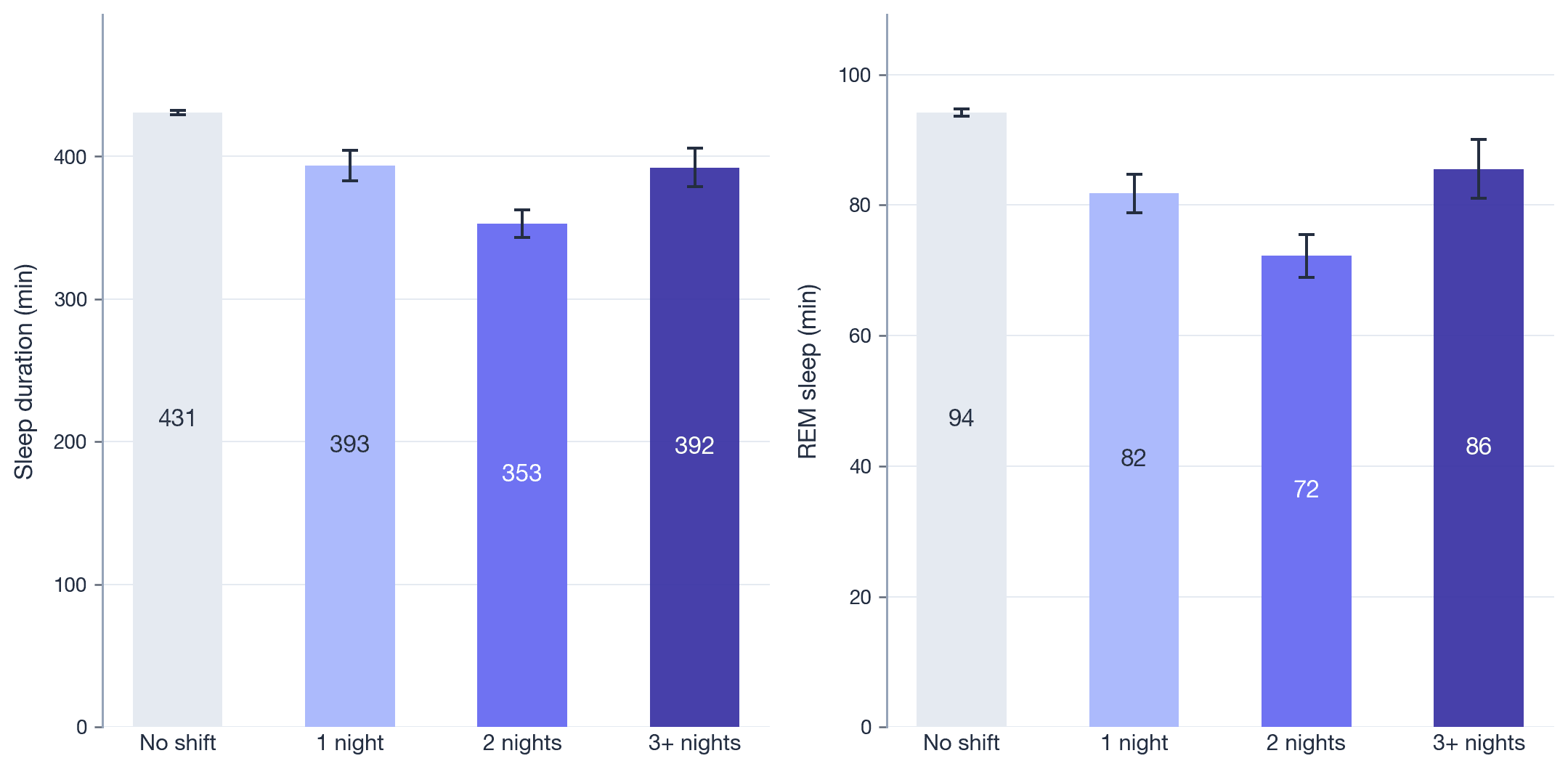
The second consecutive shift is the worst. Sleep bottoms out at 353 minutes on night two, then recovers to 392 by night three and beyond as the body adapts to the new rhythm.
The body is tied to a rigorous circadian rhythm, telling us when to go to bed and when to wake up. However, when life gets in the way, these patterns are disrupted. In this blog we analyse the effects of late-night working days or on-call shifts on our sleep, and how the effects linger up to a couple of days after.
Work shift schedules
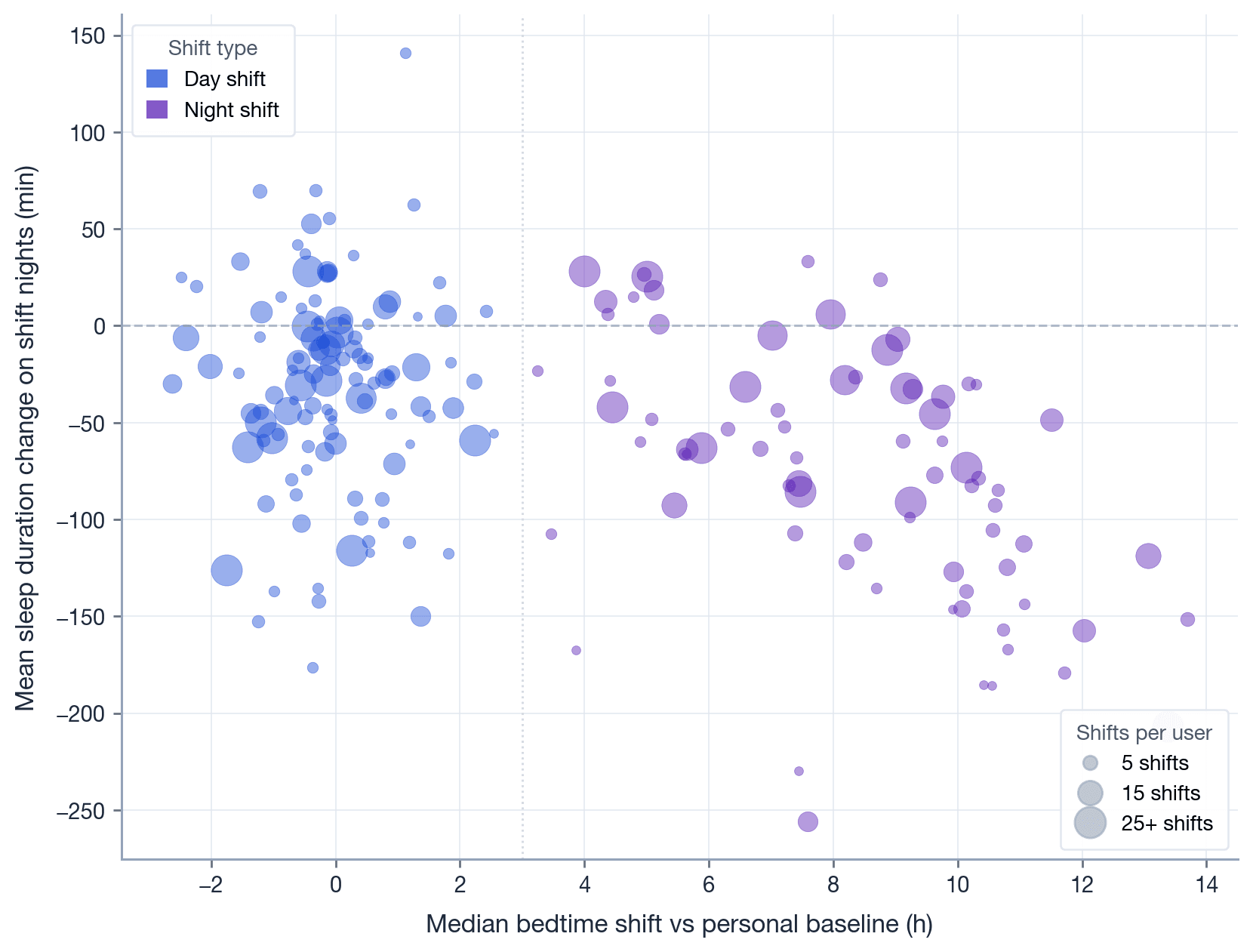
We analyzed 17,775 nights of workers' sleep. Each bubble in the chart below is one person, sized by the number of shifts they logged, from 3 to over 100.
Among night workers, the relationship is linear with every extra hour of median bedtime shift costs 12.7 minutes of sleep.
Figure 1: Scatter plot of sleep duration and timing shift across day-time and night-time work shift users.
Get the latest Terra Research reports and insights every week as soon as they're published.
Going to bed five to twelve hours later than your body expects causes a drop in total sleep duration by 1 hour on average. Despite deep sleep being unaffected, REM sleep (the phase associated to memory consolidation, emotional processing, and hormonal regulation) is statistically lower compared to no shift nights.
On the other hand, night shifts are exhausting and users actually fall asleep faster, around four minutes quicker than usual.
Figure 2: Forest chart of effects of shifts compared to user baseline.
Recovering from shift
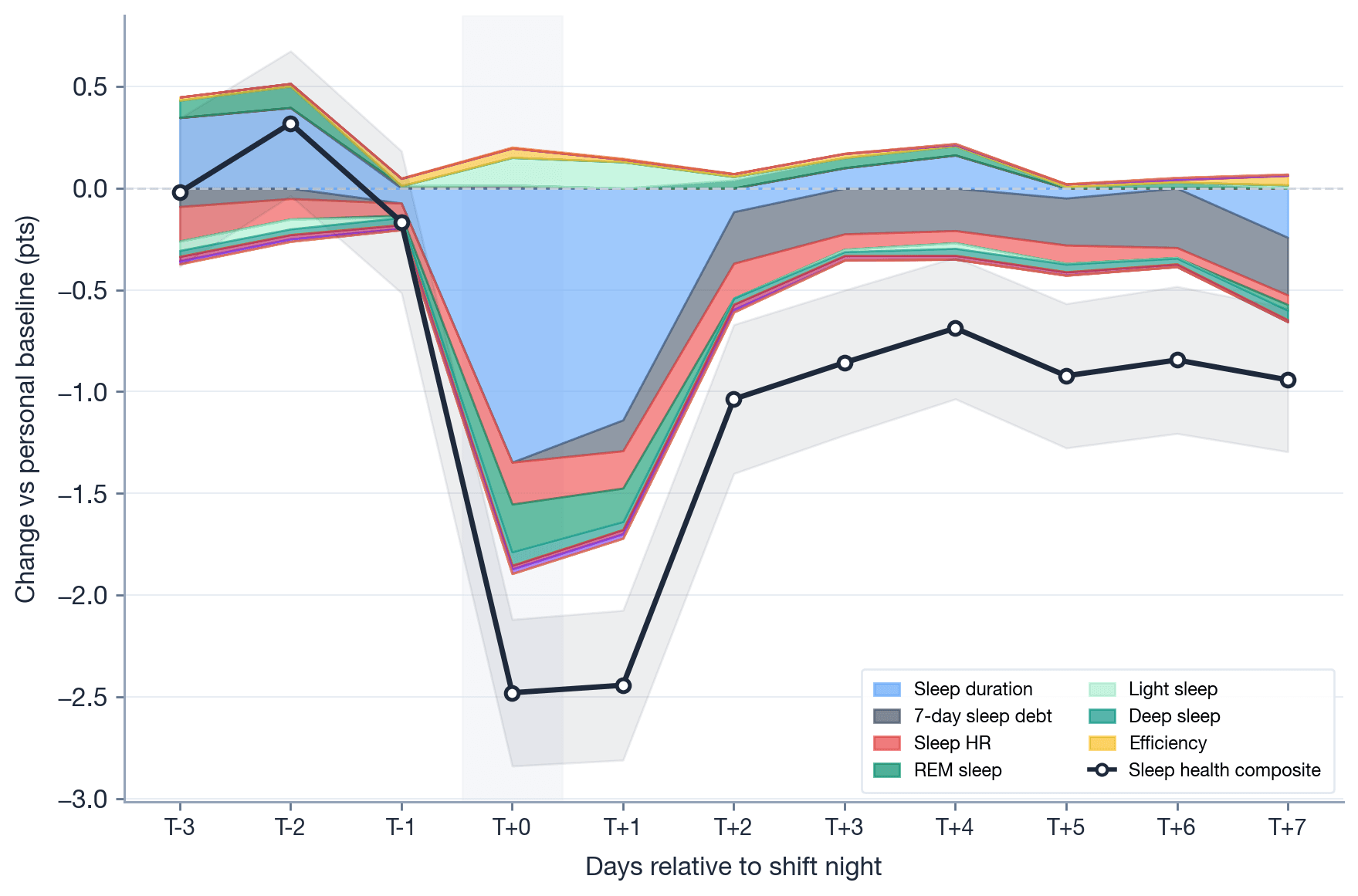
We built a composite sleep health metric combining total sleep duration, time in each sleep stage, accumulated sleep debt across the preceding week, and overnight heart rate. The plot shows the trajectory from three days before a shift to seven days after. There is a significant drop on shift nights, and the day immediately after is equally low.
From around day two, the score starts to rise again, but remains lower than pre-shift throughout the week.
Figure 3: Trajectory of sleep health metrics aggregate from 3 days prior to shift and up to 7 days after.
One-off or the new normal?
A single night of shift causes a big disruption. A second consecutive shift makes it worse. Sleep duration and REM time fall to their lowest point, as the circadian clock is being pushed further from its natural rhythm. From the third consecutive shift onward, sleep duration and REM time begin to recover as the body adapts to the new schedule.
This aligns well with research on circadian adaptation and jet lag research, where the biological clock is able to reset, but takes three to four days[1].
Figure 4: Bar chart of sleep duration and REM sleep time through consecutive shift nights. Sleep quality drops on shift days, and recovers when the pattern is consistent enough.
What does this all mean?
Night shifts force the body to override the circadian rhythm, and this costs us our sleep. Sleep after a shift is shorter and has less REM. The body then needs a multi-day recovery but it can adapt if shifts are frequent enough. However, with unpredictable shifts, the body struggles to find a stable circadian rhythm.
References
Folkard, S. (2008). Do permanent night workers show circadian adjustment? A review based on the endogenous melatonin rhythm. Chronobiology International, 25(2–3), 215–224.
Summary questions
How long does it actually take to recover from a night shift?
About four days. The composite sleep health metric — combining total sleep duration, sleep stage distribution, weekly sleep debt, and overnight heart rate — drops sharply on the shift night and stays equally low the day after. It starts climbing around day two but remains below pre-shift baseline through the full seven-day post-shift window.
How much sleep do I lose when I go to bed hours later than usual?
Going to bed five to twelve hours later than your body expects costs you roughly one hour of total sleep on average. Among night-shift workers, there's a clear linear trend: the later the bedtime shift, the greater the sleep loss. Day-shift workers, whose bedtimes stay near baseline, don't show this penalty.
Does deep sleep or REM sleep take the bigger hit on shift nights?
REM sleep. Deep sleep is essentially unaffected by shift work, but REM — the stage tied to memory consolidation, emotional processing, and hormonal regulation — drops statistically compared to non-shift nights. That means the sleep you do get after a shift is qualitatively worse, not just shorter.
Why do I fall asleep faster after a night shift if it's supposed to be bad for me?
Because you're exhausted. Wearable data shows shift workers fall asleep about four minutes quicker than their personal baseline on shift nights. Faster sleep onset here isn't a sign of good sleep — it's a marker of accumulated fatigue from overriding the circadian rhythm.
Are back-to-back night shifts worse than a single one?
Yes, initially. A second consecutive shift pushes sleep duration and REM time to their lowest point as the circadian clock is dragged further from its natural rhythm. But from the third consecutive shift onward, both metrics start recovering as the body adapts — mirroring the three-to-four-day adjustment window seen in jet lag research.
Is it better to work night shifts consistently or occasionally?
Consistently. The body can reset its circadian clock within three to four consecutive shifts, and sleep quality recovers once the pattern stabilizes. Unpredictable or one-off shifts are the worst case — they trigger the full disruption without ever allowing biological adaptation to take hold.
Can wearable data actually detect circadian disruption from shift work?
Yes. By combining self-reported shift tags with sleep duration, sleep stage breakdown, sleep debt, and overnight heart rate, wearables cleanly separate day-shift from night-shift users and quantify the ~1 hour sleep loss, REM suppression, and multi-day recovery trajectory. The signal is strong enough to distinguish one-off disruptions from adapted schedules without lab polysomnography.
Why do I still feel off two or three days after a night shift?
Because your sleep health hasn't fully recovered yet. The composite metric shows the day after a shift is just as bad as the shift night itself, and even by day seven it hasn't returned to pre-shift baseline. Recovery is gradual, not overnight — plan for a multi-day rebound rather than expecting one good sleep to reset you.