We use cookies to enhance your browsing experience and analyse our traffic. By clicking “Accept All”, you consent to our use of cookies according to our Cookie Policy. You can change your mind any time by visiting out cookie policy.
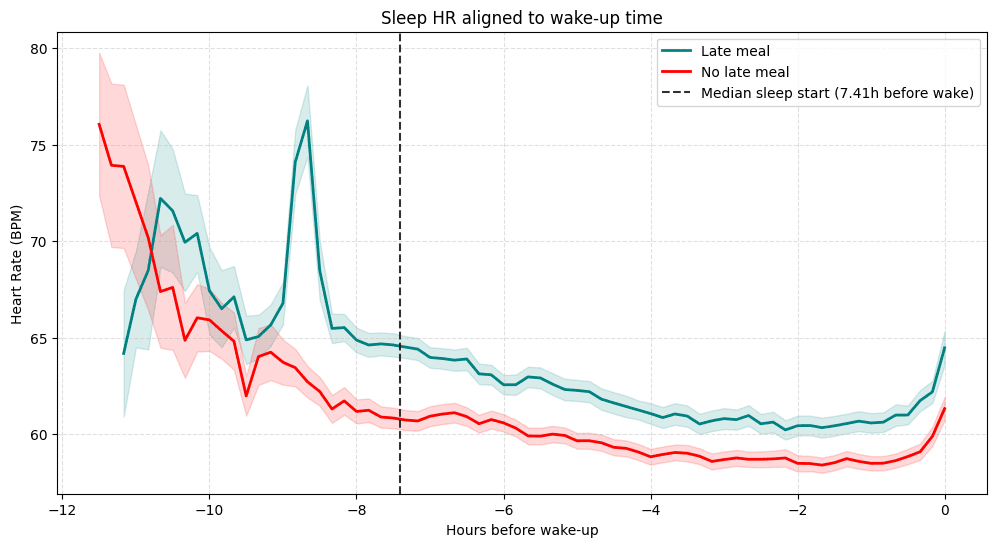
Late meals raise your heart rate during sleep. Maximum heart rate was 1.54 bpm higher on late meal nights, and the elevation persists throughout the whole night, not just around bedtime.
You also stay awake more. Late dinners added 7.4 minutes of awake time and around 1 minute of sleep latency on average, suggesting wakefulness after sleep onset takes the bigger hit.
Sleep architecture stays intact. We found no significant change in time spent in rem, deep or light sleep, which matches previous studies showing late meals affect heart rate and wakefulness more than sleep stages.
Late Meals Make Your Heart Work Harder
The clearest effect of having a later meal is that our heart rate during the night is elevated. Through linear mixed effects model, we found that, on average, maximum heart rate increased by 1.54 bpm on nights where users had a later meal compared to when they did not. This value was statistically significant (p < 0.05).
The elevated heart rate persists throughout the night, and follows a similar trend to the heart rate profile on nights without a late meal. This suggests late dinners may raise nocturnal cardiovascular and metabolic activation overall, rather than reshaping the sleep-stages pattern.
A higher cardiovascular and metabolic level is consistent with the thermogenesis effects of digestion where blood flow shifts toward the gut and metabolic rate rises as a result of the nutrient absorption.
Figure 1: Mean heart rate 4h prior to bed time through to wakeup time on nights with late meals (in teal) and nights without late meals (in red). The teal peak around 2h before bedtime is likely the time of meal consumption.
Get the latest Terra Research reports and insights every week as soon as they're published.
Motivated to understand why the heart rate trend follows a similar shape on late and early dinner nights, we studied the statistical effects of late dinners on different sleep metrics.
Using paired within-user analysis, we found a small but statistical increase in sleep latency of around 1 minute. We also found that on late dinner nights, awake time increased by 7.4 minutes on average (p < 0.05). This suggests that late meals impact wakefulness after sleep onset more than it affects the time it takes to fall asleep.
This aligns with the randomized crossover dinner-timing study, which reported lower sleep efficiency and more awakenings after late dinner[1]. Physiologically, if metabolism remains more active during the early night, sleep may become easier to interrupt even if total time in bed does not change much.
There was no significant difference in duration of each of the sleep stages (rem, deep and light). This fits some of the findings in literature; a study comparing dinner 5 hours vs 1 hour before bed found no major overall architecture change, but reported a redistribution across the night, with deeper sleep earlier and lighter sleep later [2].
The Hidden Cost of Eating Late
While a late meal might seem to not impact our routines, our lifestyle or health, it carries a hidden effect: our heart rate during the night.
Late dinners rise our cardiovascular activation because a late digestion increases blood flow into our gut, rises our temperature and metabolic rate and as a result our heart rate. Higher activation can increase our wakefulness, delay our sleep onset and disrupt our sleep. All of this can impact our bodies and how prepared for our day.
Previous research has suggested higher heart rate at night is also linked to poorer recovery, so in the long term, yes late dinners can have negative impacts!
Duan, D., Gu, C., Polotsky, V. Y., Jun, J. C., & Pham, L. V. (2021). Effects of Dinner Timing on Sleep Stage Distribution and EEG Power Spectrum in Healthy Volunteers. Nature and science of sleep, 13, 601–612. https://doi.org/10.2147/NSS.S301113
Summary questions
Does eating dinner late actually raise my heart rate while I sleep?
Yes, and the effect is measurable. Using a linear mixed effects model, maximum nocturnal heart rate was 1.54 bpm higher on nights following a late meal compared to nights without one (p < 0.05). The elevation persists across the entire night rather than spiking briefly, indicating sustained cardiovascular activation while you sleep.
Why does a late dinner make my heart work harder overnight?
It comes down to digestion-driven thermogenesis. When you eat close to bedtime, blood flow shifts toward the gut, body temperature rises, and metabolic rate increases to absorb nutrients — all of which push heart rate up. Your cardiovascular system effectively stays in a mildly activated state instead of dropping into full recovery mode.
Will eating late make it harder for me to fall asleep?
Only marginally. Paired within-user analysis showed sleep latency increased by just about 1 minute on late-dinner nights. The bigger issue isn't falling asleep — it's staying asleep, since awake time after sleep onset rose by 7.4 minutes on average (p < 0.05).
Does a late meal change my sleep stages — REM, deep, or light sleep?
No. There was no significant difference in the duration of REM, deep, or light sleep on late-dinner nights. This matches prior research showing dinner timing doesn't reshape overall sleep architecture, though it may redistribute deeper sleep earlier in the night and lighter sleep later.
If my total sleep time is the same, does a late dinner really matter?
Yes — the hidden cost is cardiovascular, not duration-based. Even when time in bed looks unchanged, elevated nocturnal heart rate (+1.54 bpm max) and an extra 7.4 minutes of wake time signal that your body isn't recovering as deeply. Higher nighttime heart rate has been linked to poorer recovery, so the impact accumulates over time.
How long before bed should I finish eating?
The data shows the late-meal heart rate signature peaks around 2 hours before bedtime, which is likely when consumption occurred. Comparative literature cited here contrasted dinners eaten 5 hours vs 1 hour before bed, with the earlier timing producing better outcomes. Pushing your last meal earlier in the evening is the simplest lever to lower nocturnal cardiovascular load.
Can wearable data actually detect the effect of meal timing on sleep?
Yes. Using paired within-user analysis and linear mixed effects models on wearable heart rate and sleep data, this study detected a 1.54 bpm increase in max nocturnal heart rate and a 7.4 minute increase in wake time tied specifically to late meals. These are subtle physiological signals that wearables capture reliably at scale without lab equipment.
Why am I waking up more at night even though I feel like I slept enough?
Late eating is a plausible culprit. The data shows late dinners increase wakefulness after sleep onset by roughly 7.4 minutes — likely because elevated metabolism and heart rate during early sleep make you easier to rouse. If you're eating close to bedtime, your sleep is more interruptible even if total time in bed looks normal.