We use cookies to enhance your browsing experience and analyse our traffic. By clicking “Accept All”, you consent to our use of cookies according to our Cookie Policy. You can change your mind any time by visiting out cookie policy.
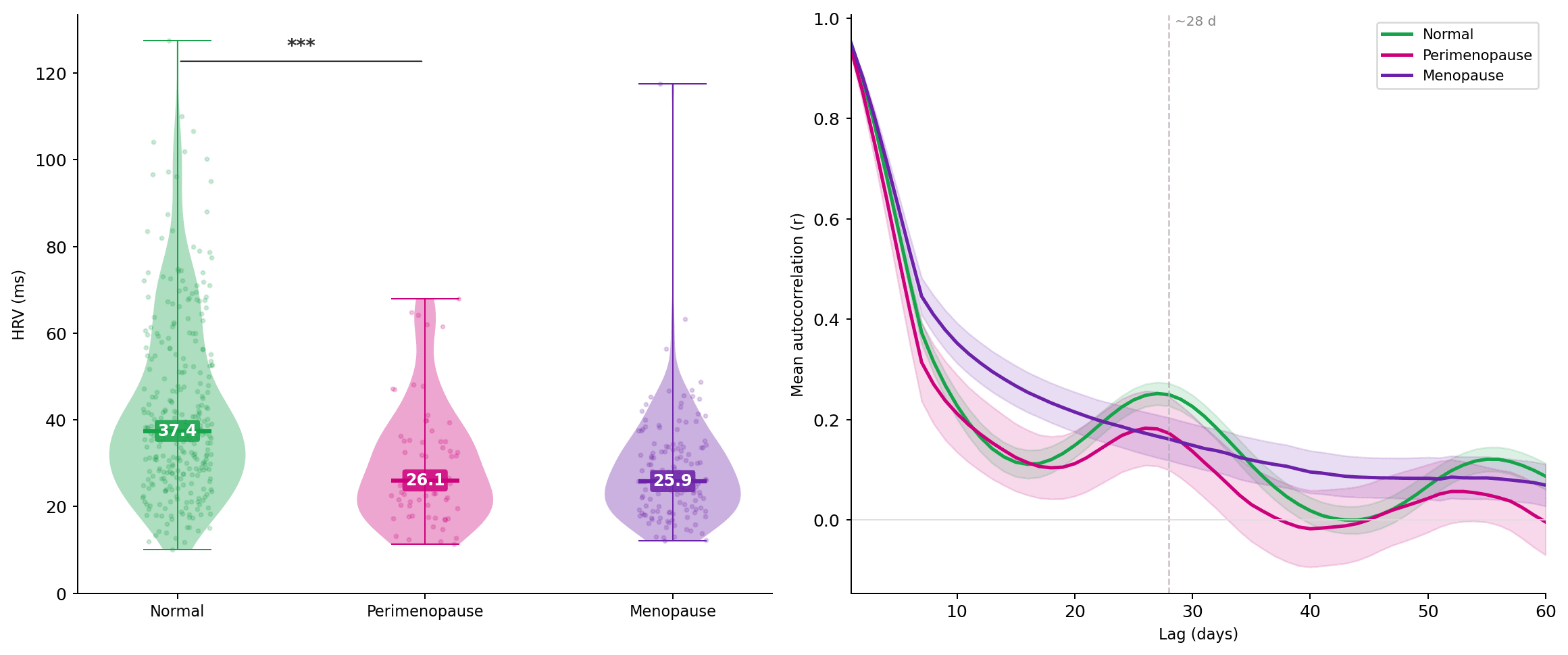
Nighttime HRV drops around 11 ms in perimenopause and stays down. After periods stop, HRV remains suppressed and loses its monthly rhythm entirely.
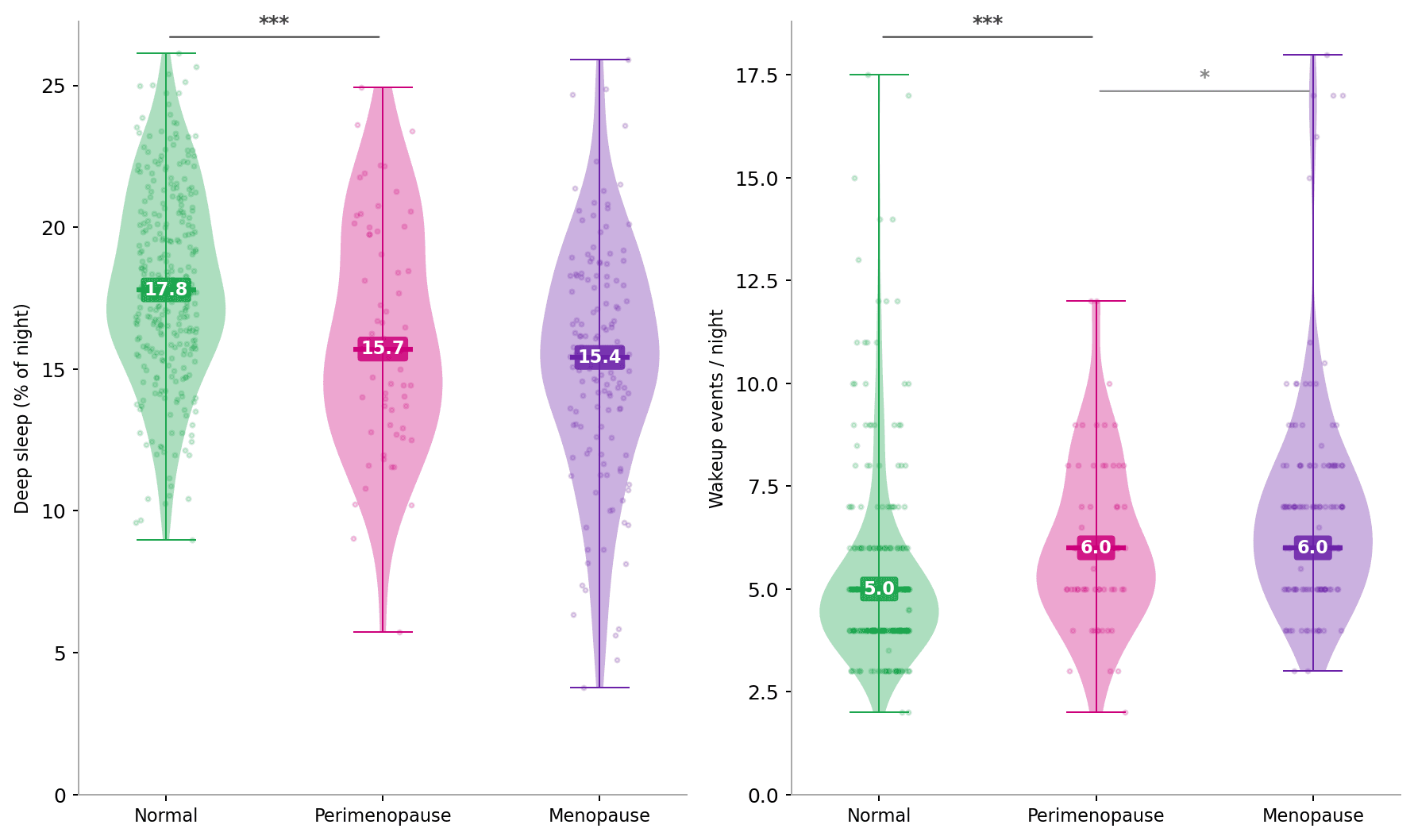
Sleep quality measurably declines. Deep sleep falls from 17.8% to 15.4% of the night across the transition, and wakeup events increase.
Hot flashes leave a temperature signature. Skin temperature can rise up to 3 °C during an episode, and nocturnal hot flashes were 5 to 15% more likely on nights with alcohol or late exercise.
Menopause is a normal stage of women aging, where oestrogen and progesterone hormone levels decline greatly and periods permanently stop[1]. While non-invasive and instantaneous hormone level monitoring is not widely available, consumer wearables track daily physiological signals as proxies for hormone changes.
Physiological Biomarkers
During the transition to menopause, known as perimenopause, the body starts to shift and show symptoms. Physiologically, the most significant change is a suppressed night-time HRV which drops by around 11ms. However, during perimenopause the body still follows a monthly rhythm and the HRV although suppressed has an autocorrelation peak at ~28 days.
Once periods permanently stop and menopause is established, HRV remains suppressed without any significant change from perimenopause but it stops ‘cycling’ which we see as the autocorrelation profile flattens.
Figure 1: HRV distribution as a violin plot (left) before menopause in green, during perimenopause in pink and menopause in purple. HRV autocorrelation on the right. HRV is suppressed during menopause and loses its cyclical pattern when periods permanently stop.
Get the latest Terra Research reports and insights every week as soon as they're published.
One of the most frequent symptoms that women report are hot flashes. Hot flashes are a brief and sudden sensation of heat, flushing and sweating during which the skin temperature can rise up to 3 °C degrees over your usual temperature[2]. Nocturnal hot flashes were found to be 5-15% more likely to be reported on nights were alcohol was consumed or the user exercised late. All of these effects were significant (p < 0.05).
Sleep quality is also affected during perimenopause and menopause. On average women spend less time in deep sleep and experience more wakeup events.
Figure 2: Deep sleep and wakeup events violin plot distribution before, during perimenopause and after menopause. Deep sleep duration drops and wakeup events increase with menopause.
Detecting Menopause Through Wearables
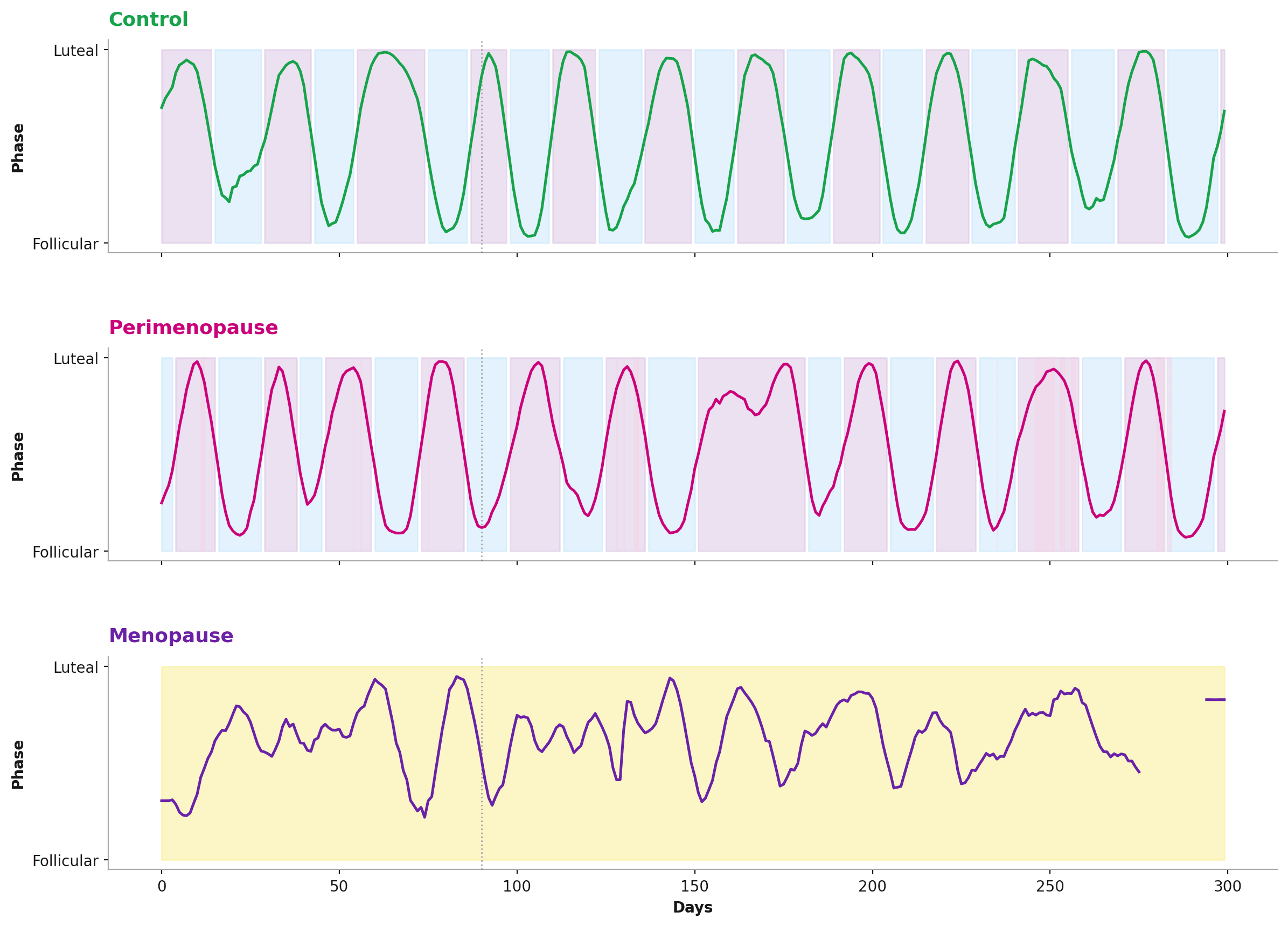
At Terra we have carried out analyses on the menstrual cycle by modeling it as a continuous luteal-follicular trajectory. This sinusoid-looking projection of the cycle has shown to flag irregularities in birth control users. Perimenopause, has a distinct signal in night-time HRV but does not show up as a disruption in this model. However, menopause has a clear disruption to the cycle.
Figure 3: Menstrual cycle sinusoidal model. Top panel shows a normal cyclic control user, middle panel is a user with perimenopause with a still cyclical pattern, and bottom panel shows high disruption during menopause.
This anomaly-detection model built on the sinusoidal representation of the menstrual cycle is causal, as opposed to the autocorrelation analysis, and therefore can be exploited for real-time menopause detection via wearables.
Can wearables actually detect that I'm entering perimenopause?
Yes — night-time HRV is the clearest early signal. During perimenopause, HRV drops by roughly 11ms compared to pre-menopause baseline, even while the monthly cycle rhythm is still intact. This suppression shows up in wearable data before periods permanently stop, making HRV a leading indicator of the hormonal transition.
What's the difference between perimenopause and menopause in my wearable data?
Both show suppressed HRV, but the cyclical pattern is the key distinguisher. In perimenopause, HRV autocorrelation still peaks at ~28 days, meaning the body maintains its monthly rhythm despite lower HRV. Once menopause is established, that autocorrelation profile flattens entirely — HRV stops cycling because periods have permanently stopped.
Why am I getting more night sweats after drinking or exercising late?
The data confirms this isn't coincidence. Nocturnal hot flashes were 5–15% more likely to be reported on nights when alcohol was consumed or the user exercised late in the evening, and both effects were statistically significant (p < 0.05). If hot flashes are disrupting your sleep, shifting workouts earlier and cutting evening alcohol are two evidence-backed levers.
How much does sleep quality actually change during menopause?
Measurably and in two directions at once. Women in perimenopause and menopause spend less time in deep sleep and experience more wakeup events per night compared to their pre-menopause baseline. It's not just that sleep feels worse — the architecture of the night genuinely shifts, with lighter, more fragmented sleep becoming the norm.
How much can my skin temperature spike during a hot flash?
Up to 3°C above your usual baseline. That's a large enough thermal signal for wrist- or finger-worn wearables with skin temperature sensors to pick up in real time, which is why nocturnal hot flashes are trackable at all. The brief, sudden nature of the spike is what distinguishes it from ambient warming or normal circadian temperature shifts.
Can wearable data detect menopause in real time, not just in hindsight?
Yes — using a sinusoidal luteal-follicular cycle model, menopause shows up as a clear disruption to the expected monthly trajectory. Unlike autocorrelation analysis, which is retrospective, this anomaly-detection approach is causal and can flag menopause as it's happening. Perimenopause, however, doesn't disrupt this model because the cycle is still running — you need the HRV signal to catch that earlier stage.
Does HRV keep dropping once menopause is established?
No. HRV remains suppressed at the perimenopause level but doesn't show significant further decline once periods permanently stop. The bigger change at that point is structural: HRV loses its cyclical pattern entirely rather than continuing to fall in magnitude.
Why does my cycle-tracking model still look normal even though I feel perimenopausal?
Because perimenopause preserves the monthly rhythm — the sinusoidal luteal-follicular projection still looks cyclical, similar to a birth-control user's trace. The perimenopause signal lives in night-time HRV suppression (~11ms drop), not in cycle-shape disruption. Only full menopause breaks the sinusoidal pattern, which is why HRV, not cycle regularity, is the biomarker to watch during the transition.