We use cookies to enhance your browsing experience and analyse our traffic. By clicking “Accept All”, you consent to our use of cookies according to our Cookie Policy. You can change your mind any time by visiting out cookie policy.
We analyzed 37,000+ nights of wearable data to understand how caffeine really affects your sleep. The results? Caffeine doesn't just cost you 10 minutes, but it attacks your sleep quality hard. REM takes the biggest hit, followed by deep sleep. Blood oxygen appears to drop, but that's misleading.
Caffeine's damage is invisible — You won't toss and turn more, but the real harm is happening underneath. Sleep architecture breaks down in ways you can't feel and the effects are worse than most people assume.
REM sleep takes the biggest hit — Caffeine reduces time in REM more than any other stage, with a drop in REM events too. Deep sleep comes second. Light sleep is barely touched.
Blood oxygen drops are misleading — SpO2 appears to fall, but when you look at individual users, the pattern disappears. It's likely an artifact of fragmented sleep, not a direct caffeine effect.
Correlating Caffeine and Tiredness
During a recent dig through our data, we found that we had access to information about whether someone had consumed caffeine during the day. As researchers, discovering a column like this is one of the best things that could happen during work. To uncover what was worth investigating, we ran a linear model across our activity and sleep columns fixing this caffeine flag as a dependent variable.
One of the mechanisms through which we regulate tiredness is adenosine—a neurotransmitter that latches onto to four different receptors in the central nervous system. Caffeine is an adenosine receptor antagonist; it latches onto the receptors that would otherwise be used by adenosine, making us feel less tired [1].
Intuitively, we understand this. Don’t have caffeine late if you’d like to sleep on time, down some coffee in the morning if you’re still sleepy. But what do the numbers say? What’s actually happening on a deeper level? Our investigation led to mixed results—some expected, others that may not be the most obvious.
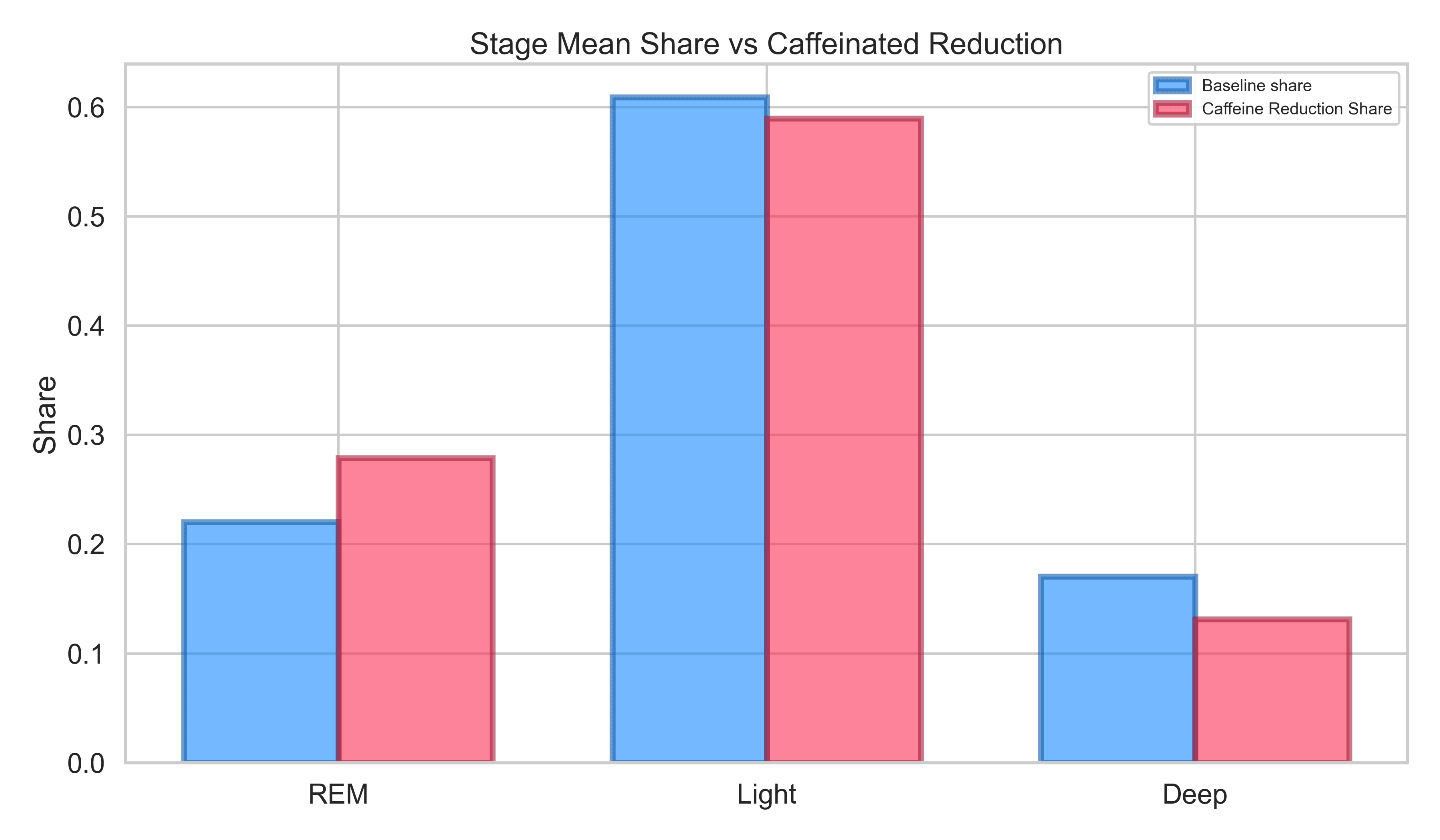
Let’s start with the most obvious, you sleep less when you drink caffeine. In our sample this showed up as a 10-minute difference with a standard error of 2-minutes. Not surprising. We also looked at how the reduction of time spent in the different sleep stages after caffeine consumption; comparing this to the proportion of time spent in each stage for people who had not consumed any caffeine. Figure 1 shows this as a bar plot across all stages.
Figure 1: Baseline share of stage duration against duration reduction in stages due to caffeine consumption.
The order is clear, the order of impact on stages is REM, deep, and then light. In other words, the parts of your sleep that are most important are most affected by consumption of caffeine. It’s not just duration that’s impacted, it’s quality. This shows up in another one of our columns ‘num_rem_events’. We see a drop in the number of REM events during sleep across with a mean reduction of 0.2 and a standard error of 0.09. Clearly, caffeine consumption is not most conducive to a good night’s rest.
Get the latest Terra Research reports and insights every week as soon as they're published.
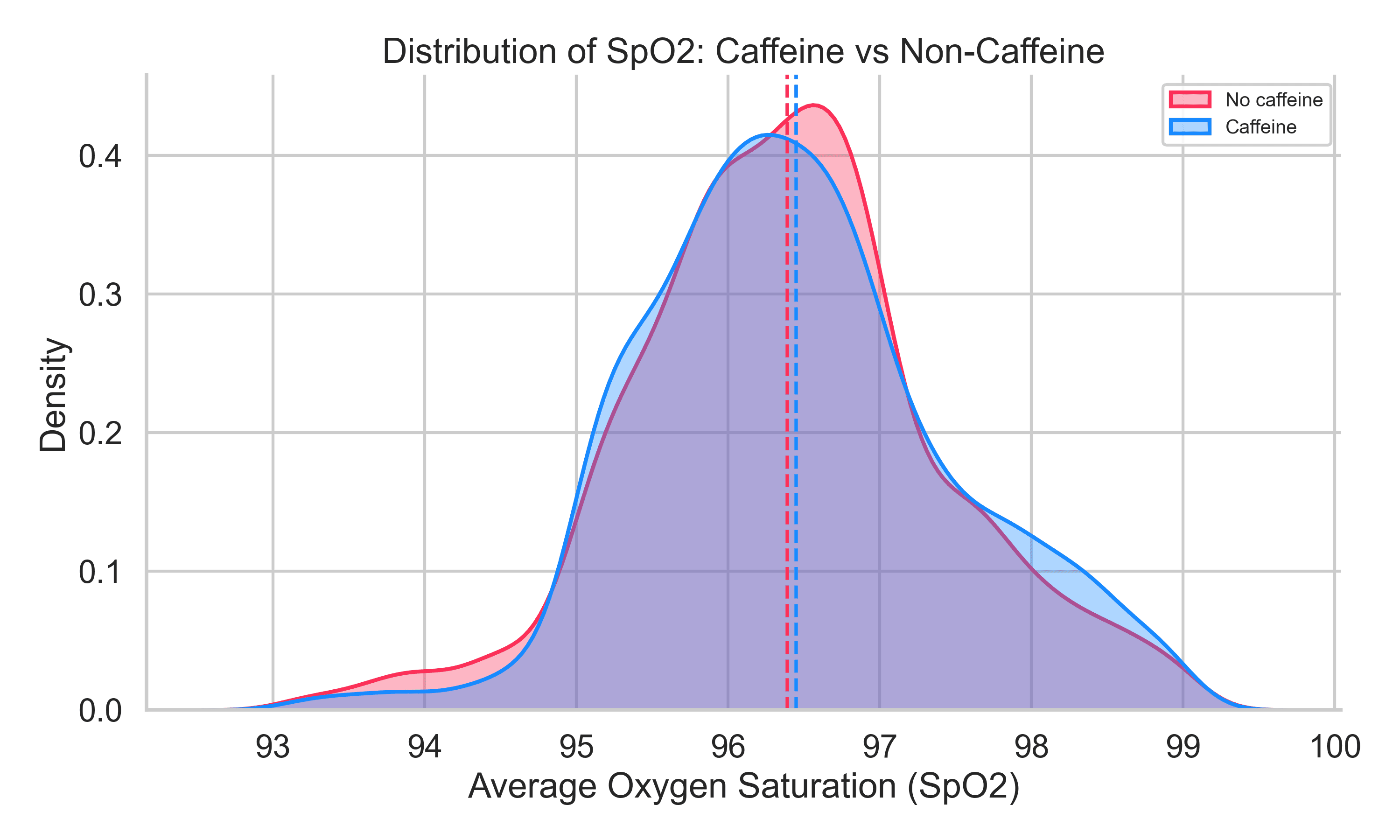
But what about other effects? Let’s look at a somewhat surprising result; drop in blood oxygenation. In our investigation this showed up as a reduction of 1.92, with a standard error of 0.84. This is a big swing for blood oxygenation during sleep, where difference between good and bad typical values are separated by a narrow gap. It’s important to note that this may be an artefact of the fragmented sleep we talked about earlier. We investigated further by plotting the distribution differences among non-caffeinated nights and caffeinated nights. This revealed nothing major, however caffeinated distributions seemed to often have a slightly wider spread (Figure 2). When looking at individual users, this pattern did not persist. This further confirmed to that this blood oxygenation results was perhaps due to the fragmented sleep mentioned earlier.
Figure 2: Distribution of blood oxygen (SpO2) on caffeine vs non-caffeine nights. The caffeine distribution is slightly wider and left-shifted, but the difference in means is small, which is likely driven by fragmented sleep rather than a direct caffeine effect.
For a final result, let’s take time spent awake in bed. We surprisingly found no substantial change to the time spent awake in bed. We saw this in two different ways. First, the difference of the caffeine effect between seconds spend in bed and asleep time differed only by five seconds. Second, the p-value for the caffeine effect on awake time in bed was ~0.9. Both results led to the same conclusion—there was no meaningful effect on time spent lying awake in bed.
Still, sleep is only one side of the coin; it’s important to look at activity too. About half the significant effects we discovered had to do with time spent doing an activity! We’ll cover this on another blog soon, so stay tuned!
References
[1] Reichert, Carolin Franziska et al. “Adenosine, caffeine, and sleep-wake regulation: state of the science and perspectives.” Journal of sleep researchvol. 31,4 (2022): e13597. doi:10.1111/jsr.13597
Summary questions
Does caffeine actually make me sleep less?
Yes, but the total time loss is smaller than most people assume. In this dataset, caffeine consumption was associated with a 10-minute reduction in sleep duration, with a standard error of 2 minutes. The bigger story isn't how much less you sleep — it's which parts of sleep get cut.
Which sleep stage does caffeine hurt the most?
REM sleep takes the biggest hit, followed by deep sleep, with light sleep affected least. When comparing stage duration reductions on caffeinated nights against baseline stage proportions, the impact ranks REM > deep > light. In other words, caffeine disproportionately strips away the most restorative stages of your sleep.
Does caffeine affect sleep quality or just sleep quantity?
Both. Beyond the 10-minute duration loss, the number of REM events during sleep dropped by a mean of 0.2 (standard error 0.09) on caffeinated nights. Sleep architecture itself becomes more fragmented — you're not just sleeping less, you're cycling through restorative stages less effectively.
Can caffeine lower my blood oxygen levels at night?
The data showed a 1.92-point drop in nighttime SpO2 with a standard error of 0.84 — a meaningfully large shift given how narrow the healthy SpO2 range is. However, when distributions were examined per individual user, the pattern didn't hold consistently. The most likely explanation is that fragmented, lower-quality sleep is driving the SpO2 reading down, not caffeine acting directly on oxygenation.
Why do I lie awake longer in bed after caffeine — or do I?
Surprisingly, you probably don't. The caffeine effect on time spent awake in bed had a p-value of roughly 0.9, and the difference between time-in-bed and time-asleep effects was only 5 seconds. Caffeine isn't keeping you staring at the ceiling — it's degrading the sleep you do get.
How does caffeine biologically interfere with sleep?
Caffeine is an adenosine receptor antagonist. Adenosine normally binds to four receptors in the central nervous system to signal tiredness, and caffeine occupies those receptors instead, blocking the sleepiness signal. That's why morning coffee wakes you up — and why late-day caffeine prevents the adenosine system from doing its job at bedtime.
Can wearable data detect caffeine's effects on sleep?
Yes. By treating a caffeine-consumption flag as a dependent variable in a linear model across activity and sleep columns, the analysis surfaced statistically meaningful effects on sleep duration, REM events, stage distribution, and SpO2. Consumer wearables capture caffeine's fingerprint on sleep architecture without any lab equipment or polysomnography.
If I want to protect my sleep, what should I take away from this?
The damage from caffeine isn't really about losing 10 minutes of sleep — it's about losing REM and deep sleep specifically, plus reduced REM events and downstream effects like fragmented SpO2 readings. If you're optimizing for recovery and cognition, timing caffeine earlier matters more than the total minutes-in-bed metric suggests.