We use cookies to enhance your browsing experience and analyse our traffic. By clicking “Accept All”, you consent to our use of cookies according to our Cookie Policy. You can change your mind any time by visiting out cookie policy.
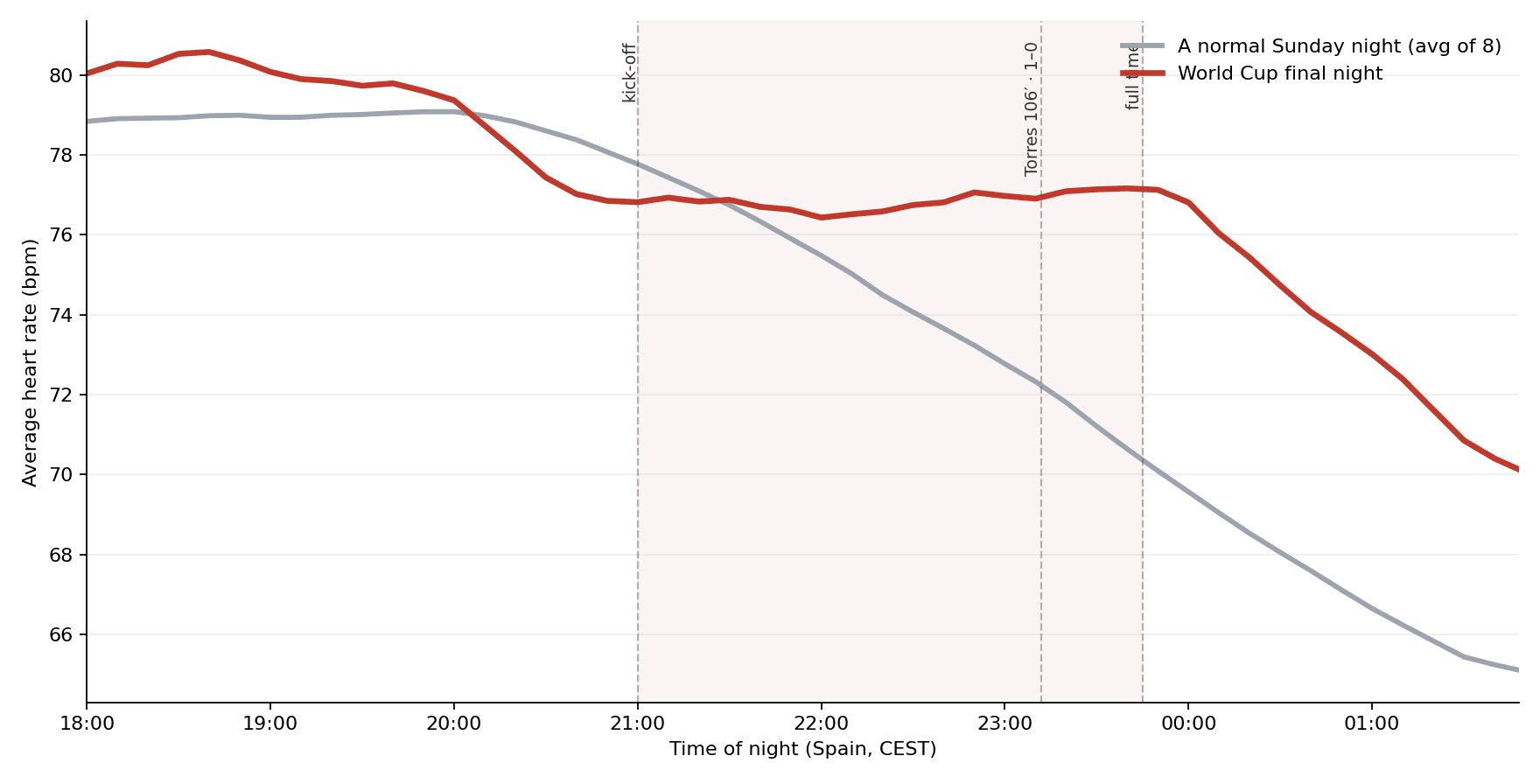
Heart rates ran ~7 bpm above a normal Sunday during the win, the largest response of any country studied.
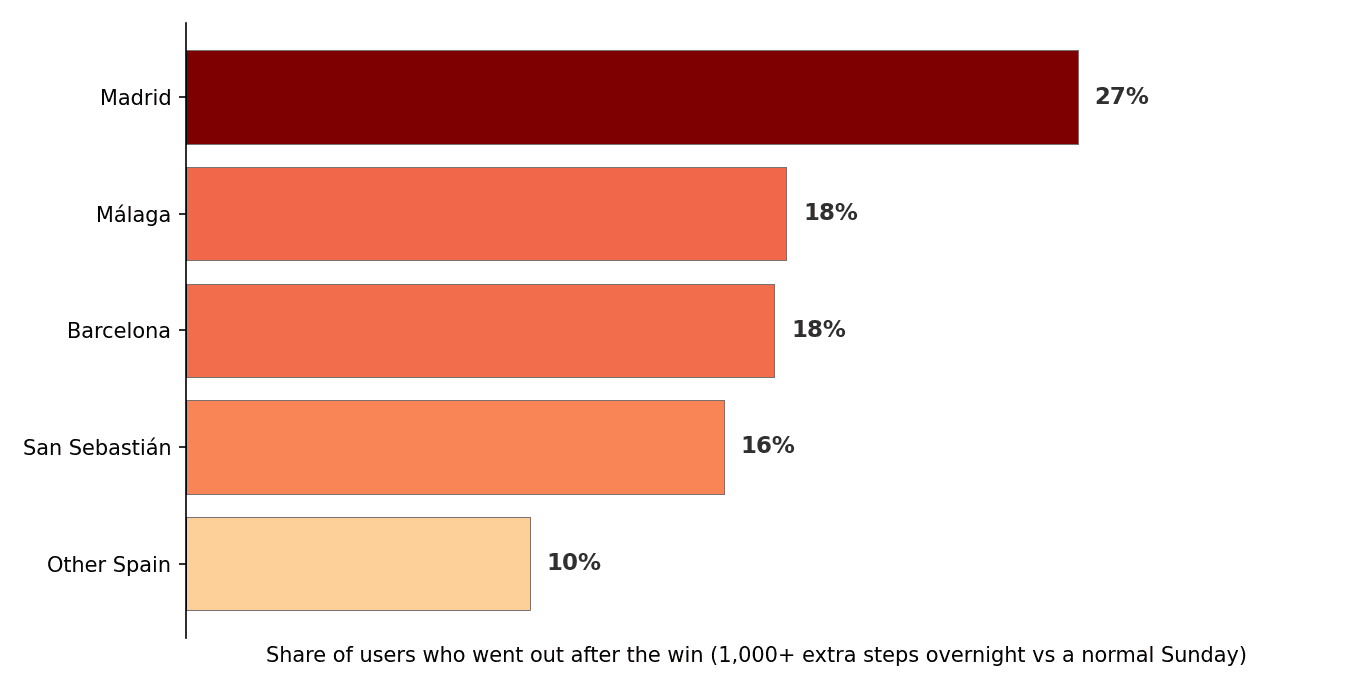
Celebrations spilled into the streets, with steps spiking over 1,000 above usual, clearest in Madrid and Málaga.
Winning has a hangover, with the nation barely moving the next morning as steps fell ~45%.
Spaniards took on the streets last Sunday to celebrate being world champions. Our excitement was clear through our heart rates during the game, our steps spiked as we went out to celebrate afterwards, and some of us had to take a day off from work the next day…
Game Adrenaline
On an average Sunday evening, heart rate usually declines steadily as we wind down before going to sleep. Last Sunday however, Spaniards stayed up to watch the game and the excitement kept our heart rates high. Over the whole match window, our heart rate was 1.63 bpm higher than normal, but as the whistle blew at full time our heart rates were more than 7 bpm higher than usual.
Figure 1: Average heart rate of Spaniards on a usual Sunday (in grey) and watching the world cup final (in red).
Get the latest Terra Research reports and insights every week as soon as they're published.
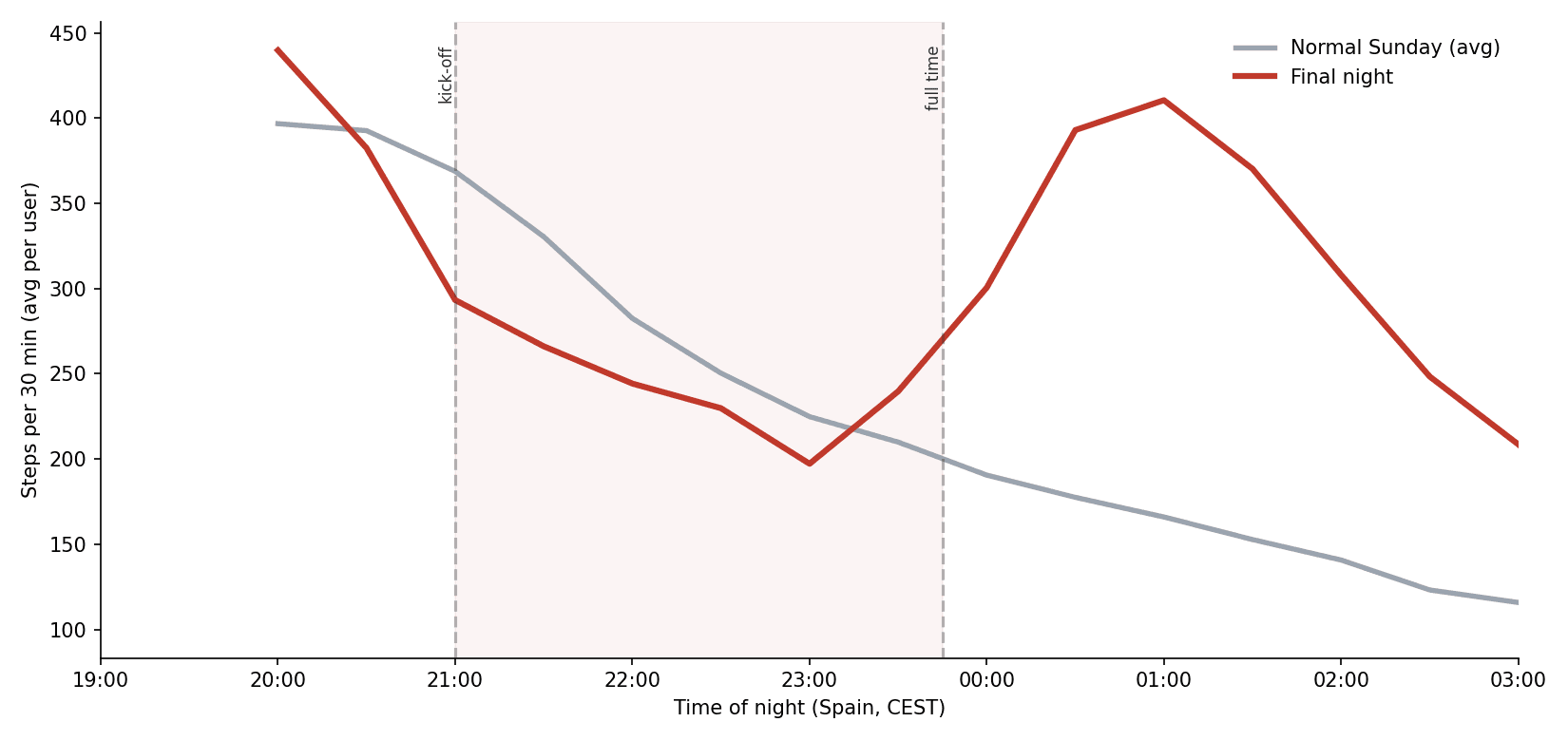
Spain moved less than usual during the match, around -100 steps/h compared to a normal Sunday, but erupted the moment it finished. The Spaniards took on the streets, and the average steps spiked around 1am.
Figure 2: Average steps throughout a normal Sunday evening (in grey) compared to the world cup final (in red).
The party wasn't spread evenly. Ranking cities by the share of users who went out afterwards, Madrid led, followed by Málaga, Barcelona and San Sebastian.
Figure 3: Spanish cities ranked by percentage of users who celebrated the world cup win after the match.
World Cup Final Viewers Across the Globe
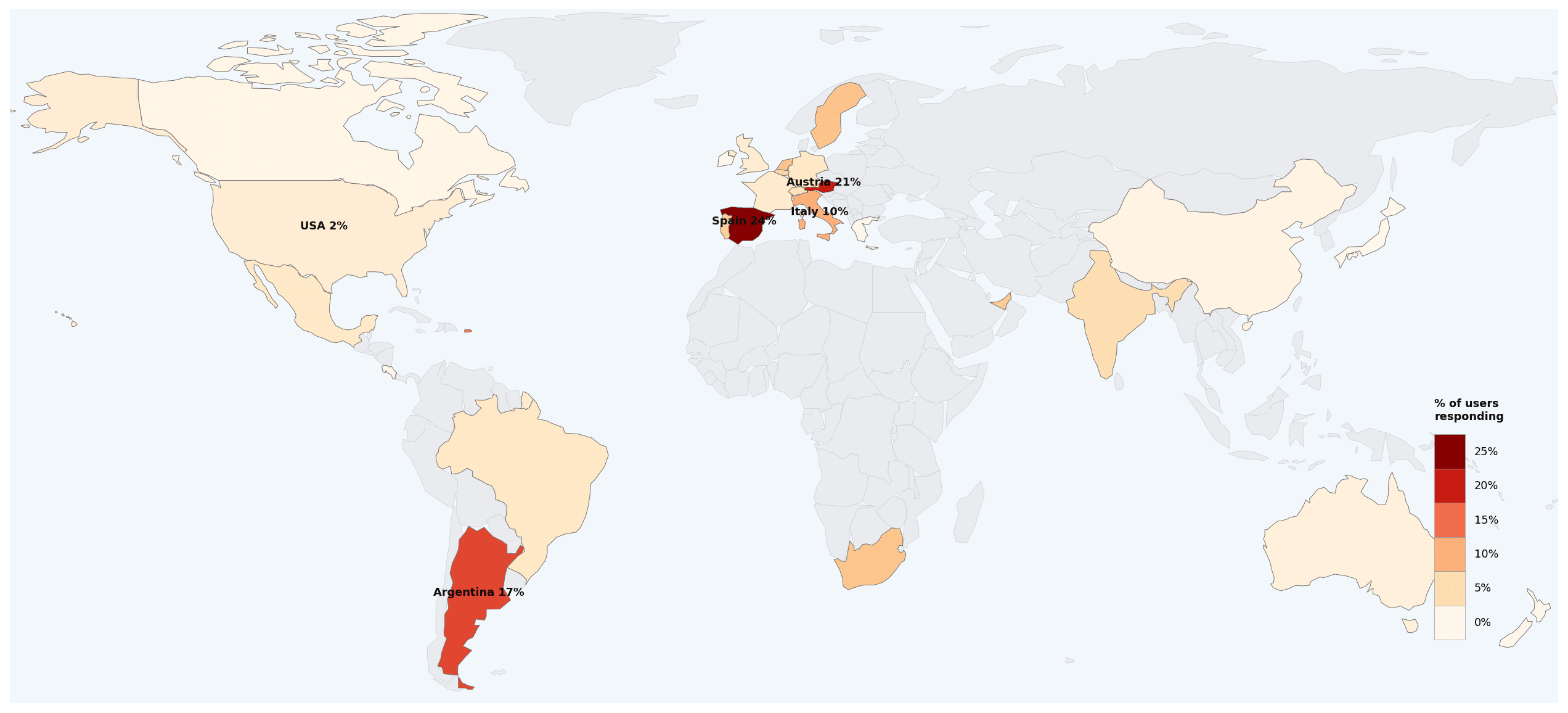
We use the high heart rate and step count over a usual Sunday as the signal to find users that were watching the final. Not surprisingly, Spain leads in percentage of viewers (followed by Argentina of course). Whether Argentinians had less viewers, or had a lower heart rate signal because they were less excited (sorry for the loss) we wont tell…
Interestingly, Austria and Italy came in third and fourth. Perhaps neighboring countries tend to support each other more strongly or Spaniards living abroad tend to chose European countries to move to. The USA, Mexico and Canada had a low percentage of viewers, but its also important to consider the vast population in the region and the signal of course being weaker as a result.
Figure 4: World map of countries, color coded by percentage of viewers.
Spaniards Called in… Sick…
The average bedtime shift was 42 minutes later than usual, but this distribution had a long right tail with the top 25% of users going to bed 2 hours later or more.
Partying all night had a next-day cost and Monday steps fell by ~45%. Spaniards opted for working from home due to ‘transport restrictions’ or simply calling in ‘sick’ [1]. But at the end of the day- WE WON!
References
Excusas utilizadas el lunes para llegar tarde al trabajo tras la victoria de España en el Mundial [“The most-used excuses for turning up late to work the Monday after Spain's World Cup win”]. Marca (Tiramillas), 20 July 2026. — Spanish media on the wave of late arrivals and ‘sick’ days the Monday after the final; the newsroom echo of our ~45% drop in Monday steps.
Summary questions
How much did Spaniards' heart rates spike during the World Cup final?
Across the full match window, average heart rate ran 1.63 bpm above a normal Sunday evening — but the real spike came at the final whistle, when heart rates were more than 7 bpm higher than usual. Instead of the typical Sunday wind-down curve, the excitement kept cardiovascular activity elevated right through what would normally be pre-sleep hours.
Did people actually move less during the match itself?
Yes. Spaniards logged about 100 fewer steps per hour than a normal Sunday while the match was on — everyone was glued to the screen. The reversal was dramatic though: steps erupted the moment the final whistle blew, peaking around 1am as fans poured into the streets.
Which Spanish cities partied hardest after the win?
Madrid led the celebrations by share of users who went out afterwards, followed by Málaga, Barcelona and San Sebastián. The post-match step spike wasn't evenly distributed across Spain — the capital drove the biggest surge in late-night activity.
Can wearable data actually identify who was watching the final?
Yes. By combining elevated heart rate with abnormal step patterns versus a typical Sunday, viewers can be flagged without any self-report. Spain topped the viewer share (followed by Argentina), with Austria and Italy surprisingly ranking third and fourth — likely reflecting neighboring-country support or Spanish expats concentrated in Europe.
How much later did Spaniards go to bed after the final?
The average bedtime shifted 42 minutes later than usual, but the distribution had a long right tail — the top 25% of users went to bed at least 2 hours later than normal. This wasn't a mild delay; a substantial minority effectively pulled an all-nighter.
Did winning the World Cup hurt productivity the next day?
Clearly. Monday steps dropped by roughly 45% compared to a typical Monday, consistent with widespread late arrivals, work-from-home claims, and 'sick' days reported in Spanish media. The celebration had a measurable next-day cost visible directly in movement data.
Why did the USA, Mexico and Canada show such low viewership signals?
Two reasons. Absolute viewer share was diluted by the region's much larger population base, and the physiological signal itself is weaker when emotional investment in the match is lower. Low percentages here reflect both denominator effects and genuinely less engagement rather than a clean measure of who tuned in.
What does this tell us about measuring collective emotional events with wearables?
National-scale sporting events leave a clear fingerprint across heart rate, steps, and sleep timing that's detectable without surveys. A 7+ bpm heart rate spike at full time, a 1am step surge, a 42-minute bedtime delay, and a 45% next-day step drop together paint a full behavioral arc — anticipation, celebration, recovery — from passive sensor data alone.