We use cookies to enhance your browsing experience and analyse our traffic. By clicking “Accept All”, you consent to our use of cookies according to our Cookie Policy. You can change your mind any time by visiting out cookie policy.
Running-based estimates landed within 6.6 ml/kg/min of the lab on average, with a correlation of 0.79 between wearable and lab values.
Resting-heart-rate estimates ran 9 points low, and a default value was the reason. When resting heart rate was missing and filled in as 60 bpm, estimates were 12.5 points low; when it was measured, 2.6.
One run isn't enough. The two largest misses, 12 and 13 points, came from people with a single run; the two closest, within 3 points, had 12 and 13 runs.
Get the latest Terra Research reports and insights every week as soon as they're published.
That led me to build three different estimates from wearable data: one using running pace and heart rate, one using cycling power and heart rate, and one using resting and maximum heart rate without needing a workout at all.
But there was an obvious question left unanswered.
If someone has actually been into a lab, put a mask on and completed a cardiopulmonary exercise test, how close are these estimates?
I don’t currently have access to a big enough cohort to run a proper validation study, although I’d love to do that through the Terra Athlete Research Club in the future. So I tried the next-best thing: an open-source experiment.
I asked people to submit a recent laboratory VO₂max result and connect their wearable data. Nearly 200 people signed up and 33 submitted a lab test. After filtering for usable tests and sufficient data, the numbers became much smaller: 21 people for the resting comparison, seven with enough running data and only two with enough cycling data.
So this is emphatically not a validation study. But it turned out to be quite a useful experiment, because the mistakes were arguably more interesting than the successes.
The running estimate was reasonably close when I had enough runs to work with. The resting estimate could be badly wrong when resting heart rate hadn’t actually been measured. And the cycling data showed why two apparently sensible VO₂max estimates from the same person can disagree.
The bigger lesson was that the sophistication of the equation wasn’t necessarily the limiting factor. The quality of the data going into it was.
How accurate were the wearable VO₂max estimates? Here is the top-line result.
Score
People
Typical error
Bias
Within 5
Correlation
Rest
22
10.8
−9.1
32%
0.24
Run
7
6.6
−1.1
43%
0.79
Bike
2
6.7
−3.3
1 of 2
—
Bias, in the table above, is our score minus the lab. Negative means we are low. Typical error is the mean absolute error, in ml/kg/min.
There is obviously a big difference between the three models. The resting estimate substantially underestimated VO₂max. The running estimate was only about one point low on average, although individual errors were still large. There is nowhere near enough cycling data to say anything useful about average accuracy.
The seven running estimates ranked people in a reasonably similar order to the lab results, with a correlation of r = 0.79. But seven people is far too few to make much of that statistic, and correlation isn't the same thing as agreement anyway.
The overall pattern is similar to what has been found in published wearable research. As we’d probably expect, a 2022 systematic review found that wearable algorithms using exercise data generally estimated VO₂max better than approaches based primarily on resting data, although errors for individual people remained substantial.[1]
The question is why.
Why can resting heart rate make a VO₂max estimate wrong?
The resting model doesn't use pace, power or the physiological response to a particular workout.
Instead, it starts with a wonderfully simple relationship published by Uth and colleagues in 2004:
VO₂max = 15.3 × HRmax / HRrest
The principle makes sense. A highly trained endurance athlete tends to be able to achieve a high cardiac output during exercise while having a relatively low resting heart rate.
I then blend this result with an age-and-sex prior so that an extreme heart-rate value cannot send the score completely off the scale. That prior is deliberately conservative: it is a population estimate, not a physiological test.
And this is where the experiment exposed a major problem. For around half of the people in the dataset, I didn't actually have a recorded resting heart rate. So the model filled one in: 60 beats per minute.
That sounds sensible. Sixty is a perfectly normal resting heart rate. But it may be completely wrong for someone with a VO₂max of 60, 70 or 80. The difference becomes enormous.
Resting heart rate
People
Mean bias
Mean absolute error
Filled in as 60
11
−12.5
12.5
Measured
10
−2.6
6.4
Among the people for whom we actually measured resting heart rate, the estimate was only about 2.6 ml/kg/min lower on average. When I substituted 60 bpm, it was more than 12 points lower.
Maximum heart rate creates a similar, although smaller, problem. If I never see a heart rate that looks like a real maximum, I use the Tanaka age-prediction equation:
HRmax = 208 − (0.7 × age)
Again, this is a reasonable population estimate.[2] But population averages aren't necessarily good estimates of an individual.
The original Uth study illustrates the point nicely. With measured maximum and resting heart rates, their equation performed considerably better than when predicted maximum heart rate was substituted.[3]
At the very high end of fitness, there is another problem. The Uth equation can produce VO₂max values in the 70s or 80s, but it needs an extreme HRmax-to-HRrest ratio to get there. In practice that often means resting heart rates well into the 30s.
M119 submitted a laboratory VO₂max of 87. The resting heart rate we had was the default 60, giving an estimate of around 51. It turned out that the lab test was from 2009, rather than within the requested six-month window, so I excluded it from the analysis above. But 87 is still a spectacular VO₂max. M119, if you're reading this, I'd still quite like to know who you are!
Another participant, M013, was 16 with a reported laboratory VO₂max of 84.9. Again, there was no measured resting heart rate and the estimate ended up around 50. A further caveat here is that the Uth equation was originally developed in trained adult men, so I would be particularly cautious about interpreting an individual result in a 16-year-old.
The model can miss in the opposite direction too.
M094 had a measured resting heart rate of 42. The ratio interpreted that as very high aerobic fitness and estimated a VO₂max of 59. The laboratory result was 43.5.
A low resting heart rate is associated with endurance training, but it isn't a direct measurement of VO₂max. Genetics, training history, sleep, illness, stress, medication and measurement conditions can all influence heart rate. A simple heart-rate ratio cannot know why someone's heart rate is low.
Why one run may not be enough to estimate VO₂max
The running model is the one that behaved best in this experiment. For these seven people, the average bias was only −1.1 ml/kg/min and the mean absolute error was 6.6. That still means the individual errors can be substantial. I certainly wouldn't describe a 6.6 ml/kg/min error as laboratory accuracy.
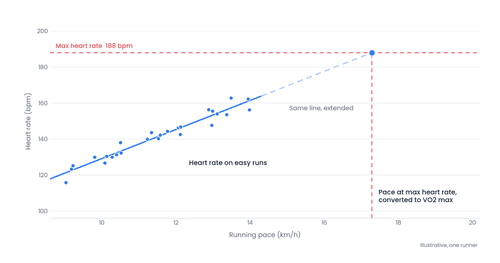
But that magnitude isn't completely surprising for a field estimate. Published wearable studies also tend to find relatively small average bias from exercise-based algorithms alongside much wider errors for individual users.[1] The model doesn't require a maximal run. It estimates the oxygen cost of running from pace and gradient, looks at where that effort sits relative to heart-rate reserve, and extrapolates the relationship towards maximum.
Very easy efforts under roughly 40% of heart-rate reserve are removed. Efforts above about 90% are down-weighted because the relationship between heart rate and oxygen consumption becomes less predictable close to maximum.
The two largest underestimates came from people for whom I had only one run.
Member
Lab
Run
Error
Runs
Heart-rate information
M016
52.8
39.9
−13
1
Observed max 151
M082
61.6
49.5
−12
1
Measured rest, plausible max
M094
43.5
41.4
−2
1
Measured rest, plausible max
M127
60.0
61.0
+1
13
Rest filled in as 60
M037
58.1
61.1
+3
12
Rest filled in as 60
M045
56.6
63.9
+7
35
Measured rest, plausible max
M091
68.2
76.2
+8
35
Measured rest, plausible max
A single run, however finely you slice it, is still one effort. You might create hundreds of analysis windows from it, but if someone spends most of the run at a similar pace and heart rate, those aren't hundreds of independent pieces of physiological information.
You're repeatedly looking at roughly the same point on the curve. M016 is the clearest example. He is 39 and the highest heart rate in the available data was 151 bpm. The Tanaka equation would predict an HRmax of around 181 at that age. That doesn't mean his real maximum is 181, individual variation around age-predicted HRmax can be considerable, but 151 is suspiciously low unless he genuinely has an unusually low maximum.
The model effectively treated an ordinary exercise heart rate as being close to maximal. As a result, the curve had nowhere left to go and produced a VO₂max of about 40 rather than his laboratory value of 53.
Then look at M037 and M127. With 12 and 13 runs, respectively, their estimates were within three points of the lab. I’d love to do more work in the future on how many runs are required for an accurate estimate, or what range of intensities we need to see.
M045 and M091 both had 35 runs and ended up seven or eight points too high. So I think we can assume more data isn't automatically better but more varied physiological information probably is.
As a side point, I think the running speed-HR relationship can be a valuable metric from wearable data. In previous research, we have found useful fitness information hidden in the relationship. In an earlier Terra analysis of 1,613 parkruns, a simple speed-at-heart-rate metric captured much of the same fitness signal as race performance.
Why running and cycling VO₂max estimates can disagree
The cycling model takes a slightly different approach. Instead of trying to infer metabolic demand from speed and gradient, it uses cycling power:
VO₂ ≈ 10.8 × W/kg + 7
That estimates the approximate oxygen cost of a given cycling workload. I then use heart rate to extrapolate from those submaximal workloads towards an estimate of VO₂max.
In theory, power is an attractive input because it directly measures external mechanical work. Running pace is messier: gradient, surface, wind and GPS accuracy can all influence the apparent relationship between speed and physiological cost.
But that doesn't necessarily mean cycling should give a better estimate of a laboratory VO₂max. VO₂max itself is somewhat modality-specific. A runner may achieve a higher value on a treadmill than on a bike, while a highly trained cyclist can show the opposite pattern.
That matters here because the submitted lab results weren't all performed under a single standardised protocol or necessarily on the same exercise modality. And unfortunately, only two people had enough cycling data to calculate a bike score.
Both also had running estimates, though, which makes the individual comparisons interesting.
M037's laboratory value was 58. Run estimate: 61. Bike estimate: 48.
Same person. Similar period. Same observed maximum heart rate. Same resting heart rate assumption.
But a 13-point difference between the running and cycling estimates. That points towards the power-to-heart-rate relationship rather than the heart-rate inputs alone.
If heart rate is relatively high while measured cycling power is modest, the model sees someone who appears to be approaching their physiological ceiling without producing much external work. Extrapolate that relationship and VO₂max comes out low.
That could reflect the model. It could reflect cycling efficiency, fatigue, heat, positioning, power-meter accuracy or the type of exercise used in the laboratory test. With one person, I simply don't know.
M127 went the other way and looked excellent! Lab: 60. Run: 61. Bike: 63. But the Bike score came from six rides, so I wouldn't use one good result as evidence that the cycling model works.
There are many limitations of my little experiment. The laboratory results were self-submitted rather than collected by us under one standardised protocol. Laboratory tests may have been performed on different ergometers. The timing between laboratory testing and wearable data wasn't perfectly standardised. The sample is small and very heavily selected.
Missing wearable data aren't random either. Someone with enough good running data to produce a running estimate is probably different from someone who doesn't run regularly. Someone training with a cycling power meter is different again.
So these numbers describe this sample. They don't establish the accuracy of these models in the population.
So, can you trust your wearable VO₂max?
I think the answer is: it can be useful, but you need to understand what the number actually represents. What surprised me most from this experiment wasn't that one equation was dramatically better than another.
It was about how much the quality of the inputs mattered, and perhaps the wider lesson extends beyond VO₂max. Wearables give us extraordinary quantities of physiological data. It is tempting to assume that more data inevitably means greater accuracy.
But thousands of measurements of the wrong thing don't necessarily tell us what we want to know. The challenge is sampling the right physiology, under the right conditions, often enough to make a useful inference. That, I think, is where wearable-derived metrics get really interesting.
The Terra VO₂max scores are now available through the Terra dashboard for customers to use. We'll keep updating the models as we collect more evidence, and hopefully the next step will be a much larger prospective comparison against laboratory testing.
Thanks to everyone who volunteered their data and helped me do some science.
References
Molina-Garcia P, Notbohm HL, Schumann M, et al. Validity of Estimating the Maximal Oxygen Consumption by Consumer Wearables: A Systematic Review with Meta-analysis and Expert Statement of the INTERLIVE Network. Sports Medicine. 2022;52:1577–1597. https://doi.org/10.1007/s40279-021-01639-y
Tanaka H, Monahan KD, Seals DR. Age-predicted maximal heart rate revisited. Journal of the American College of Cardiology. 2001;37(1):153–156. https://doi.org/10.1016/S0735-1097(00)01054-8
Uth N, Sørensen H, Overgaard K, Pedersen PK. Estimation of VO₂max from the ratio between HRmax and HRrest — the Heart Rate Ratio Method. European Journal of Applied Physiology. 2004;91(1):111–115. https://doi.org/10.1007/s00421-003-0988-y
Bland JM, Altman DG. Measuring agreement in method comparison studies. Statistical Methods in Medical Research. 1999;8(2):135–160. https://doi.org/10.1177/096228029900800204
Millet GP, Vleck VE, Bentley DJ. Physiological differences between cycling and running: lessons from triathletes. Sports Medicine. 2009;39(3):179–206. https://doi.org/10.2165/00007256-200939030-00002
Summary questions
How accurate is my wearable's VO₂max compared to a lab test?
It depends heavily on which model and which data your wearable has. In this experiment, the running-based estimate was only about 1.1 ml/kg/min low on average across 7 people, with a correlation of r = 0.79 to lab values, while the resting-heart-rate model was 9.1 ml/kg/min low on average across 22 people. Even the best model had a mean absolute error of 6.6 ml/kg/min — useful for tracking, but nowhere near lab accuracy for an individual number.
Why is my resting-heart-rate-based VO₂max estimate so wrong?
Usually because your actual resting heart rate wasn't measured. For the 11 participants whose resting HR was filled in with a default of 60 bpm, the estimate was 12.5 ml/kg/min too low on average, versus just 2.6 ml/kg/min for the 10 people with a measured resting HR. The Uth equation (VO₂max = 15.3 × HRmax/HRrest) is only as good as the two heart-rate numbers you feed it — and defaults can be catastrophically off for fit people whose true resting HR is in the 40s or 30s.
Can one run really tell my watch my VO₂max?
No, and the data showed this clearly. The two biggest underestimates in the running cohort (M016 at −13 and M082 at −12) both had only a single run available, while participants with 12–13 runs landed within three points of their lab value. One run — however finely sliced into analysis windows — mostly samples the same point on the heart-rate-to-pace curve, so you need multiple sessions across varied intensities for a reliable estimate.
Why do my running and cycling VO₂max scores disagree?
Because VO₂max is partly modality-specific and the two models use very different inputs. For participant M037, the running estimate was 61, the cycling estimate was 48, and the lab value was 58 — a 13-point gap for the same person in the same period. Cycling efficiency, power-meter accuracy, position, and whether the lab test itself was run- or bike-based can all shift the result, so disagreement between the two scores doesn't mean one is 'wrong.'
Does more wearable data automatically mean a more accurate VO₂max?
No. Two participants with 35 runs each still ended up 7–8 ml/kg/min above their lab values, while others with 12–13 runs were within three points. The lesson from this dataset is that varied physiological information — different intensities, durations and conditions — matters more than raw session count. Thousands of near-identical efforts just sample the same part of the curve repeatedly.
Should I trust my wearable VO₂max if I'm very fit?
Be skeptical at the extremes. The Uth equation struggles to produce values in the 70s or 80s without an extremely low resting heart rate — M119 had a lab VO₂max of 87 but got estimated at 51 with a default resting HR of 60, and 16-year-old M013 had a lab value of 84.9 but was scored around 50. The underlying equations were developed in trained adult men and compress the top of the distribution, so elite scores on your watch are likely underestimates.
Why can a low resting heart rate fool my wearable into overestimating fitness?
Because the heart-rate-ratio method assumes a low resting HR reflects aerobic training, but it can't tell why your heart rate is low. Participant M094 had a measured resting HR of 42 and got an estimated VO₂max of 59, while the lab measured 43.5. Genetics, medication, sleep, illness and measurement conditions all affect resting HR independently of cardiorespiratory fitness.
What's the single biggest factor in getting an accurate wearable VO₂max?
Input quality, not equation sophistication. The resting model's bias collapsed from −12.5 to −2.6 ml/kg/min simply by having a real resting HR instead of a default, and the running model's worst errors all came from having a single session or an unrealistically low observed maximum HR (like M016's 151 bpm versus an age-predicted 181). Sampling the right physiology under the right conditions matters more than which formula sits on top of the data.