We use cookies to enhance your browsing experience and analyse our traffic. By clicking “Accept All”, you consent to our use of cookies according to our Cookie Policy. You can change your mind any time by visiting out cookie policy.
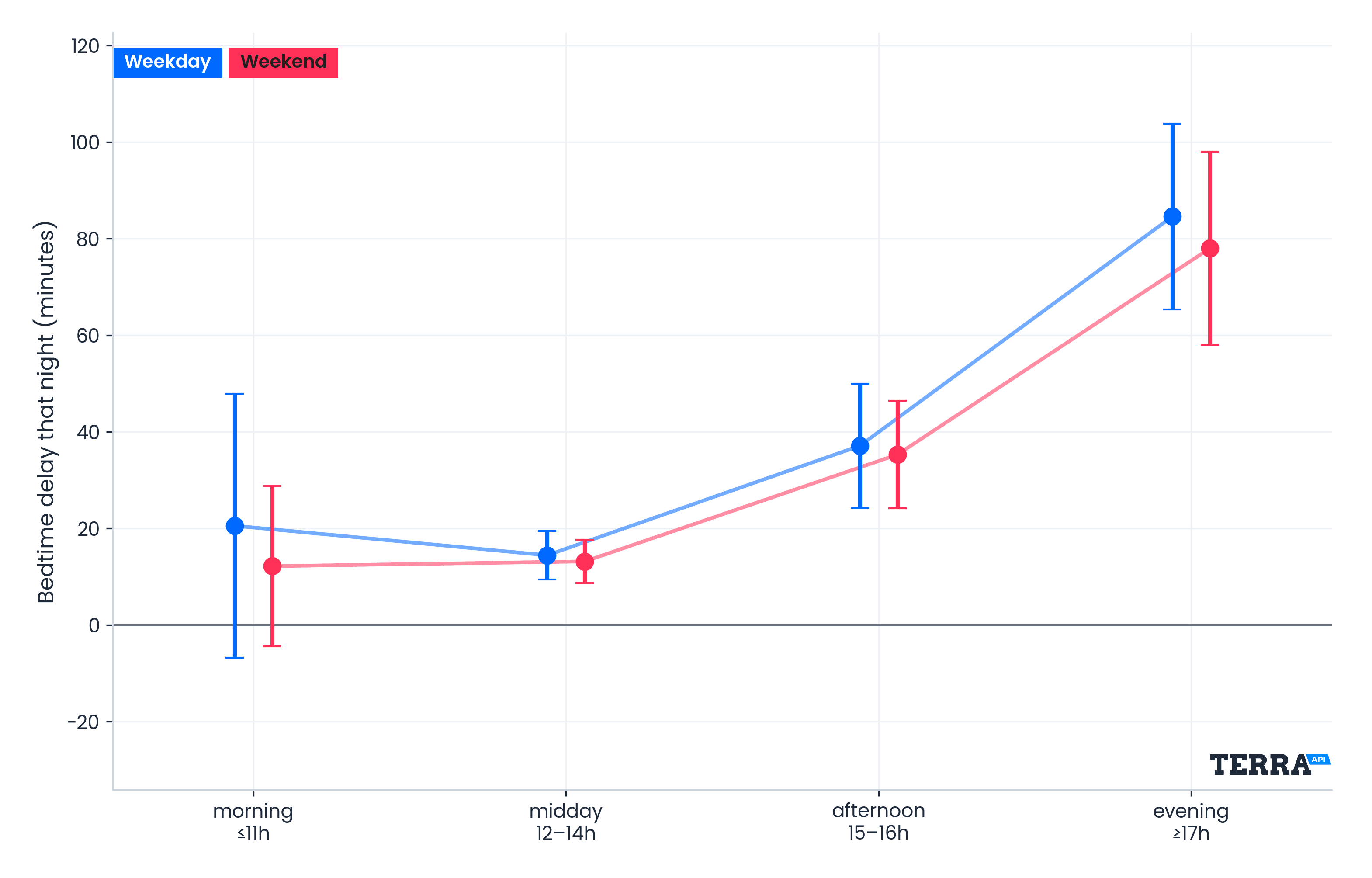
We analyzed 340,889 nights that followed a nap of 45 minutes or more. After 5pm, a nap pushes bedtime back about 80 minutes. The cost rises with timing: nothing in the morning, 15 minutes at midday, 35 mid-afternoon, 80 in the evening.
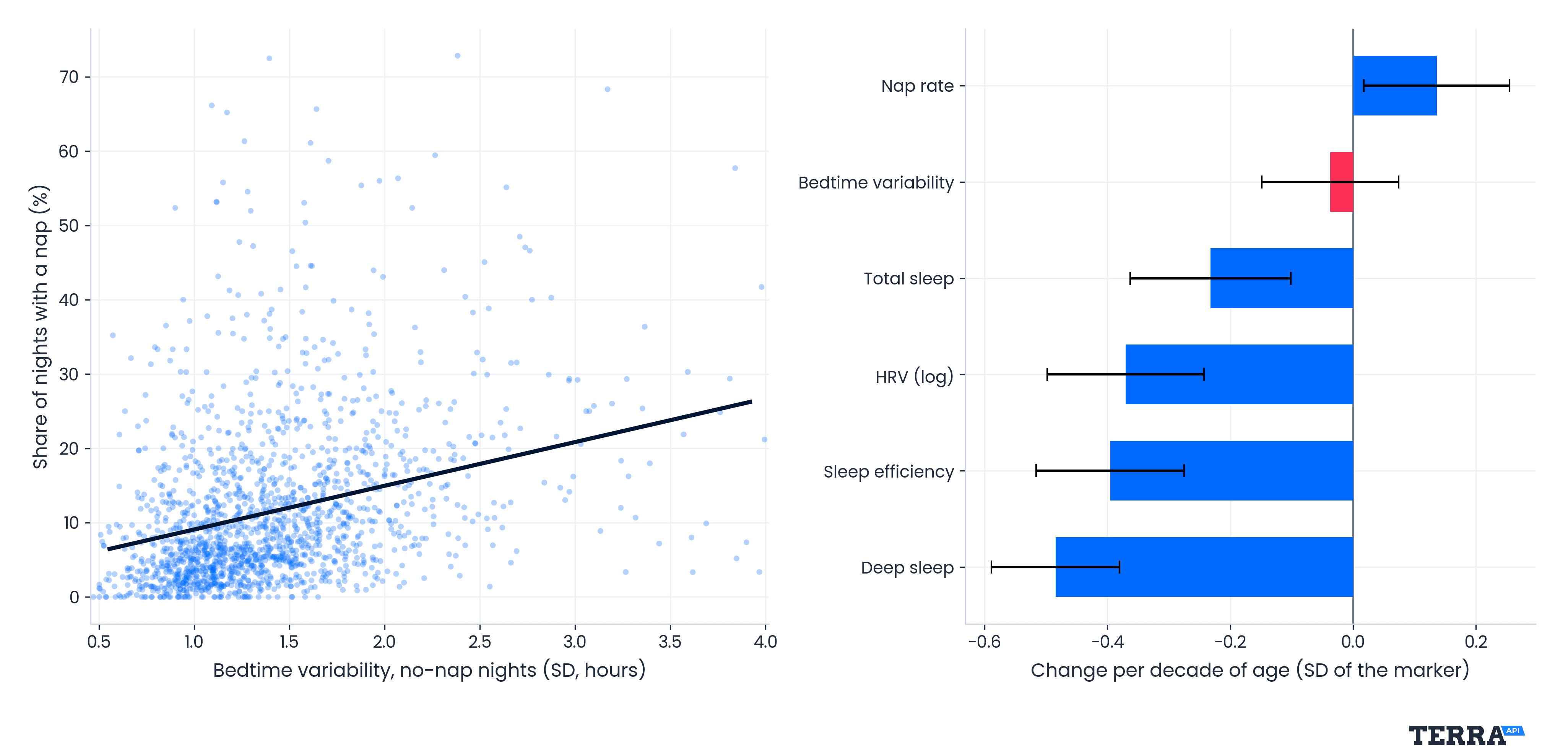
Frequent nappers are irregular sleepers, not older ones. Each extra hour of bedtime variability comes with 3.5 percentage points more nap days, and the link holds on non-nap days too.
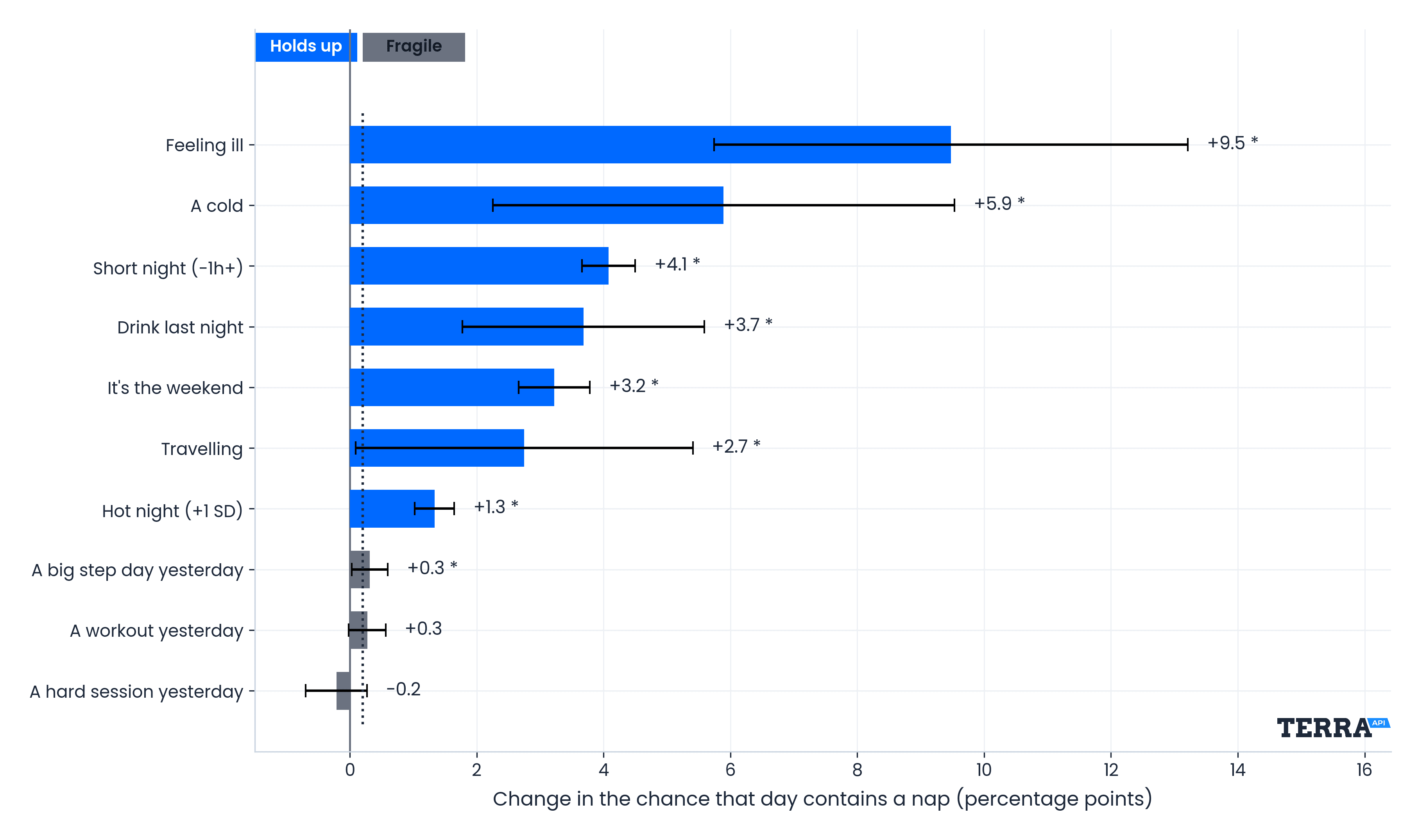
Illness, not training, is what makes people nap. Logging illness raises the chance of a nap that day by 9.5 percentage points. A hard session the day before changes it by almost nothing.
How nap timing shifts bedtime
We analyzed 340,889 nights from daily records of users that have taken a nap on that same day. A nap of 45 minutes or more pushes that night's bedtime later, and how much depends almost entirely on when you took it.
Figure 1: Delay in that night's bedtime after a nap of 45 minutes or more, by when the nap started, against the same person's no-nap nights. Person × week fixed effects, 95% CI.
A nap that starts before 11am does nothing measurable: +0.34 h on a weekday and −0.20 h at the weekend, neither statistically distinguishable from zero across 1,923 long morning naps. After midday, the cost of a nap on that night’s sleep increases from a 14 minutes bedtime delay when napping at midday, 36 minutes for a mid-afternoon nap, and 84 minutes for a nap after 5pm.
Evening naps costing more on that same night’s sleep is not because they are longer. In fact, evening naps are shorter, about 36 minutes compares to 47-52 at midday. The lost sleep from going to bed later is partially recovered by waking up later, although you only recover about half of the time lost at bedtime.
This aligns with research done by Leong et al. (2024) [1], which demonstrated from a cohort of adolescents that long, late naps delayed bedtimes and shortened nocturnal sleep.
Get the latest Terra Research reports and insights every week as soon as they're published.
Although 88% of the variation in nap rate is within-people rather than between them, the strongest trait that separates frequent nappers from the rest is how irregularly they sleep.
The standard deviation of bedtime correlates with the probability of tagging a nap at r = +0.336, and an extra hour of bedtime variability comes with 3.5 percentage points more nap-nights. This variability holds on their non-nap days as well, which suggests the variability is not a consequence of napping.
Age is known to alter sleep quality and timing [3]. Older users are attributed to lower sleep efficiency, shorter and lighter nights and greater probability of napping. However, bedtime irregularity does not correlate to age which demonstrates this is a trait of common nappers and not a confound of age.
Figure 2: (Left) Bedtime variability against how often users nap. (Right) How much each sleep marker moves per decade of age, in standard deviations of that marker.
This matters beyond napping, because irregular sleep timing is one of the better-evidenced risk markers in sleep research. Cribb et al. (2023) [2] followed 88,975 UK Biobank participants for a median of 7.1 years and found that people at the 5th percentile of sleep regularity had a 1.53× higher all-cause mortality hazard than the median, and 1.88× for cardiovascular mortality.
What actually makes you nap
A day of intense exercise is not the lead cause of napping. If not exercise, then what?
Illness logging dominates and raises the chance of a nap that day by 9.5 percentage points, followed by a cold by 5.9. Tagging behaviors can be a confound themselves, as people tagging illness are more likely to also tag other behaviors like napping.
However, the temperature signal alone is free from this bias, and a hot night with a temperature signal over 1SD from baseline also raises the likelihood of tagging a nap.
Figure 3: Change in nap probability with co-occuring events.
Conclusion
A long nap does not wreck your night. It moves it. Nap in the morning and you pay nothing; nap after 5pm and you are going to bed an hour and a half later and getting only half of that back by waking later. On top of that, and independently of how long the night ends up being, you spend a couple of minutes less in deep sleep.
And if you want to know why someone napped, the answer is usually that they are ill, that they slept badly, or that they are away from home. It is almost never that they trained hard.
References
Leong, R.L.F., Tian, L., Yu, N., Teo, T.B., Ong, J.L., & Chee, M.W.L. (2024). Bidirectional associations between the duration and timing of nocturnal sleep and daytime naps in adolescents differ from weekdays to weekends. Sleep, 47(9), zsae147. https://doi.org/10.1093/sleep/zsae147
Cribb, L., Sha, R., Yiallourou, S., Grima, N.A., Cavuoto, M., Baril, A.-A., & Pase, M.P. (2023). Sleep regularity and mortality: a prospective analysis in the UK Biobank. medRxiv 2023.04.14.23288550. https://doi.org/10.1101/2023.04.14.23288550
Ohayon, M.M., Carskadon, M.A., Guilleminault, C., & Vitiello, M.V. (2004). Meta-analysis of quantitative sleep parameters from childhood to old age in healthy individuals: developing normative sleep values across the human lifespan. Sleep, 27(7), 1255–1273. https://doi.org/10.1093/sleep/27.7.1255
Summary questions
Will an afternoon nap actually mess up my bedtime?
Yes, and the later it is, the worse it gets. Across 340,889 nap-nights, a midday nap pushed bedtime back only 14 minutes, a mid-afternoon nap 36 minutes, and a nap starting after 5pm delayed bedtime by 84 minutes versus the same person's no-nap nights. Morning naps before 11am had no measurable effect at all.
Can I just sleep in to make up for a late nap?
Only partially. The data shows you recover roughly half of the delayed bedtime by waking up later — so an 84-minute evening-nap delay only nets back about 40 minutes on the back end. You're still losing sleep, and independently spending a couple of minutes less in deep sleep on those nights.
Are evening naps worse because they're longer?
No — they're actually shorter. Evening naps averaged about 36 minutes, compared to 47–52 minutes for midday naps. The bedtime damage comes from timing (proximity to sleep onset), not duration, which is why a short evening nap costs more than a longer midday one.
Does napping a lot mean something is wrong with my sleep?
It's more likely a sign of irregular sleep than anything else. Bedtime variability correlates with nap probability at r = +0.336, and every extra hour of bedtime standard deviation adds 3.5 percentage points to nap-night frequency. Critically, this irregularity persists on non-nap days too, so napping isn't causing the variability — the irregular schedule is driving the naps.
Why should I care about irregular bedtimes beyond just being tired?
Because sleep regularity is one of the strongest survival markers in sleep research. Cribb et al. (2023) followed 88,975 UK Biobank participants for a median of 7.1 years and found people at the 5th percentile of sleep regularity had a 1.53× higher all-cause mortality hazard and 1.88× higher cardiovascular mortality hazard versus the median. Frequent napping is a visible flag for this underlying pattern.
Do I nap because I trained hard the day before?
Almost never. Intense exercise is not a lead cause of napping in this dataset. Illness is by far the biggest driver — logging illness raises same-day nap probability by 9.5 percentage points and a cold by 5.9, and abnormally hot nights (temperature >1SD above baseline) also increase nap likelihood independent of any tagging bias.
Is napping frequency mostly a personality trait or a situational thing?
Overwhelmingly situational. 88% of the variation in nap rate is within-person rather than between people — meaning the same individual naps or doesn't nap depending on the day's circumstances (illness, poor sleep, being away from home, heat). Being a "napper" isn't fixed; it tracks what's happening to you that day.
When is the safest time to nap if I don't want to wreck my night?
Before 11am. Long morning naps (across 1,923 observations) produced bedtime shifts of +0.34h on weekdays and −0.20h on weekends — neither statistically distinguishable from zero. If you need to nap and want to protect your bedtime, move it earlier; the cost curve rises sharply after midday and becomes severe after 5pm.