We use cookies to enhance your browsing experience and analyse our traffic. By clicking “Accept All”, you consent to our use of cookies according to our Cookie Policy. You can change your mind any time by visiting out cookie policy.
Hot nights shorten sleep by 1.4 minutes per degree. Each 1°C rise in night minimum temperature cut sleep by 1.4 minutes across 34,360 users.
Heat compresses the sleep window rather than causing wakefulness. Time in bed fell as much as time asleep, while awake-in-bed time stayed flat.
Iberians lost half as much sleep as the French. Iberia lost 7 minutes on hot vs cool nights to France's 15.5, despite similar absolute temperatures.
We’ve all heard a lot about heat waves recently, and if you’ve been in Europe, you’ve experienced them, too. I’ve spent a few weeks writing about how temperature impacts running. The one thing we can probably all agree on is that uncomfortably warm nights make it harder to sleep.
This is a very blunt analysis. We have had to group users into countries and use a single, centralized weather record as the variable. There are also a bunch of potential confounding factors. We don’t know if someone has the world’s best air-con, or is just relying on a clapped-out fan. I’ve been using an EightSleep mattress, and it definitely helps on the warm nights.
Think of this as a population-level investigation of whether the high country-level late June 2026 had an impact on sleep. I’ve linked 1.4 million wearable-recorded nights to Open-Meteo weather and asked: did those hot nights cost people sleep, and how?
The answer is yes. But the mechanism is not what you might assume. People do not lie in bed awake much longer. They spend less time in bed altogether, and sleep duration falls with it.
The heatwave in the data
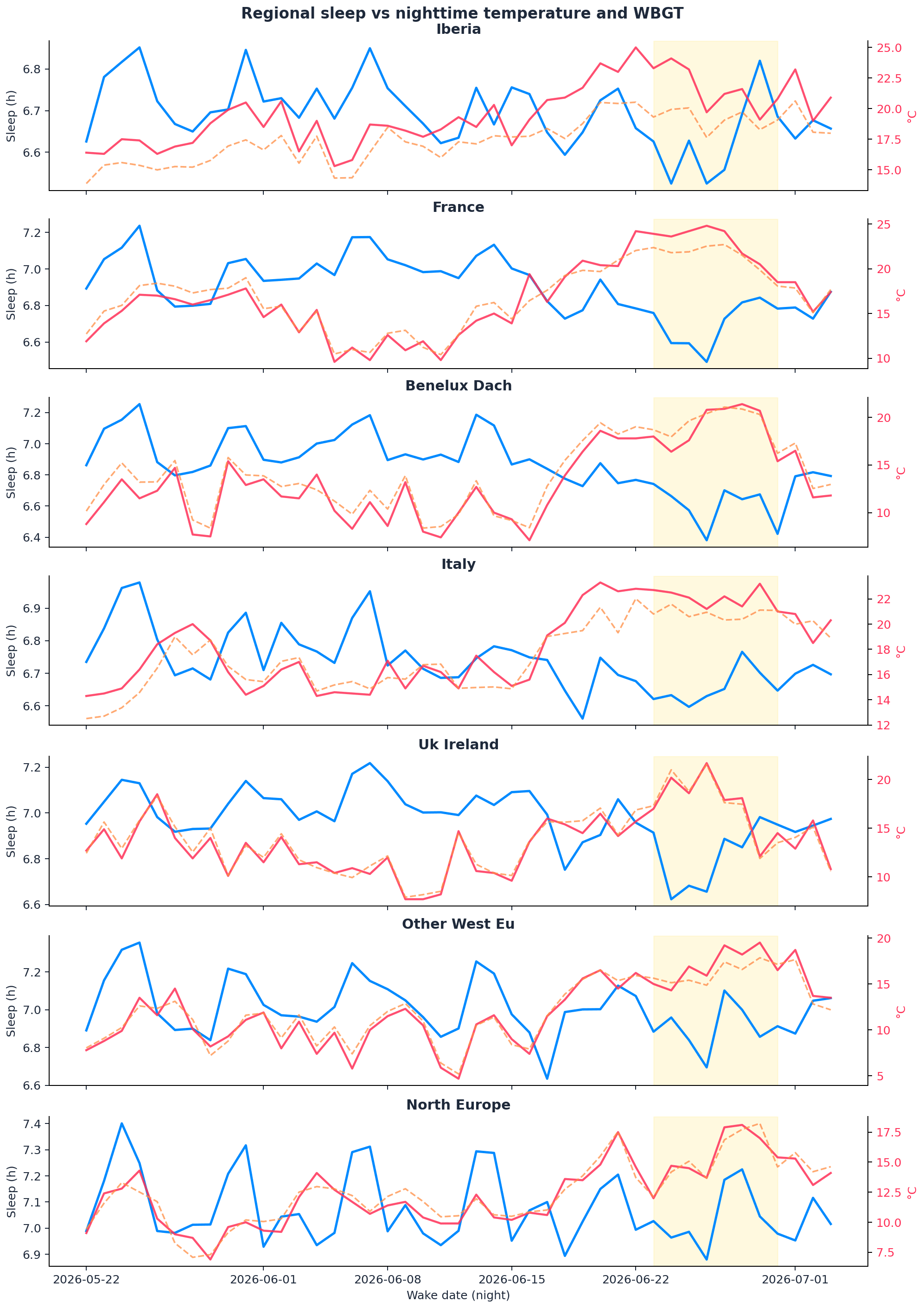
I analyzed Terra sleep data for 22 May – 3 July 2026 (43 nights), with the anomaly window 23–30 June peaking 24–26 June. Hourly Open-Meteo archive weather was aggregated over the sleep window, yielding night minimum temperature and night mean WBGT (Wet Bulb Globe Temp - see previous blog.)
In France, mean night minimum temperature rose from 15.3°C to 22.7°C during the heatwave (peak 24.8°C). The UK moved 12.6°C to 17.5°C (peak 21.7°C). Iberia, already warm at baseline (18.9°C), saw a smaller relative jump (21.6°C). Scandinavia, our cool control, warmed only modestly (11.4°C → 15.4°C).
Get the latest Terra Research reports and insights every week as soon as they're published.
These are wearable-owning, GPS-active users and are not population-representative. Location comes from median activity GPS, collapsed into coarse regions. Weather is matched at region centroids.
I used three lenses: region-night time series, dose–response deciles, and within-person models (each user's hot nights vs their cool nights, day-of-week held fixed). I excluded wakeup counts from this analysis; only 1.7% of nights in the data reported them.
Warmer Nights = Less Sleep (1.4 minutes lost per degree)
Within-person demeaned regression:
-1.40 min asleep per +1°C night minimum temperature
-1.48 min asleep per +1°C night mean WBGT
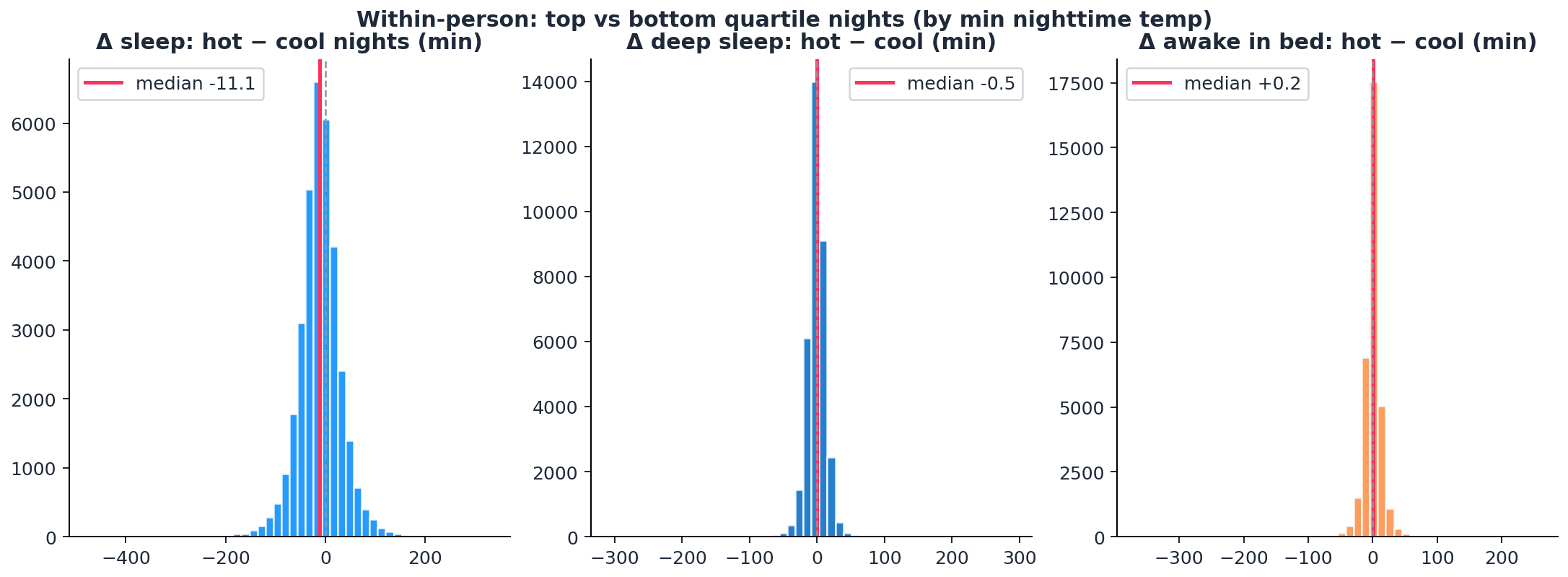
When I did a hot-vs-cool quartile comparison across 34,360 users with ≥14 nights of data, the median sleep change was −11.1 minutes between each user's hottest and coolest quartile nights.
I presumed that this decrease in time asleep would come from more awake time; that’s what hot nights feel like to me. I go to bed, and the discomfort keeps me uncomfortably awake. But I was wrong.
Metric
Within-person effect per +1°C
Interpretation
Time asleep
−1.40 min
Less total sleep
Time in bed
−1.49 min
Shorter nights overall
Time awake in bed
+0.05 min
Negligible — not the driver
Asleep ÷ in bed (calculated)
not significant
Ratio unchanged
Hot nights do not keep people awake longer. People end their nights earlier, or start them later, and total time in bed contracts by almost the same amount as lost sleep. Calculated sleep efficiency (asleep ÷ in bed) is flat within-person: both numerator and denominator shrink together.
The data shows a compressed sleep window, not a particularly restless one. A small but statistically significant rise in awake-in-bed time (+0.05 min/°C; +0.25 min median hot vs cool) exists, but it is an order of magnitude smaller than the sleep loss.
Regular readers will know I’m not a great fan of wearable determined sleep stages, but I still like to report them. Here, REM takes the hardest proportional hit during the shorter night (−0.60 min/°C vs −1.40 min total).
Figure 1: Regional time series of mean sleep (blue line), night minimum temperature (red line), and WBGT across seven European regions. Sleep troughs track temperature peaks through the heatwave window (yellow band), with the largest co-movement in France, Benelux/DACH, and the UK; Scandinavia shows a flatter response.
Dose–Response
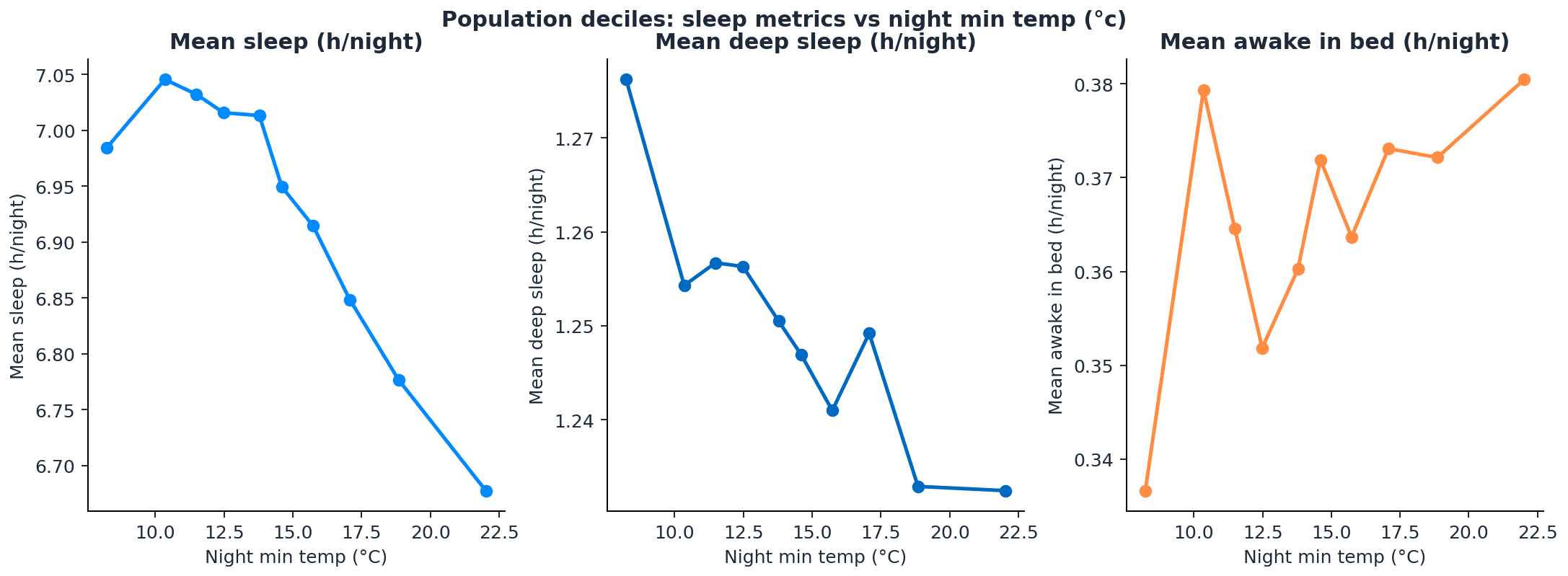
Sleep moves steadily across night-temperature deciles with no visible threshold at 18°C, which was another surprise to me as I presumed there would be a threshold effect. There may still be at an individual level, and here it is just smoothed out by population variation. Awake-in-bed time is flat to slightly rising at the population level; the dominant signal is shorter sleep duration.
Figure 2: Population decile dose–response for sleep duration, deep sleep, and awake-in-bed time vs night minimum temperature. Total and deep sleep fall as nights get warmer; awake-in-bed time is essentially flat, heat shortens sleep, not by keeping people awake longer.
Regional Differences: Iberia is More Resilient
Regions accustomed to warm summer nights show smaller within-person sleep penalties:
Region
Users
Median Δsleep (hot − cool)
France
4,427
−15.5 min
UK / Ireland
18,295
−11.9 min
Benelux / DACH
5,775
−10.8 min
Italy
1,964
−10.5 min
Iberia
1,987
−7.0 min
North Europe (control)
1,083
+1.2 min
Iberians lose roughly half the sleep of the French on the same hot-vs-cool comparison, despite experiencing similar absolute night temperatures during the heatwave. Baseline Iberian nights already average about 19°C minimum, so we can presume these users are just more used to the conditions: building stock, behavior (later schedules, siesta culture), and physiology may all contribute. France and the UK, where warm nights are exceptional, show the largest hits.
Scandinavia, which swerved the heat wave, shows no meaningful signal and provides a useful null control.
Figure 3: Within-person histograms of hot-minus-cool quartile night deltas for sleep, deep sleep, and awake-in-bed time. Most users lose sleep on their hottest nights (median −11 min); deep sleep falls too; awake-in-bed change clusters around zero.
Humidity and Autonomic Strain
HRV (RMSSD) associated more clearly with WBGT (−0.019 ms/°C, p = 0.001) than with dry-bulb min temperature alone. Humidity is coming into play here, and it makes sense that muggy nights add autonomic load.
Conclusion
A week of heatwave nights costs ~1.5 hours of cumulative sleep (eleven minutes × eight nights), drawn disproportionately from REM. The dominant mechanism powering this is behavioral compression of the sleep window (less time in bed), not lying awake for longer. That has practical implications: cooling the bedroom enough to stay in bed may matter more than managing fragmentation once you are there.
The standout sleeping performance of Iberians suggests adaptation is real. Regions facing more frequent warm nights may develop behavioural and infrastructural buffers that northern Europe lacks. As nighttime warming becomes routine, today's France may be tomorrow's normal, but today's Iberia shows the penalty can be smaller for populations already accustomed to heat.
Summary questions
Does hot weather actually cost me sleep, or does it just feel that way?
Yes, and the effect is measurable. Across 1.4 million wearable-recorded nights linked to Open-Meteo weather, each +1°C in night minimum temperature cost 1.40 minutes of sleep within-person. In a hot-vs-cool quartile comparison across 34,360 users with ≥14 nights of data, the median sleep loss was 11.1 minutes between each person's hottest and coolest nights.
Why am I not lying awake longer on hot nights if I'm sleeping less?
Because the mechanism isn't fragmentation — it's a shorter sleep window. Time in bed fell 1.49 min/°C while time asleep fell 1.40 min/°C, and awake-in-bed time barely moved (+0.05 min/°C). People end nights earlier or start them later, so calculated sleep efficiency stays flat while both the numerator and denominator shrink together.
Is there a temperature threshold, like 18°C, where sleep suddenly gets worse?
No — the dose-response is smooth. Sleep duration falls steadily across night-temperature deciles with no visible break at 18°C or anywhere else at the population level. Individual thresholds may exist, but they're smoothed out in aggregate, so the practical implication is that every degree matters, not just crossing a magic number.
Which sleep stage takes the biggest hit during heatwaves?
REM sleep is disproportionately affected. Total sleep dropped 1.40 min/°C, but REM alone fell 0.60 min/°C — meaning REM absorbs a much larger share of the loss than its normal proportion of the night. Over an eight-night heatwave, that's roughly 1.5 hours of total sleep lost, weighted toward REM.
Do people in hotter countries handle warm nights better?
Yes, clearly. Iberian users lost a median of just 7.0 minutes between hot and cool quartile nights, versus 15.5 minutes for the French and 11.9 for UK/Ireland users — roughly half the penalty despite similar absolute night temperatures during the heatwave. Baseline Iberian nights already sit around 19°C, so building stock, behavior, and physiological adaptation likely all contribute.
Does humidity matter, or is it just the temperature?
Humidity matters, especially for autonomic recovery. HRV (RMSSD) tracked wet-bulb globe temperature more clearly than dry-bulb minimum (−0.019 ms/°C, p = 0.001), suggesting muggy nights add cardiovascular strain beyond what raw temperature captures. For sleep duration itself, WBGT and dry-bulb effects were similar (−1.48 vs −1.40 min/°C).
Should I focus on cooling my bedroom or on managing waking up during the night?
Cooling the room is the higher-leverage move. Since heat compresses the sleep window rather than fragmenting sleep, the goal is keeping conditions tolerable enough that you stay in bed longer, not managing mid-night awakenings. The awake-in-bed increase was only about 0.25 minutes between hot and cool nights — an order of magnitude smaller than the duration loss.
Can wearable data actually detect climate-driven sleep effects at scale?
Yes. Linking 1.4 million wearable nights across seven European regions to centralized weather records surfaced clear regional co-movement between temperature peaks and sleep troughs during the 23–30 June 2026 anomaly window, with Scandinavia serving as a null control (+1.2 min change) because it escaped the heat. Even with coarse country-level weather matching and no visibility into individual air-con setups, the within-person signal held at roughly −1.4 minutes per degree.