We use cookies to enhance your browsing experience and analyse our traffic. By clicking “Accept All”, you consent to our use of cookies according to our Cookie Policy. You can change your mind any time by visiting out cookie policy.
We compared nightly wearable data from 266 pregnancies against 76 non-pregnant controls. Temperature, resting heart rate, and breathing rate all rise in the first weeks and stay elevated, tracking hCG and estrogen levels.
Pregnancy switches off the monthly rhythm. Outside pregnancy, temperature and heart rate peak on a 28-day cycle; during pregnancy that peak disappears, and in the 25 pregnancies that ended early, it came back.
A classifier picked up pregnancy 10 days after ovulation, before a missed period. It scored 0.80 PR-AUC at day 10 (1.0 is perfect, 0.5 is a coin flip) and 0.93 by day 50.
Shifts in heart rate, temperature and breathing rate throughout pregnancy have been well reported across wearable and clinical studies[1]. These physiological changes, originate from rises and drops in hormone levels and are therefore used as proxies for hormonal tracking[2].
Through wearables we can access almost immediate information about our health and hormones tracked through physiological biomarkers. In this blog we look at the hormonal and physiological changes observed from the small window of our wearables.
The Role of Hormones
In previous blogs, we found rises in temperature, heart rate and breathing rates that followed after ovulation, as the body enters into the luteal phase. These physiological changes serve as proxies for the rise in progesterone and oestrogen hormone levels[3], which are extremely useful when we move beyond menstrual cycle tracking and start to analyze pregnancy.
Following ovulation, progesterone levels rise to prepare the uterine lining for implantation[4]. In a typical cycle, progesterone would eventually fall, triggering menstruation. But if implantation occurs, that drop never happens. Instead during early pregnancy, the implanted embryo releasing human chorionic gonadotropin (hCG) hormone signals the body to maintain progesterone production[5].
The rising levels of progesterone have multiple effects on the body. Progesterone has a thermogenic effect, which we clearly see reflected in the temperature rises during ovulation and the luteal phase. Progesterone also increases the breathing rate in order to deliver more oxygen and support the high demand from mother and baby[6].
As pregnancy progresses, other hormones take on larger roles. Oestrogen steadily increases, supporting the growth of the uterus, maintaining the uterine lining, and preparing breast tissue for lactation. Its gradual rise aligns with cardiovascular adaptations, including increases in heart rate and blood volume, particularly as the body moves toward the third trimester[6].
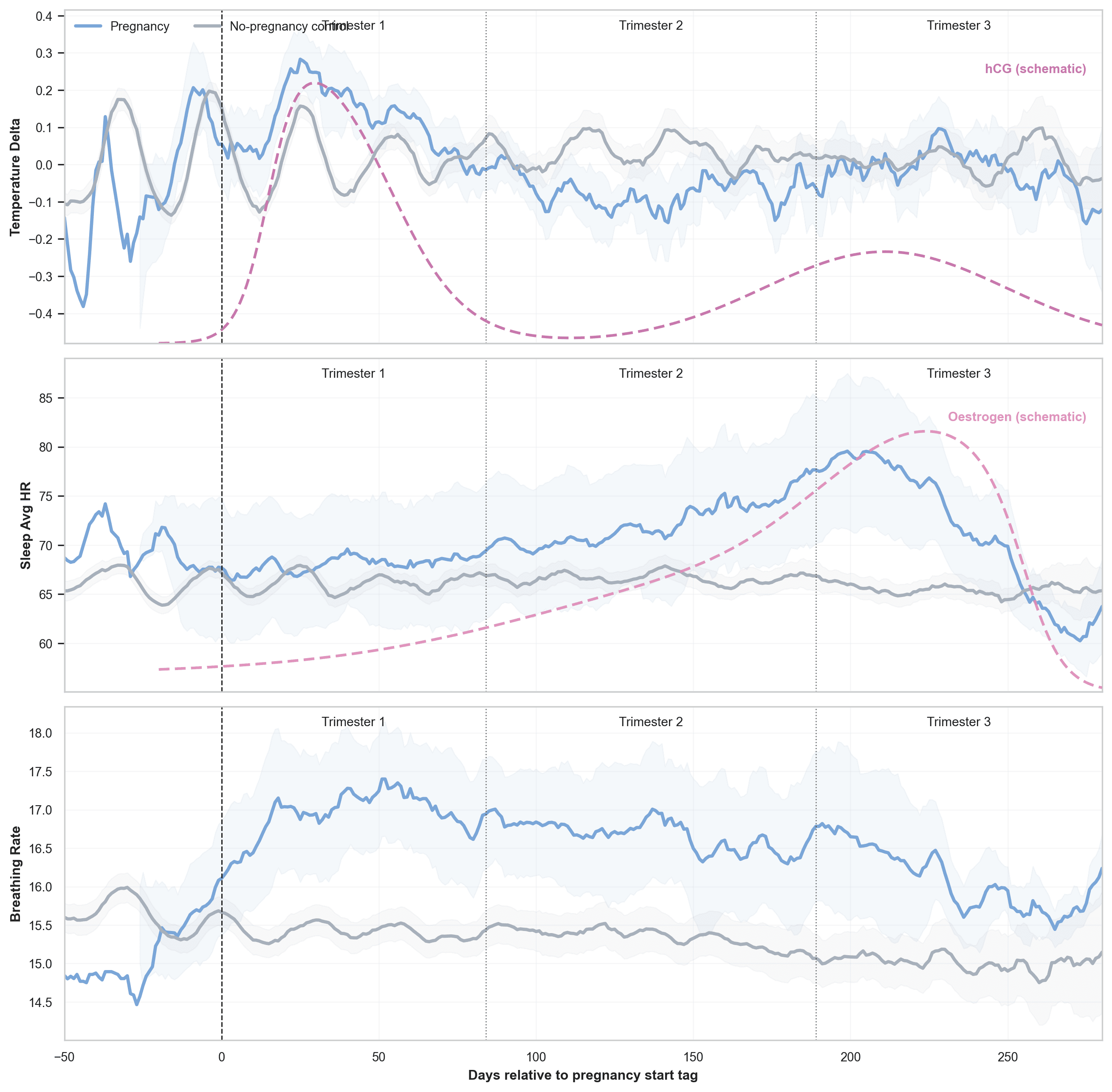
All of these physiological changes are well represented in wearable data (Figure 1). Temperature follows a similar trend to the empirical hCG hormone levels during pregnancy. Short after implantation, hCG rapidly increases which promotes progesterone secretion, the main driver for temperature.
Heart rate aligns well with Oestrogen levels, slowly climbing throughout pregnancy and reaching a peak around the start of the third trimester. Breathing rate rapidly climbs after implantation and remains high throughout, likely showing a similar relationship with hCG as temperature.
Figure 1: Temperature, heart rate and breathing rate trajectories during pregnancy (blue) compared to a control non-pregnancy trajectory (grey). Empirical hormone levels (in pink) plotted to show similarity to physiological biomarkers.
Get the latest Terra Research reports and insights every week as soon as they're published.
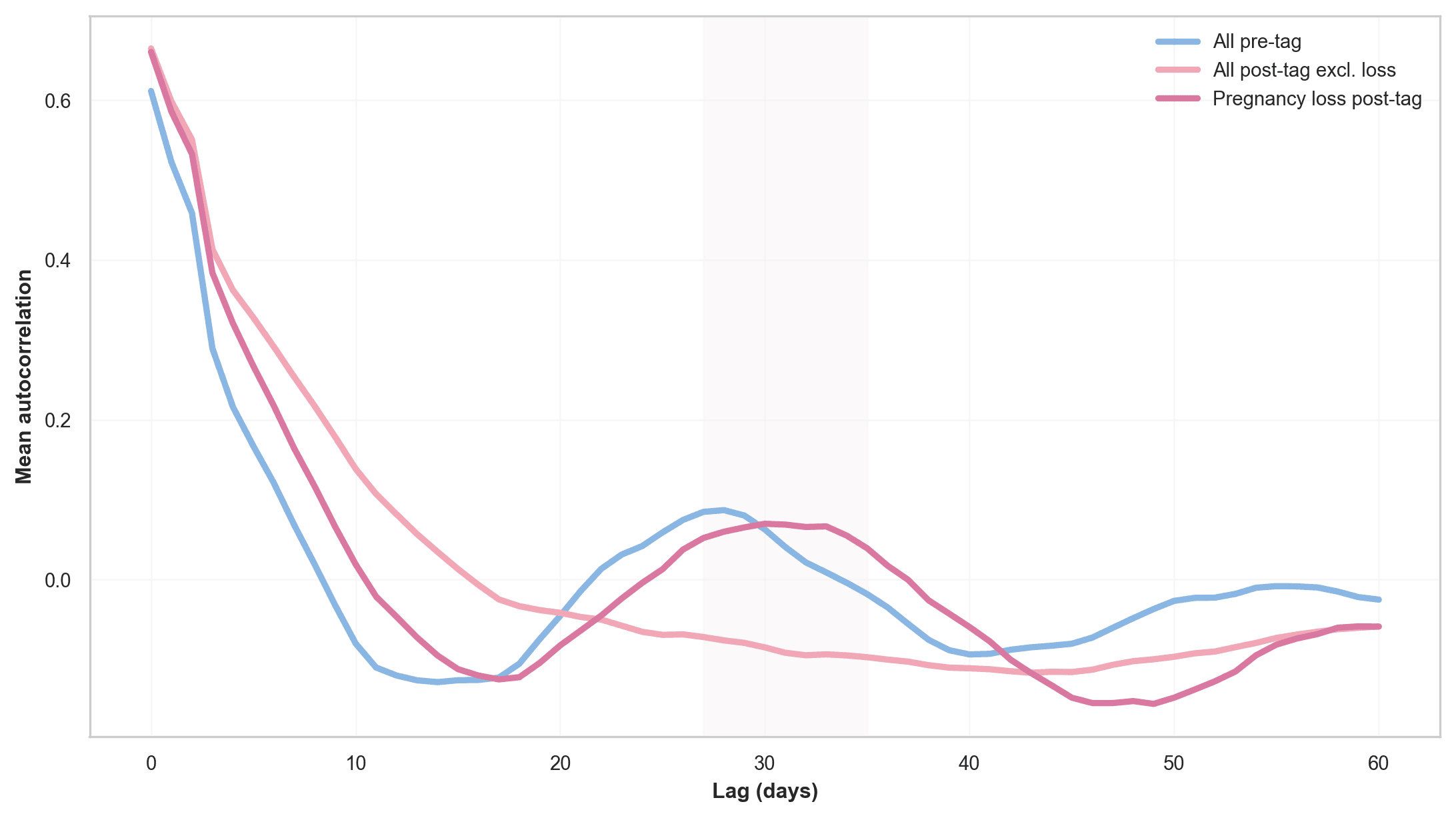
The underlying pattern in women’s physiology which we have extensively looked into at Terra, its cyclical signature, is no longer there during pregnancy. We computed the average autocorrelation profile for the average night-time heart rate, breathing rate and temperature across users. As expected, prior to any pregnancies the ~28 day autocorrelation peak appears clearly.
However, our physiology flattens out during pregnancy which is expected as our hormones are no longer following a monthly rhythm but are working in a longer term process where shifts for different hormones have different timings.
Now, the really interesting part. In pregnancies which had an early termination or miscarriage, the cyclical pattern is still there. As the body returns to the usual physiology earlier, it recovers the monthly structure in the autocorrelation profile.
Figure 2: Autocorrelation profiles for physiological biomarkers (temperature, heart rate and breathing rate) before pregnancy in dark pink, during pregnancy in light pink, and during a pregnancy with early termination in blue.
How early does pregnancy show up in physiology?
We analyzed how early the body starts changing and diverging from menstrual cycle-like physiology by exploiting the characteristic patterns of our physiological biomarkers, including the sustained elevation of breathing rate, the loss of cyclicality, and the gradual rise in night-time heart rate to analyze how early the body.
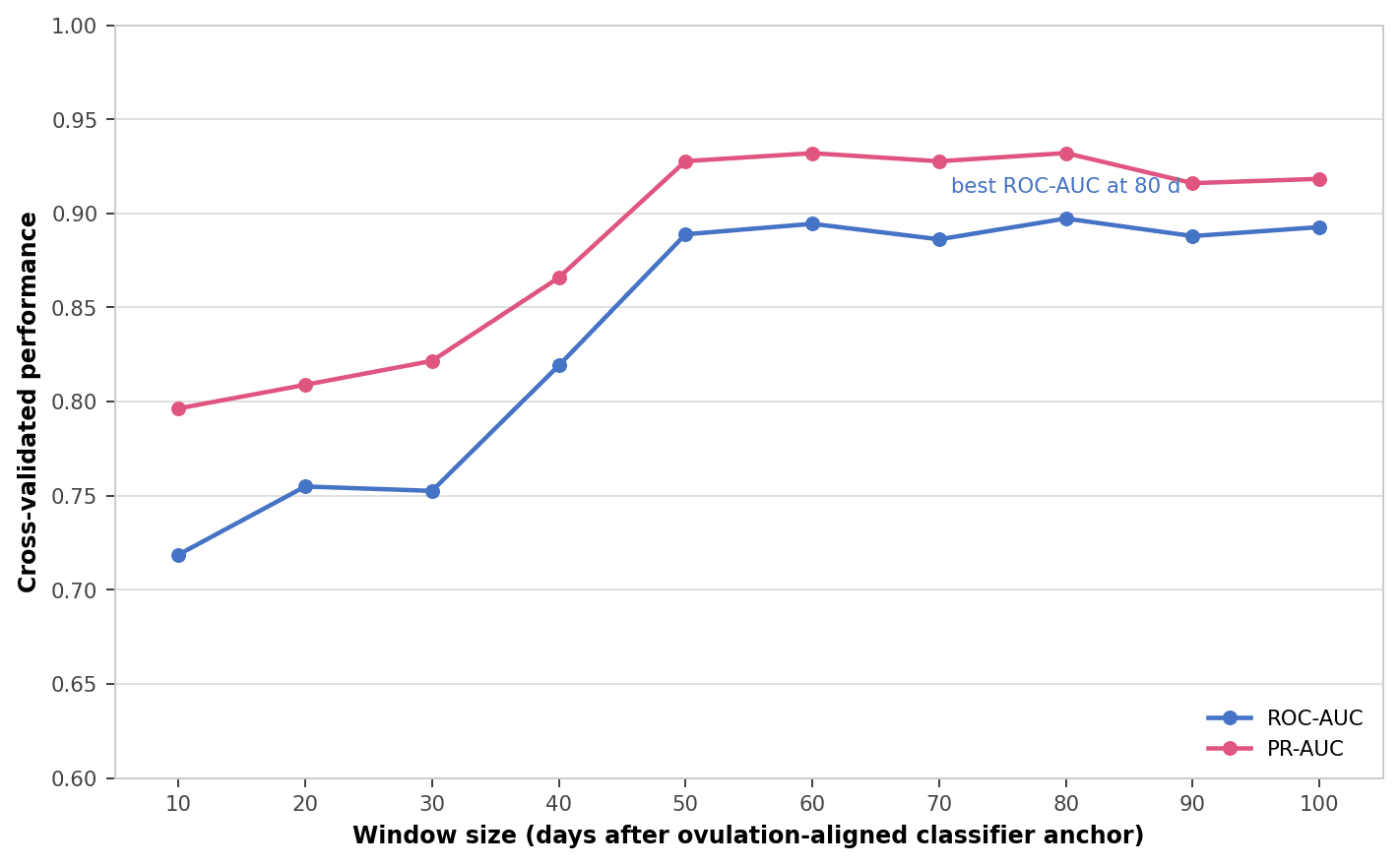
To do this, we trained a classifier across different horizons from the last ovulation before pregnancy and achieved a PR-AUC around 80% only 10 days after ovulation. This means that before the ‘missed period’ that would likely lead to taking a pregnancy test, the model can already pick up signals from pregnancy.
Figure 3: Performance for pregnancy detection against window size.
Conclusion
At the biology level, pregnancy is controlled by hormones which ensure the pregnancy is supported, the baby grows safe with enough space, oxygen and nutrients. Wearables are not great at telling us our hormone levels. They do however, give us a small peek into them by showing how physiology responds to hormones.
Early progesterone (via hGC) has one of the largest impacts on physiology, increasing our temperature and breathing rate to sustain pregnancy. Oestrogen has an impact on heart rate, although this is more evident in the later stages of pregnancy. The biggest take away is that these changes are evident from very early days of pregnancy!
References
Bossung, V., Singer, A., Ratz, T., Rothenbühler, M., Leeners, B., & Kimmich, N. (2023). Changes in Heart Rate, Heart Rate Variability, Breathing Rate, and Skin Temperature throughout Pregnancy and the Impact of Emotions-A Longitudinal Evaluation Using a Sensor Bracelet. Sensors (Basel, Switzerland), 23(14), 6620. https://doi.org/10.3390/s23146620
Jee, S. B., & Sawal, A. (2024). Physiological Changes in Pregnant Women Due to Hormonal Changes. Cureus, 16(3), e55544. https://doi.org/10.7759/cureus.55544
Forman, R. G., Chapman, M. C., & Steptoe, P. C. (1987). The effect of endogenous progesterone on basal body temperature in stimulated ovarian cycles. Human reproduction (Oxford, England), 2(8), 631–634. https://doi.org/10.1093/oxfordjournals.humrep.a136605
Alpçetin, S.İ.A., Taghiyeva, T., Demirdağ, E. et al. Progesterone levels on the day of the β-hCG test predict pregnancy outcomes in FET cycles. Sci Rep16, 2656 (2026). https://doi.org/10.1038/s41598-025-30902-9
Georgescu T. The role of maternal hormones in regulating autonomic functions during pregnancy. J Neuroendocrinol. 2023;35(12):e13348. doi:10.1111/jne.13348
Summary questions
Can wearables really detect pregnancy before a missed period?
Yes. A classifier trained on wearable physiological signals reached a PR-AUC of around 80% just 10 days after ovulation — before the point at which most people would even take a pregnancy test. The model picks up on sustained elevation in breathing rate, loss of menstrual cyclicality, and a gradual rise in night-time heart rate, all of which begin shortly after implantation.
Can wearables really detect pregnancy before a missed period?
Yes. A classifier trained on physiological biomarkers achieved a PR-AUC of around 80% just 10 days after ovulation — before the point at which most women would even take a pregnancy test. The signals come from sustained elevation in breathing rate, loss of cyclicality, and a gradual rise in night-time heart rate, all of which diverge from normal menstrual-cycle physiology within days of implantation.
Which physiological signals change first when I get pregnant?
Temperature and breathing rate move first, driven by the hCG-fueled surge in progesterone shortly after implantation. Progesterone has a thermogenic effect that pushes night-time temperature up, and it also increases breathing rate to deliver more oxygen to mother and baby. Heart rate rises more gradually, tracking oestrogen, and peaks around the start of the third trimester.
Why does my temperature stay elevated if I'm pregnant?
Because progesterone never drops. In a normal cycle, progesterone falls and triggers menstruation, but once implantation occurs, hCG released by the embryo signals the body to keep producing progesterone. Progesterone is thermogenic, so the luteal-phase temperature rise you'd normally see just before your period simply doesn't reverse — it stays elevated and continues climbing, mirroring the hCG curve in early pregnancy.
Why does my temperature stay elevated instead of dropping before my period?
In a normal cycle, progesterone falls at the end of the luteal phase and temperature drops with it, triggering menstruation. If implantation occurs, the embryo releases hCG, which signals the body to keep producing progesterone — so that temperature drop never happens. A sustained luteal-phase temperature elevation on your wearable is one of the earliest physiological signatures of pregnancy.
Which wearable metric changes first in pregnancy?
Breathing rate and temperature move first, both driven by the hCG-progesterone axis shortly after implantation. Breathing rate rises rapidly to deliver more oxygen to mother and baby and stays elevated throughout pregnancy. Heart rate changes are more gradual, tracking oestrogen and peaking around the start of the third trimester as blood volume and cardiovascular load increase.
What happens to my ~28-day cycle pattern during pregnancy?
It disappears. The autocorrelation profile of night-time heart rate, breathing rate and temperature shows a clear ~28-day peak before pregnancy, but flattens out during pregnancy because hormones stop following a monthly rhythm and instead shift on longer, staggered timescales. This loss of cyclicality is itself a detectable signal used by the pregnancy classifier.
What happens to my monthly physiological rhythm during pregnancy?
It disappears. The ~28-day autocorrelation peak that's clearly visible in night-time heart rate, breathing rate and temperature before pregnancy flattens out completely once pregnancy begins, because hormones are no longer cycling monthly but shifting on longer, staggered timelines. This loss of cyclicality is itself one of the strongest early signals a pregnancy is underway.
Can wearable data show signs of a miscarriage or early termination?
Yes — indirectly, through the return of the cyclical signature. In pregnancies that ended in early termination or miscarriage, the ~28-day autocorrelation peak in temperature, heart rate and breathing rate reappeared as the body returned to its usual cyclical physiology. The recovery of monthly rhythm in wearable data reflects the resumption of normal menstrual-cycle hormone dynamics.
Can wearable data show a miscarriage or early pregnancy loss?
The autocorrelation data suggests yes. In pregnancies that ended in early termination or miscarriage, the monthly cyclical signature in temperature, heart rate and breathing rate reappears as the body's hormones return to their pre-pregnancy rhythm. The return of that ~28-day pattern is a physiological fingerprint of the body reverting to normal cycling.
Does my heart rate really increase throughout pregnancy?
Yes, and it climbs steadily rather than jumping early. Heart rate tracks oestrogen, which rises gradually to support uterine growth, blood volume expansion and breast tissue development, peaking around the start of the third trimester. This is why cardiovascular changes in wearable data become most pronounced in later pregnancy, unlike temperature and breathing rate which shift almost immediately after implantation.
Do wearables actually measure my hormone levels?
No — wearables can't measure progesterone, oestrogen or hCG directly. What they capture is the downstream physiological response: temperature tracks progesterone (driven by hCG in early pregnancy), heart rate tracks oestrogen more visibly in later pregnancy, and breathing rate responds sharply to the hCG-progesterone rise. It's an indirect but remarkably tight proxy.
Do wearables actually measure my hormone levels?
No — wearables can't measure progesterone, oestrogen or hCG directly. What they capture is how your physiology responds to those hormones: temperature and breathing rate rising with progesterone (driven by hCG), and heart rate climbing with oestrogen. The trajectories of these biomarkers closely mirror the empirical hormone curves, making them reliable proxies for hormonal state.
Why does heart rate keep climbing throughout pregnancy?
Because oestrogen rises steadily across all three trimesters, driving cardiovascular adaptations including increased blood volume and higher resting heart rate. Unlike the sharp early jump seen in temperature and breathing rate, heart rate climbs gradually and reaches its peak around the start of the third trimester, when maternal cardiovascular demand is highest.
Why is breathing rate such a useful pregnancy signal?
Because it rises rapidly after implantation and stays elevated throughout pregnancy, closely mirroring hCG dynamics. Progesterone drives up respiratory rate to increase oxygen delivery for both mother and baby, producing a sustained departure from the normal cyclical pattern. That persistence — rather than the typical luteal-phase bump followed by a drop — is one of the strongest early markers the classifier relies on.
How does pregnancy physiology differ from a normal luteal phase?
In a normal luteal phase, progesterone rises then falls, temperature drops, and menstruation begins — restoring the ~28-day cycle. In pregnancy, hCG keeps progesterone high so temperature never drops, breathing rate stays elevated, heart rate slowly climbs with oestrogen, and the cyclical autocorrelation signature vanishes entirely. It's this persistent divergence from luteal-phase patterns that lets a model flag pregnancy just 10 days post-ovulation.