We use cookies to enhance your browsing experience and analyse our traffic. By clicking “Accept All”, you consent to our use of cookies according to our Cookie Policy. You can change your mind any time by visiting out cookie policy.
Norway claimed 41 medals at the 2026 Milano-Cortina Winter Olympics, more than any nation in a single Winter Olympic Games. Using wearable and sensor data from over thousands of European users we explored whether Norwegian exercise habits help explain this dominance. The findings reveal Norwegians exercise more, favor outdoor activities like walking, hiking, and cross-country skiing, train at more sustainable intensities aligned with the "Norwegian Threshold" model, and maintain greater activity diversity. These patterns were visible across all fitness levels, suggesting a deeply embedded cultural approach to movement.
Norway dominated the 2026 Winter Olympics with 41 medals — our activity data reveals Norwegians don't just exercise more, they exercise fundamentally differently, favoring outdoor, nature-based activities like walking, hiking, and cross-country skiing over indoor alternatives.
Norwegians consistently train at more sustainable intensities — spending more time in tempo and threshold zones (Z3–Z4) and less at maximum effort — a pattern consistent with the "Norwegian Threshold" model, visible even among casual exercisers.
These differences span the entire population — from the least to most active, suggesting Norway's success stems not from producing better athletes but from a culture that encourages sports to be fun and inclusive rather than specialization of athletes from a young age.
If you’re anything like us, today feels a little bittersweet, with the Milano-Cortina 2026 Winter Olympics finishing yesterday. There's nothing quite like the thrill of the Games: the competition between the very best, those moments of drama, raw emotion, unexpected upsets, and pure awe-inspiring performances that remind us what human limits (and breaking them) really look like.
The Winter Games have that special magic of pulling you into sports you might otherwise skip. I found figure skating mesmerizing, with its artistry and precision; the high-octane chaos of snowboard cross (huge congrats to Team GB on that gold!) had me on the edge of my snowy seat; and those big air competitors flipping through the sky like it was nothing. Unreal. Curling's always got that slow-burn intensity and strategy that hooks you in, and it was fantastic to see SkiMo (Ski Mountaineering) make its debut; those athletes charging up mountains and bombing down them are superhuman, with transitions that make triathletes seem amateur!
Norway dominated the medal table with 18 gold medals, 12 silver, and 11 bronze for a staggering 41 total medals, the most by any nation and a new record for the highest number of golds ever won at a single Winter Games. This remarkable haul propelled Norway to the top spot ahead of the United States (12 gold, 12 silver, 9 bronze; 33 total) and the Netherlands (10 gold, 7 silver, 3 bronze; 20 total), while cross-country skiing superstar Johannes Høsflot Klæbo made history by sweeping gold in all six of his events for an unprecedented personal tally of six golds at one Games.
What makes Norway's achievement truly extraordinary is its population of approximately 5.65 million people; with 41 medals, the country achieved roughly 0.73 medals per 100,000 inhabitants—a per-capita dominance that dwarfs larger nations and underscores Norway's unparalleled winter sports culture, talent development, and sheer excellence in disciplines like cross-country skiing and biathlon.
For comparison, the next two strongest per-capita performers were Switzerland (23 total medals, roughly 0.26 medals per 100,000 people) and Austria (18 medals, roughly 0.20 medals per 100,000 people). The United States, with its massive population of around 349 million, managed about 0.009 medals per 100,000 people despite a strong 33-medal haul, highlighting how Norway's success stands out even more when adjusted for population size. This triumph cements Norway's status as the undisputed powerhouse of the Winter Olympics.
So to make up for the loss of the Olympics in our Lives today, I thought I’d dive into the data to see if Norway's activity patterns are different - and to try to tie the data to a few theories that could explain Norway's success.
When we analyzed activity patterns across European countries, we expected regional variations. What we discovered was striking: Norwegians don't just exercise more, they exercise fundamentally differently. The patterns reveal a distinct approach that extends from casual exercisers to elite athletes, suggesting something deeply embedded in Norwegian culture.
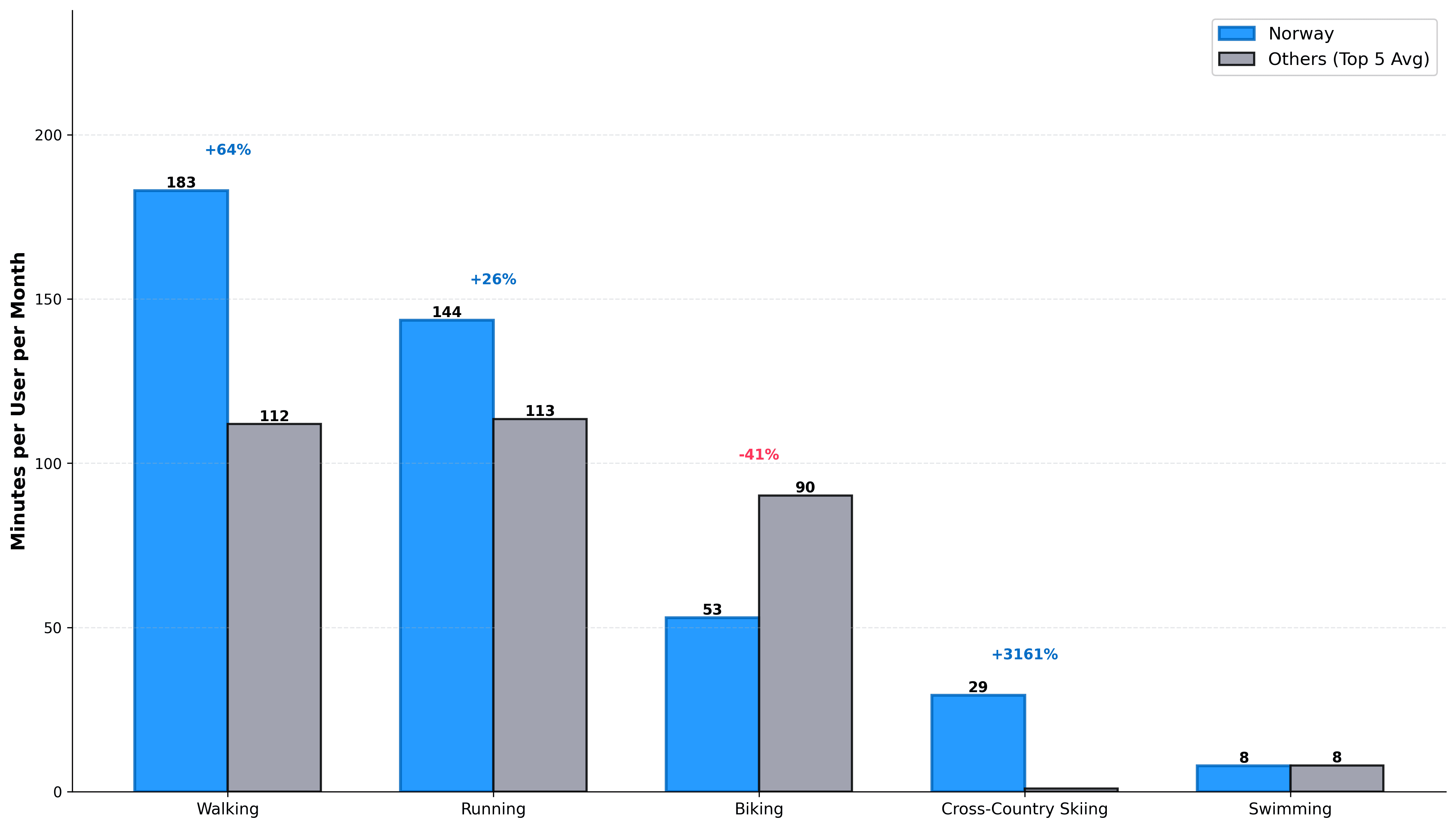
Figure 1: Activity Type Comparison - Norway vs Others (Top 5 Average) shows how Norwegians allocate time across activity types compared to the average of other top countries. It (surprisingly!) shows that Norwegians do a lot of cross-country skiing, but also rely heavily on walking and running.
The Big Picture: Volume, Modality, and Intensity
We compared Norwegian users to those from the top five European countries (United Kingdom, Germany, France, Austria, and Italy) across three dimensions: how much they exercise, what activities they choose, and how intensely they train.
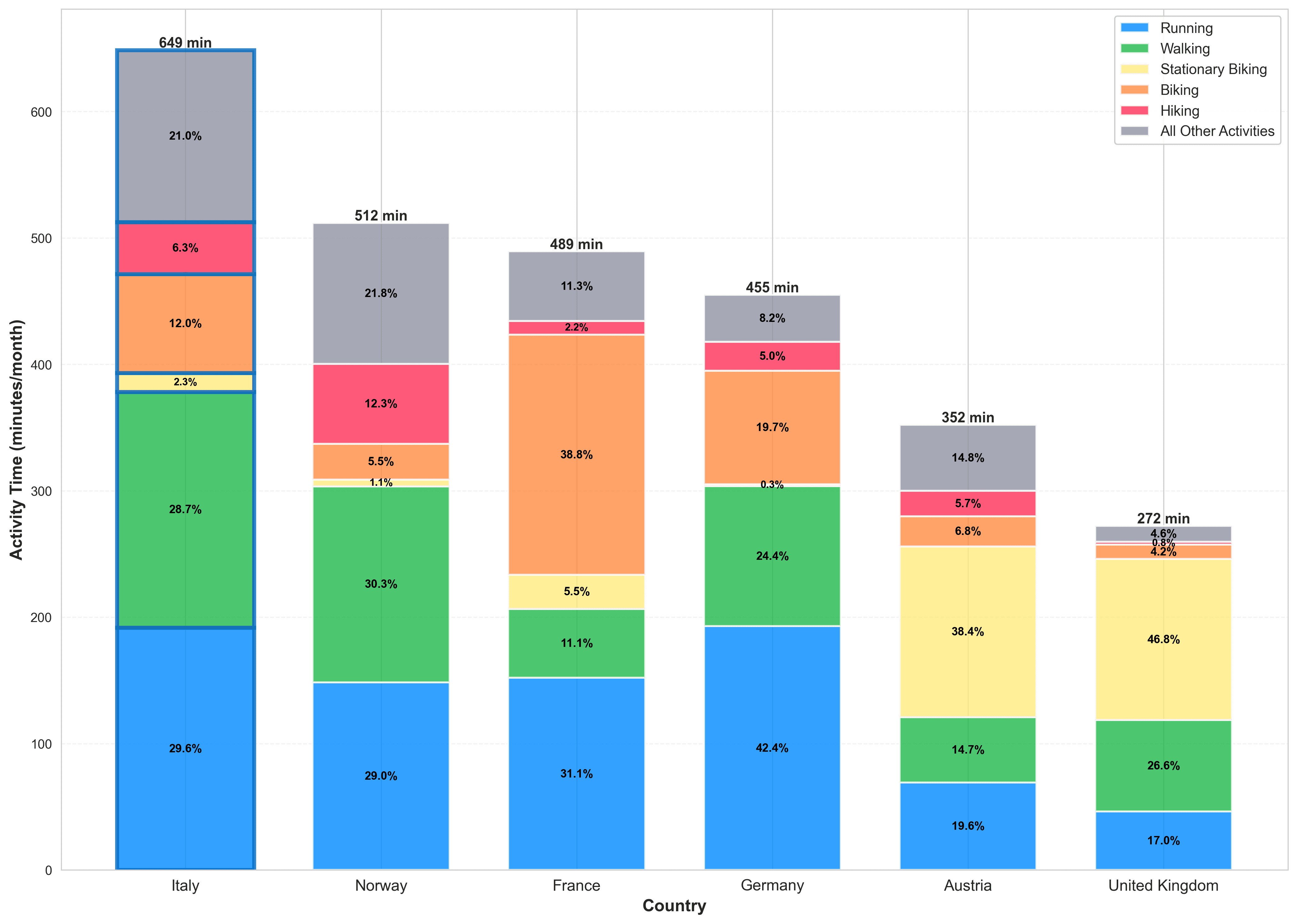
Volume tells the first part of the story: Norwegians average 512 minutes of activity per month, compared to 368 minutes for others—an 39% difference. They come out as the second most active nation, after Italy, whose activity is powered by cycling. This advantage isn't just at the top end. Even the 25th percentile Norwegian user is more active than the median user in other countries. This suggests a widespread cultural pattern where physical activity is more integrated into daily life.
Modality reveals the most distinctive aspect - Norwegians spend 183 minutes per month on walking and hiking combined, compared to 112 minutes for others—a 64% increase. But the real standout is cross-country skiing: Norwegians average 29 minutes per month, while others average less than 1 minute. That's over 20 times more.
While other countries rely heavily on indoor activities like elliptical machines or stationary bikes, Norwegians show a strong preference for outdoor, nature-based activities. Hiking appears in Norway's top five activities, while it's largely absent from other countries' lists.
Intensity patterns add another layer. Norwegians spend 13.9% of their time in low-intensity zones (recovery and aerobic) compared to 9.0% for others, while spending 62.6% in high-intensity zones compared to 72.7% for others. This suggests that, even at the population level, Norwegians take a more sustainable, endurance-focused approach
Figure 2: Activity Time Composition by Modality - how total monthly activity time is split across activity types for Norway and the top 5 countries. Norwegians spend more time walking/hiking and cross-country skiing (other activities), while others rely more on indoor activities like stationary biking and elliptical machines.
Norwegians seem to enjoy a wider diversity of exercise types. Norway stands out with the highest mean diversity at 3.39 activity types per user and substantial variability (CV 87.8%). The UK exhibits the lowest mean diversity (1.53 activity types). Italy and Germany display diversity of 3.08 and 2.96 activity types, respectively, with moderate variability (CV of 81.7% and 75.8%). France sits in the middle with 2.30 types and a CV of 87.7%. This greater breadth in Norway aligns closely with its grassroots training philosophy, which emphasizes multi-sport participation, delayed specialization, and prioritizing fun and enjoyment well into adolescence—principles echoed in David Epstein's book Range, where generalists who sample widely often outperform early specialists in the long run.
At 15, Klæbo came 101st in the Norwegian National Junior Championships sprint. At 16, he placed 76th in distance and 58th in the sprint [1]. In any other country or performance culture, a young skier with those results would likely have been written off and discouraged to continue. That’s not the sports performance culture Norway is built on. Klæbo’s grandfather and primary coach urged him to focus extensively on technique and agility to close the gap to his more developed competitors. That patience and belief in a late bloomer’s potential has likely made Klæbo into what many consider the most technically skilled cross-country skier of all time.
Get the latest Terra Research reports and insights every week as soon as they're published.
Digging Deeper: What Happens When We Look at the Most Active?
The population-level differences were clear, but we wanted to understand whether these patterns held across different activity levels. What we discovered was surprising: the intensity profile actually reverses for the most active Norwegians.
When we segmented users by activity level, from the least active (bottom 25%) to the most active (top 10%), we found that low-activity Norwegians show the strongest preference for low-to-moderate-intensity training. In the "Very Low" activity segment, Norwegians spend 12.5% of their time in low-intensity zones compared to just 4.7% for others, while spending 58.6% in high-intensity zones compared to 80.1% for others. This suggests that even casual Norwegian exercisers engage in more sustainable, endurance-focused activities.
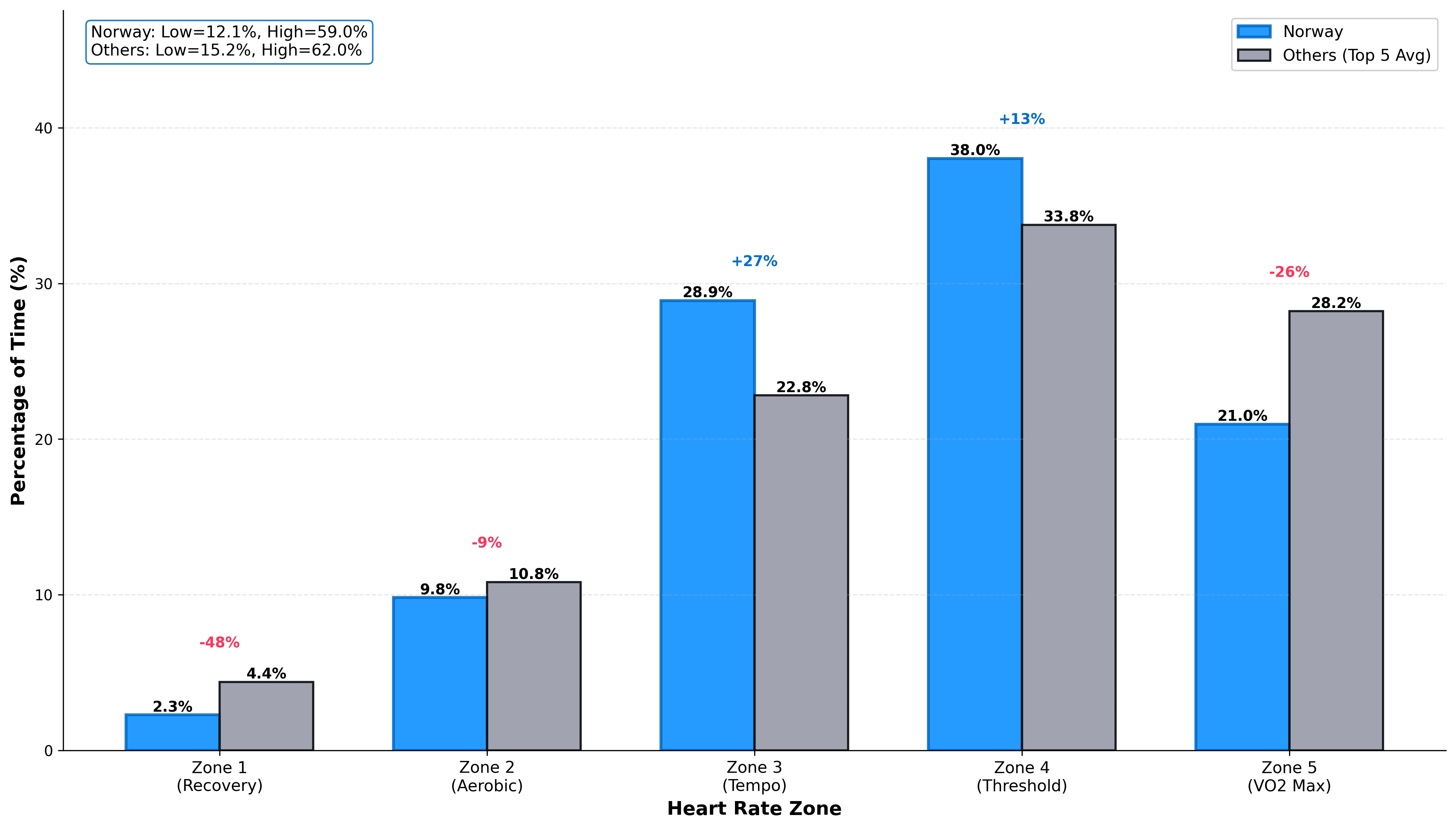
Figure 3: Intensity Distribution - Top 10% Most Active Users (Norway vs Others) . Norway's top 10% (most active users) spend more time in the tempo and threshold zones (Z3–Z4) and less time in the maximum-intensity zone (Z5) than the rest.
But here's where it gets interesting: as we move up the activity spectrum, the pattern shifts. For the top 10% most active users, Norwegians actually train at higher average heart rates than their counterparts in other countries. However, they still maintain a key difference: they spend significantly more time in the tempo and threshold zones (Zones 3 and 4) while consistently avoiding the maximum-intensity zone (Zone 5). This is the “Norwegian Threshold” model playing out in the data.
The top 10% of Norwegian users spend 28.9% of their time in Zone 3 (tempo), compared to 22.8% for others, and 38.0% in Zone 4 (threshold), compared to 33.8% for others. Meanwhile, they spend only 21.0% in Zone 5 (VO2 max) compared to 28.2% for others. This aligns with the theory of accumulating activity time at, or slightly below, Lactate threshold because you can do much more work at this intensity than at slightly higher intensities.
The Segmentation Story: Why This Matters
I think this tells us something important: it's not that Norwegians prefer easier workouts. Instead, the data suggests a different approach to the exercise. Low-activity individuals tend to focus on sustainable activities within a generally more active, outdoor lifestyle, while high-activity individuals incorporate greater intensity while remaining sustainable.
The modality differences also persist across segments. Even in the "Very Low" activity segment, Norwegians show massive differences in hiking and cross-country skiing - although we could have probably guessed that one! This isn't about elite athletes, it's about how even the least active Norwegians choose to move their bodies. When a Norwegian decides to be active, they're more likely to head outdoors for a hike or ski than to step onto a treadmill.
This pattern suggests that outdoor, nature-based activities aren't just recreational choices; they're the default. The infrastructure, culture, and geography of Norway make these activities more accessible and normalized. Cross-country skiing isn't a niche sport; it's a way of life.
What This Means Beyond the Numbers
These findings point to something deeper than exercise preferences. They suggest a fundamentally different relationship with physical activity embedded in Norwegian culture. The "friluftsliv" concept, roughly translated as "open-air living," isn't just a marketing slogan; it's reflected in the data. Norwegians don't just exercise more; they exercise in ways that connect them to nature, that can be sustained long-term, and that integrate movement into daily life rather than compartmentalizing it as "workouts."
Perhaps most importantly, these differences aren't limited to the most active individuals. They're visible across the entire distribution, from the 25th percentile to the 95th percentile. This suggests that the Norwegian approach isn't about having better athletes—it's about fostering a culture where physical activity is more accessible, normalized, and integrated into daily life.
Limitations
We are not shy about the limitations in this work; there are many. We analysed a sample of over 10,000 users across Europe. And while we had a large sample of users from some countries, such as the UK (4,400), we had only 135 from Norway. The heart rate zone analysis is interesting, but as we have written about before, there are many reasons not to trust this data. Automated modality detection is also improving over time, but it varies across devices. And of course, we are in no way making the argument that any of these findings is responsible for Norway's Olympic success; that would be causation. We are just pointing out that Norwegian behavior differs from that of some of their neighbours, and we can all decide what we want to learn from this.
The Takeaway
When we set out to understand how Norwegians exercise differently, we expected regional variations. But the picture of a culture that approaches physical activity fundamentally differently emerged, not just in volume, but also in modality, intensity distribution, and training philosophy.
The data tells a clear story: Norwegians have found a way to make physical activity more sustainable, more enjoyable, and more effective. And perhaps most importantly, they've made it accessible to everyone, not just the most dedicated athletes. That's a lesson worth learning.
How much more do Norwegians actually exercise compared to other Europeans?
Norwegians average 512 minutes of activity per month versus 368 minutes for users in the UK, Germany, France, Austria, and Italy — a 39% advantage that puts Norway second only to Italy (whose volume is cycling-driven). Crucially, even the 25th-percentile Norwegian is more active than the median user in other countries. The gap isn't being driven by elite athletes; it's a population-wide pattern.
What activities do Norwegians do differently?
Norwegians spend 183 minutes per month walking and hiking combined, compared to 112 minutes for others — a 64% increase — and average 29 minutes per month on cross-country skiing versus less than 1 minute elsewhere, more than 20 times higher. Hiking appears in Norway's top five activities and is largely absent from other countries' lists, while others lean on indoor modalities like ellipticals and stationary bikes. The Norwegian default is outdoor and nature-based.
Do Norwegians actually train at lower intensities?
At the population level, yes — Norwegians spend 13.9% of time in low-intensity zones versus 9.0% for others, and 62.6% in high-intensity zones versus 72.7%. But the pattern reverses among the most active: top-10% Norwegians train at higher average heart rates than their counterparts. The distinguishing feature is where that intensity sits, not how hard they go overall.
What does the "Norwegian Threshold" model look like in the data?
Among the top 10% most active users, Norwegians spend 28.9% of time in Zone 3 (tempo) vs 22.8% for others, 38.0% in Zone 4 (threshold) vs 33.8%, and only 21.0% in Zone 5 (VO2 max) vs 28.2%. They accumulate work at or just below lactate threshold while consistently avoiding maximum-intensity efforts. It's the textbook threshold approach showing up in consumer wearable data.
Is Norway's exercise culture really broader, or just deeper?
Broader. Norway shows the highest mean activity diversity at 3.39 activity types per user, compared to 1.53 in the UK, 2.30 in France, 2.96 in Germany, and 3.08 in Italy. This multi-sport, multi-modality pattern echoes the grassroots Norwegian philosophy of delayed specialization — Johannes Klæbo himself placed 101st at the National Junior Championships at 15 before becoming arguably the most technically skilled cross-country skier ever.
How dominant was Norway at Milano-Cortina 2026 on a per-capita basis?
Norway won 41 total medals (18 gold, 12 silver, 11 bronze) — the most of any nation and a new record for golds at a single Winter Games — from a population of about 5.65 million, or roughly 0.73 medals per 100,000 people. The next closest per-capita performers were Switzerland at 0.26 and Austria at 0.20, while the United States managed 0.009 despite 33 total medals. Adjusted for population, no one is close.
Does the Norwegian pattern hold for casual exercisers too?
Yes, and it's arguably more striking there. In the "Very Low" activity segment, Norwegians spend 12.5% of their time in low-intensity zones vs just 4.7% for others, and 58.6% in high-intensity zones vs 80.1%. Even the least active Norwegians choose hiking and cross-country skiing over treadmills — the cultural default toward sustainable, outdoor movement is visible from the 25th percentile to the 95th.
Can this data prove Norway's exercise culture causes its Olympic success?
No, and the analysis explicitly avoids that claim. The sample includes only 135 Norwegian users out of 10,000+ across Europe, heart-rate zone data has known reliability issues, and automated modality detection varies by device. What the data does show is that Norwegian activity behavior — more volume, more outdoor modalities, more diversity, and a threshold-weighted intensity profile — is measurably different from its neighbors, and worth learning from regardless of medal counts.