Health Insurance Reward Schemes
From Team Terra: We built this report to share our learnings and insights from industry leaders in the health incentives space. Get an inside look at the trends shaping health reward schemes in 2025.
By submitting, you agree to our Privacy Policy
Why Rewards Matter for Insurers
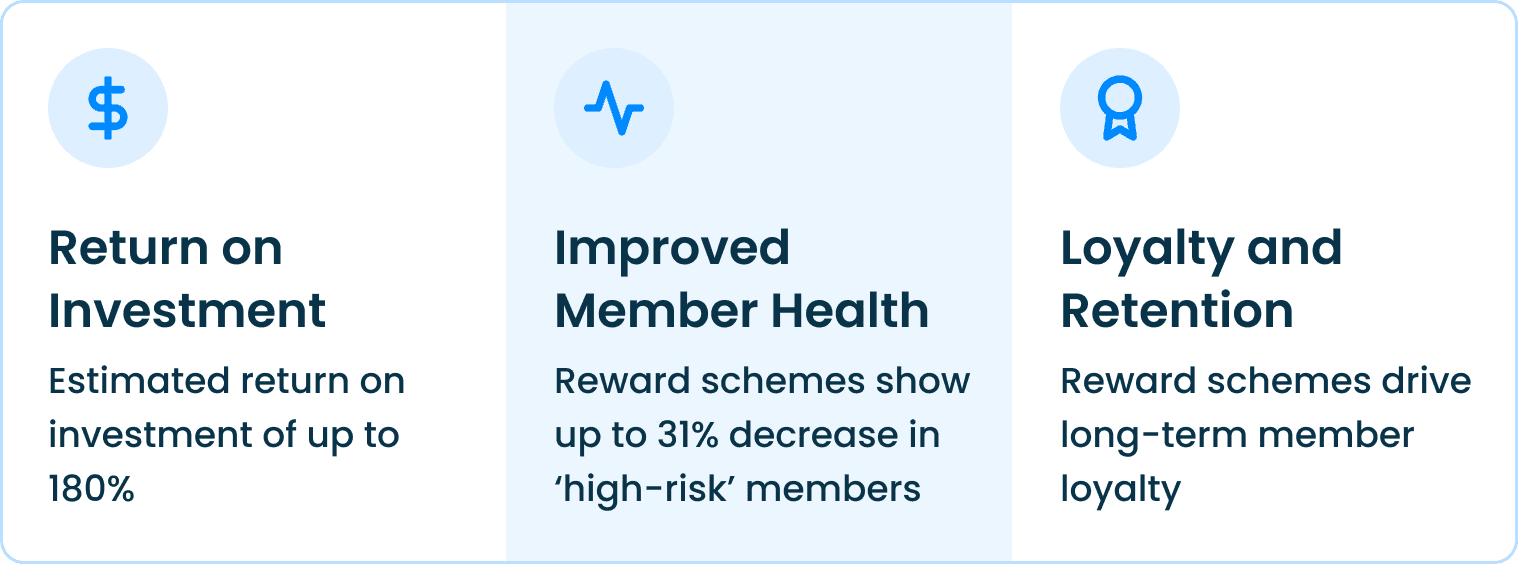
Rewards schemes are now core drivers of value and growth, delivering an ROI of up to 180%. They matter because they deliver reduced claims by helping members understand and improve their health. At the same time, they increase engagement and loyalty through more frequent touchpoints. This leads to measurable improvements in member health and increased member retention.
To make them work effectively, insurers need reliable and rich data, covering various health metrics across a range of sources and data types. By leveraging this with data analysis and AI, and designing an effective incentive structure, reward schemes drive a mutual benefit for both insurers and members.
Shifts in consumer wearable adoption and attitudes to data sharing have made the mainstream adoption of rewards schemes viable among members. Today, 44% of Americans own wearable health tracking devices while 40% have expressed support for insurance wellness programmes that exchange health data for incentives, rising from 30% in 2016.
40% of Americans support wellness programmes exchanging health data for incentives
As a result, the activity-based health insurance market is now worth $100 billion globally, with strong annual growth of 13.4%. This is highly relevant to health insurers more broadly, highlighting both the significant growth opportunity for existing players and the threat of disruption from early adopters.
Consequently, health reward programmes have become a standard offering across the industry. Nearly all top insurers have implemented some form of rewards-based engagement, integrating health and activity tracking with incentives. Giants like UHC, Cigna, and Generali offer comprehensive programmes that track a variety of health factors, from basic metrics like steps and heart rate to more complex data points related to sleep and nutrition.
As well as innovation among industry leaders, digital-native health insurers have emerged in both emerging and established markets. Providers such as Ottonova and Eden Care are setting new standards for digital engagement.
While rewards schemes have become common, it's important to note that not all insurers have embraced them. Some currently limit their digital offerings to standard telemedicine services, highlighting a gap in adoption across the industry.
Key insights
Market Timing: With 13.4% annual growth and rising consumer acceptance, the window for achieving a competitive advantage through early adoption of rewards programmes is rapidly closing. Insurers who delay implementation risk significant market share loss to more agile competitors.
Digital-First Disruption: Digital-native insurers like Ottonova and Eden Care are fundamentally reshaping member expectations. Traditional insurers relying on basic digital offerings (e.g., telemedicine only) are increasingly exposed to competitive pressure. The gap between basic and comprehensive digital engagement programmes is becoming a key market differentiator.
Wearables are Mainstream: With 44% wearable adoption, these devices are no longer a niche data source for experimental initiatives but a core method for assessing member health. Ensuring comprehensive wearable market coverage is essential for any successful rewards programme.
Impact and ROI
To build an effective reward scheme, programs offer mutual benefits to both insurers and members, creating two forms of return on investment (ROI). For insurers, there is a verified financial ROI from reduced claims, and improved retention and engagement. For members, beyond financial incentives, there is a proven health ROI from improved long-term health and wellbeing.
Financial ROI
Substantial financial returns have been well documented for health reward schemes across different industry sectors, ranging from health insurers to employee wellness programs for health reward schemes in the workplace.
In a study of 121 small businesses in Colorado, a ROI of $2.03 for every dollar was recorded, obtained from medical and productivity savings over one year. Led by Pinnacol Assurance, the scheme incorporated health assessments, coaching, and incentives to encourage positive changes in member behaviour. Members showed measurable improvements across 10 health risk factors, including obesity, poor nutrition, and physical inactivity.
Get the full report for complete ROI figures and actionable insights on how to integrate rewards into your product...

Want the full report?
Get access to the full report by entering your email below. You'll receive a link to download the complete PDF version for free.
By submitting, you agree to our Privacy Policy